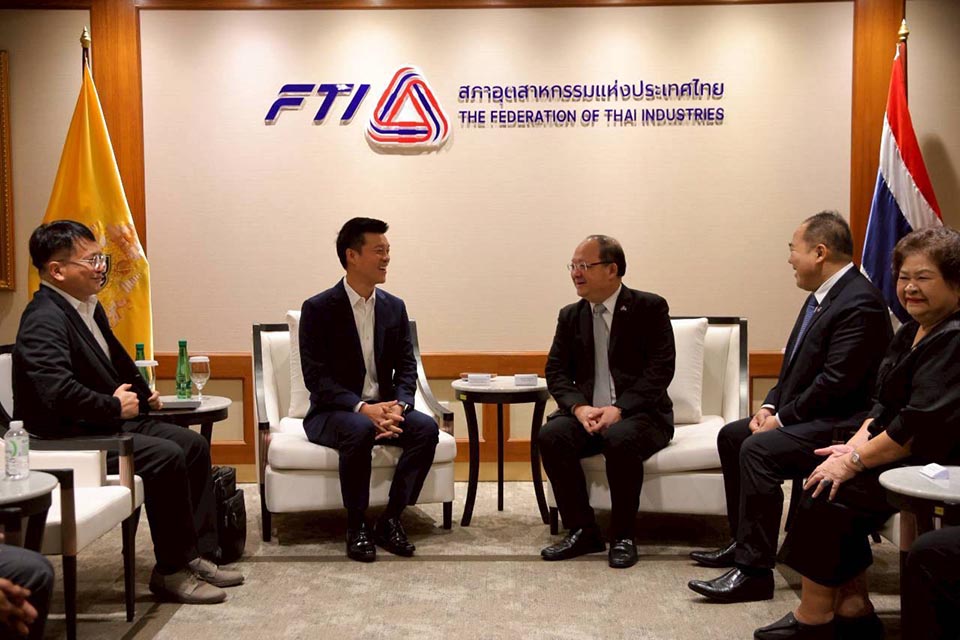
BANGKOK, Thailand – Natthaphong Ruengpanyawut, leader and prime ministerial candidate of the People’s Party, met with the Federation of Thai Industries (FTI) on Monday to unveil a comprehensive economic roadmap designed to modernize the nation’s industrial sector.
The “People’s Government” plan outlines a strategic framework divided into three distinct phases: the first 100 days, the first year, and a full four-year term. During the meeting, Natthaphong emphasized that Thailand requires a government with the political will to bypass bureaucratic hurdles and prioritize private sector growth as the primary engine for national development.
The initial 100-day phase focuses on immediate economic relief and the protection of local businesses from unfair competition. Proposed measures include a rigorous crackdown on substandard foreign goods and platforms that distort the market. To stimulate domestic spending, the party plans to inject 250 billion baht in liquidity through various credit lines, including 100 billion baht for first-home loans and another 100 billion baht dedicated to digital and AI industrial transformation. Additionally, the plan calls for energy reform by allowing Direct Power Purchase Agreements for clean energy and accelerating the national Net Zero target to 2050.
As the administration moves into its first full fiscal year, the strategy shifts toward structural deregulation and government efficiency. Natthaphong pledged to execute a “Regulatory Guillotine” operation to eliminate obsolete laws within 18 months, utilizing a unified digital “Biz Portal” to streamline state permits and reduce corruption. The party also intends to transform the state into a primary supporter of local production through an e-shopping system for government procurement of Thai-made products, while simultaneously targeting a reduction in electricity costs by 0.25 baht per unit.
Over a full four-year mandate, the People’s Party aims to use state procurement as a strategic tool to seed high-tech industries, including semiconductors, defense technology, and medical devices. This long-term vision includes “Orange Megaprojects” aimed at improving public quality of life, such as deploying electric buses in 15 major cities and a 10 billion baht upgrade to Ranong Port to facilitate trade with India. Natthaphong concluded by asserting that his team is prepared to implement these policies immediately to ensure Thailand’s economy grows on a transparent, competitive, and sustainable foundation. (TNA)