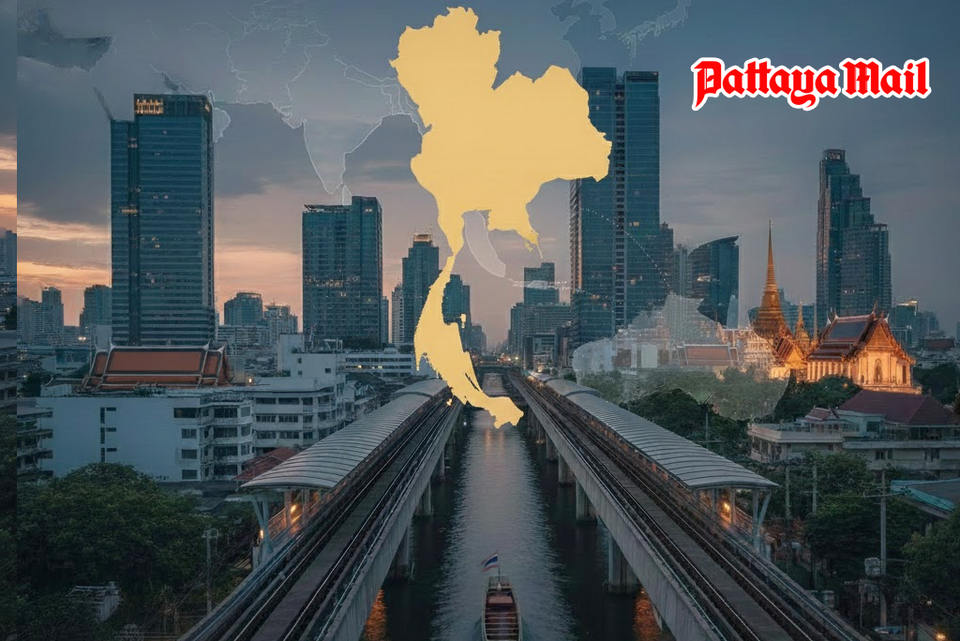
BANGKOK, Thailand – In geopolitics, noise is often mistaken for power. Nations that speak loudly are assumed to matter more. In reality, the most consequential states are frequently those that say the least. Thailand and more precisely Bangkok falls squarely into that category.
Thailand is not a military heavyweight. It does not export ideology, lead blocs, or shape global narratives. Yet when major powers map Southeast Asia, Bangkok appears not as a secondary consideration, but as a constant. This is not symbolism. It is structure.
Strategic debate in Southeast Asia is dominated by maritime thinking: sea lanes, naval reach, chokepoints. That lens naturally favors Singapore. What it obscures is the continental system of mainland Southeast Asia and Thailand sits at its center. It links China’s southwest to the Mekong states and onward to both coasts. Economically and logistically, it functions as the hinge holding the mainland together.
For China, Thailand is indispensable to any credible land-based Belt and Road strategy. Without it, overland access from Yunnan to warm-water ports remains incomplete and politically fragile. For the United States, an Indo-Pacific strategy that bypasses Thailand leaves a strategic vacuum across the continental interior. Thailand does not need to obstruct these pathways to exert influence. The option to enable or quietly delay is enough.
Financial resilience reinforces this position. Thailand maintains large foreign exchange reserves, a relatively stable currency, and limited exposure to external financial coercion. The Bank of Thailand’s substantial gold holdings signal a preference for hedging rather than dependence. Thailand is not easily pressured, and attempts to do so would carry regional consequences.
Those consequences extend into global supply chains. Thailand is not a disposable manufacturing site. It is a deeply embedded node in automotive, electronics, and advanced component production. These ecosystems took decades to build. Disrupting them would impose costs well beyond Thailand itself. This makes economic pressure an inefficient weapon.
Thailand’s diplomacy reflects this structural confidence. Bangkok maintains stable relations with Beijing while remaining Washington’s oldest treaty ally in Asia. This is not ambiguity. It is risk management. Forcing Thailand into a binary choice would produce resistance, not alignment.
Singapore understands this better than most. As a financial hub dependent on regional stability, it benefits from Thailand acting as a buffer absorbing pressure, moderating competition, and preventing mainland tensions from cascading southward.
In Asian political culture, loss of face matters. Overt pressure on Thailand would not provoke confrontation, but quiet disengagement, delays, reduced cooperation and passive resistance. A central state that disengages silently is far more disruptive than one that opposes loudly.
Bangkok does not command Southeast Asia. It does not seek leadership. But it occupies a position that cannot be bypassed. Its power lies in indispensability, not assertion. In presence, not posture. That is why Thailand remains a silent power and why those who underestimate silence tend to miscalculate.