
















|
Out of Africa - the amazing Sriracha Tiger Zoo
by Lesley Warner
This Sunday I decided to go and discover the greatest tiger zoo in the entire world (as quoted on the leaflet), Sriracha Tiger Zoo. I figured it should be
easy to find, straight along Sukhumvit Road. It was easy to find, but I took the new road towards Rayong and turned off towards Sriracha, and it was still easy even for me. In
a ‘decent’ car it would only take about 35 minutes. I was quite excited, being a sucker for our furry friends, and I was not disappointed. The zoo is impressive right down
to the ‘hong nam’ which I have to say were about the best I been to in any outside venue in Thailand.
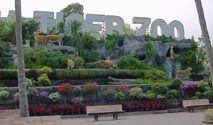 The Sriracha Tiger Zoo is
impressive even at its entrance The Sriracha Tiger Zoo is
impressive even at its entrance
There are young tigers frolicking in and out of the pools provided for them in their pens, and it’s a pleasure to watch them and their mums looking on from
next door. You can hold a baby tiger in your arms and feed it from a bottle, or have your photo taken with a bear, tiger or snake - whatever takes your fancy.
 You can hold a baby tiger in your
arms and feed it from a bottle You can hold a baby tiger in your
arms and feed it from a bottle
There are a variety of different shows running continuously throughout the day, but I found the crocodile show was most fascinating. I was mesmerized when I
watched a beautiful young girl put her arm up to the elbow into a crocodiles open jaw, and then the young man put his head into another crocodile’s mouth. What a way to earn
a living!
The elephant show was different from the many other elephant shows I have seen. They used mostly baby elephants and they were obviously having as much fun
doing the show as we were watching them performing.
 The Amazing Circus and my beloved
favourites the tigers The Amazing Circus and my beloved
favourites the tigers
Then there was the Amazing Circus and my beloved favourites the tigers, who were acting like huge ‘pussy cats’. But we were well protected as the circus
ring was fully enclosed by a high chain link fence. The Chimps, as always, were wonderful entertainers and loving every minute. There was even pig racing; the funniest part was
the very large pig that started the show by picking the winners for the following races.
 What a way to make a living! What a way to make a living!
I was impressed by the zoo and happy with the condition of the animals, but you need to give yourself plenty of time to see it, as everything is quite spread
out and it’s a huge place. The prices were refreshing, unlike these parks in England where they rip you off on anything you purchase. I only paid 15 baht for a delicious ice
cream.
 The baby elephants were obviously
having as much fun doing the show as we were watching them The baby elephants were obviously
having as much fun doing the show as we were watching them
Entrance fee is 250 baht for adults and 150baht for children. Telephone: 038 296556-8, fax: 038 296559, e-mail [email protected] or you can visit their
website www.tigerzoo.com
China’s Long Stone Serpent; The Great Wall (Part One)
by Chalerm Raksanti
From Shanhaiguan to Chengde
Stony and grey, the Great Wall of China rises from the ocean surf at Shanhaiguan. As if to shake off the clinging waters of the Gulf of Bo Hai, it twists
across a narrow plain, contorts into itself at a massive gate, and then uncurls to ascend the peaks of the Yan Shan Range. From Shanhaiguan one can follow the wall for 2,000
miles across China, from the coastal plain to its termination in the desert at Jiayuguan.
 Market in Chengde Market in Chengde
The town of Shanhaiguan lies on a five mile sliver of plain between mountains and sea, a pass that opens like an avenue into the heart of China. The pass
was strategic long before the eighth century. The most significant moment in the entire history of the Wall came one spring morning in 1644 when Manchu horsemen swept through
the undefended First Gate here at Shanhaiguan, sealing the downfall of the Ming Dynasty. After the conquest, the Wall became largely irrelevant to these victors, and drifted
into eclipse.
Shanhaiguan is now far from China’s present frontiers, but it still has some significance. Coastline defences include a nearby air base and military jets
still roar overhead. In the midst of the city stands the eastern gate tower. Honeymoon couples pass through the Gate, arm in arm, photographing each other. Here the Great
Wall bears the inscription: “First Gate Under Heaven”. The words reflect the belief that the world was divided into a central and superior Chinese civilisation, and a
peripheral, inferior barbarian outland.
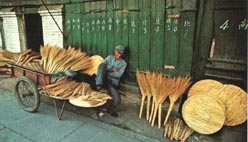 Broom peddler in Shanhaiguan Broom peddler in Shanhaiguan
The Wall stood for the proposition that unbridgeable cultural differences exist among peoples. The Chinese felt theses differences were so profound that
they could only be dealt with by separation. In present times, government officials understand that the Wall, and the symbol of division it stood for, is obsolete. Enough
epoch changes through the centuries finally took place which brought into being a new, unified nation, where different ethnic groups can start to live in peace as brothers.
Nevertheless, the Chinese name for China, Zhongguo, means “Middle Kingdom”, and reverberates an echo of that ancient division of the world into “inner” and
“outer”.
As one follows the wall outside Shanhaiguan to Jiao Shan Hill, the mountains rise sharply. This is where the Wall quits the narrow coastal plain and begins
the climb inland and the 14 hour drive to Chengde. Visitors to China always find the country awakens early. Women in surgical masks begin seeping the dirt streets at first
light. Farmers patiently scoop cow dung from the roads into straw baskets. This will be used for manure at planting time. At daybreak families emerge from their walled houses
with cups and toothbrushes. As the sun rises, so does the tempo of the pace. Shopkeepers open their doors and prepare for early customers. Rural China is still a place of
endless labour. All muscles, sweat and energy expelled by both people and their animals. It is still the land of the bent back, the shouldered hoe, the pushed wheelbarrow,
the rake and the shovel. Every inch of arable land is committed to a purpose. Thousands of years of trial and error have identified the ideal place for every use. So many
people and so little room. On long sections of narrow roads, farmers will appropriate a section for drying corn, or threshing red beans or millet. From dawn until dark, these
people rarely rest. Theirs is a hard life, but tenacity and perseverance is their mainstay.
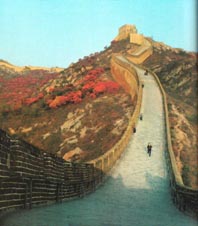 As the elevation rises, one sees the Great Wall spread out upon the highest peaks,
running along the roof of the earth, its watchtowers square and gaunt, with rows of bunkers on the top-most ridges. All across the northern frontier of China, such sights had
faced wandering horsemen in former times. They could ride for weeks through the border country and never circumvent the Wall. This was the one immovable object which was
forever a lifelong contrast from their nomadic life; a life where everything a man could need was carried with him. The Wall was like a mountain, never moving; always there. As the elevation rises, one sees the Great Wall spread out upon the highest peaks,
running along the roof of the earth, its watchtowers square and gaunt, with rows of bunkers on the top-most ridges. All across the northern frontier of China, such sights had
faced wandering horsemen in former times. They could ride for weeks through the border country and never circumvent the Wall. This was the one immovable object which was
forever a lifelong contrast from their nomadic life; a life where everything a man could need was carried with him. The Wall was like a mountain, never moving; always there.
It is true that the Great Wall began as a deliberate linkage of several separate walls built by warring states for protection against each other in the
period before China was a unified nation. Only fragments of these former walls exist. It is the Wall established by the Han Dynasty which, more or less, is its present route.
This line, dictated by climate and soil, stood for centuries as the northern limit of China proper. In time, the Han wall was supplanted by the larger, more solid and more
advanced restorations of the Ming Dynasty. This is essentially the Wall we know today.
The building of the Great Wall was the last step in a totalitarian reign of the first Qin Emperor. He had imposed a unified legal system administered by
professional bureaucrats, standardised writing, weights, measurements, and coinage. But his soldiers’ swift conquests left him with a huge pool of surplus manpower. They
were highly mobile and dangerously armed. By sending them to work on the Wall, he secured the boundaries of his domain, and stabilised his new society. In the border region,
trade and culture passed in both directions. When China was strong, its influence spread beyond the margin of the Wall. When it was weak, even the Wall might be breached.
Barbarian tribes who could not be expelled by military force were tolerated if they acquiesced to China’s cultural forces which was encouraged through diplomacy. These
“inner” nomads lived under Chinese protection. In time they adopted Chinese ways. The Great Wall also helped to keep the Chinese in, physically and psychologically. It
defined the cultural frontier, the range of Chinese civilisation.
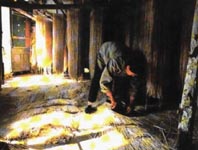 Noodle factory near Shanhaiguan Noodle factory near Shanhaiguan
As a defence, did the Wall succeed? For its first 500 years or so, yes. Until the fall of the Han Dynasty, it frustrated the hit-and-run tactics of nomadic
horsemen. After that, its success was intermittent. Genghis Khan’s Mongols broke through in 1211. On that fateful day at the town of Shanhaiguan, the unopposed Manchus
poured through the gate. And for the first time in five centuries, the Great Wall lost its status as a fierce and impenetrable barrier.
The obscure provincial town of Chengde was transformed in 1703 when the monarch Kang Xi began to build an elaborate summer palace. Its throne room, edict
room, and imperial apartments still remain as a monument preserving the dream world of mandarin China. The British sent emissaries here to promote trade. However, the Chinese
philosophy was more insular. As far as they were concerned, they possessed everything they needed, and wanted nothing from outsiders. Chinese officials did, however, try to
conciliate the nomads by promoting Tibetan Lamaism, the religion of the Mongols. They erected eight impressive monastery complexes near Chengde. It was more practical to have
monasteries than thousands of troops. Since the tenets of Lamaism obliged at least one male in every family to become a celibate monk, it was a way to siphon off a great
portion of the male population into a docile clergy. This way, China’s ancient foes were both flattered and diminished at the same time.
Chengde is a characteristically austere northern Chinese industrial town dominated by mining and textiles. . As one strolls through the town, the long
houses, half hidden behind walls, give up few secrets. But the sidewalk markets sell fruits and vegetables in fidelity to the seasons: apples and pears, scallions and
coriander, long beans and cabbages. Just outside Chengde, most of the monasteries remain. There is a feeling of decay in the air, peeling paint and crumbling walls. Even the
windows are bricked up. In some dark rooms, Buddhas have been assembled for safe keeping. But the world of wind chimes and temple bells have been replaced with loudspeakers
and government radio broadcasts.
The Art of Wine Tasting - Part 2
by Ranjith Chandrasiri 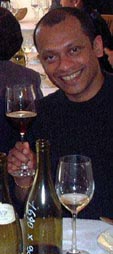
(This is the second part of Ranjith’s wine tasting feature, and he has a great offer at the end of the article which will be of interest to all wine
lovers.)
Olfactory Appreciation
When you stop swirling, it’s time to take the next step: smelling. Agitating the wine vaporizes it, and the thin film of liquid on the sides of the glass
evaporates rapidly; the result is an intensification of the aromas. If the glass narrows at the top, the aromas are further concentrated. Stick your nose right into the bowl
and inhale.
There’s no consensus about the proper sniffing technique. Some advocate two or three quick inhalations; others prefer one deep, sharp sniff. The goal is
to draw the aromas deep into the nose, to bring them into contact with the olfactory mucosa and thence to the olfactory bulb, where the sensations are registered and
deciphered. It’s a remote and protected place, and a head cold or allergies will effectively block it off from even the strongest aromas. But with practice, and keen
attention, you’ll learn how to maximize your perception of aromas, and then how to decipher them.
The world of aromas is vast and bewildering. First of all, our olfactory equipment is incredibly sensitive; we can distinguish aromas in quantities so
small that laboratory equipment can scarcely measure them. Second, our analytic capacity is extraordinary; it is estimated that the number of different smells human brain can
identify ranges up to 10,000! Finally, wines have a staggering number of olfactory elements.
Serious wine tasters love to identify smells. “Chocolate!” cries one. “Burnt matches!” insists another. “Tea, tobacco, mushrooms and a bit of the
old barnyard,” intones a third. Are they just playing word games? Let’s face it, it’s no wonder we lack the words to describe the complex, fleeting sensations that
emanate from a glass of wine.
But in fact, wine does smell of more than grapes. Analysis of its volatile components has identified the same molecules that give many familiar objects
their distinctive scents. Here are just a few: rose, iris, cherry, peach, honey and vanilla. Who’s to say that some of the more imaginative descriptors - from road tar to
cat’s pee, sweaty socks to smoked bacon - aren’t grounded in some basic chemical affinity?
As with colour, wine’s aromas offer insights into character, origin and history. Because our actual sense of taste is limited to four simple categories
(the well-known sweet, sour, bitter and salt), aroma is the most revealing aspect of our examination. But don’t simply sniff for clues. Revel in the sensation. Scientists
say smells have direct access to the brain, connecting immediately to memory and emotion.
Tasting Wine
 The colour of the wine at the
rim of the glass, tipped against a white background, gives the taster his first information. Is it clear? Is it red purplish (young) or turning to brick red with age? Great
wines have strikingly deep and fresh colour. Is white very light, touched with youthful green, or turning to gold? The colour of the wine at the
rim of the glass, tipped against a white background, gives the taster his first information. Is it clear? Is it red purplish (young) or turning to brick red with age? Great
wines have strikingly deep and fresh colour. Is white very light, touched with youthful green, or turning to gold? |
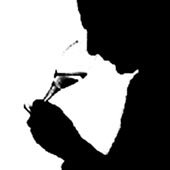 Almost everything about a wine
is revealed by its scent. The taster inhales deeply. The first impression is the most telling. Is there any ‘foreign’ or ‘wrong’ smell? Does it smell of fresh grapes
or have a complex ‘bouquet’ from age in barrel and bottle? Almost everything about a wine
is revealed by its scent. The taster inhales deeply. The first impression is the most telling. Is there any ‘foreign’ or ‘wrong’ smell? Does it smell of fresh grapes
or have a complex ‘bouquet’ from age in barrel and bottle? |
 The taste in the mouth confirms
the information given by the nose. The taster takes a good mouthful, not a sip, and lets it reach every part of his mouth. The body, or wineyness, now makes its impact. Is it
generous or meagre? Is it harsh with tannin as young reds should be? Is it soft and flat or well balanced with acidity? The taste in the mouth confirms
the information given by the nose. The taster takes a good mouthful, not a sip, and lets it reach every part of his mouth. The body, or wineyness, now makes its impact. Is it
generous or meagre? Is it harsh with tannin as young reds should be? Is it soft and flat or well balanced with acidity? |
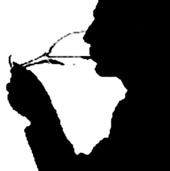
 Holding the wine in his mouth,
the taster draws air between his lips. The warmth of his mouth helps to volatilise the wine; a more positive impression of the taste materializes at the very back of the
mouth as vapours rise to the nasal cavity from behind. After swallowing (or spitting) is the flavour short-lived or lingering? Holding the wine in his mouth,
the taster draws air between his lips. The warmth of his mouth helps to volatilise the wine; a more positive impression of the taste materializes at the very back of the
mouth as vapours rise to the nasal cavity from behind. After swallowing (or spitting) is the flavour short-lived or lingering? |
Now comes the best part. You can be mesmerized by wine’s flashing colours and hypnotized into dreamy reverie by its evocative aromas, but actually
drinking the wine is what loosens the tongue, opens the arms and consummates the liquid’s true purpose.
You might think it’s the easiest part, too. After all, you learned to drink from a cup when you were 2 years old and have been practicing diligently ever
since. But there’s a huge distinction between swallowing and tasting. Once again, correct technique is essential to full appreciation.
With the aromas still reverberating through your senses, put the glass to your lips and take some liquid in. How much? That depends on the size of your
mouth. But too little is as ineffective as too much. I find that one-third to one-half an ounce is just about right. You need to have enough volume to work it all around your
tasting apparatus, but not so much that you’re forced to swallow right away - because you don’t want to swallow, not just yet. It takes time and effort to force the wine
to divulge its secrets. I keep a pleasant wine in my mouth for 10 to 15 seconds, sometimes more.
Roll the wine all around your mouth, bringing it into contact with every part, because each decodes a different aspect of the liquid. Wine provokes
sensations, too. The astringency of tannins is most perceptible on the inner cheeks; the heat of the alcohol burns in the back of the throat.
Second, chew the wine vigorously, sloshing it around in your mouth, to draw every last nuance of flavour from it.
Don’t forget the finish. After you swallow, exhale gently and slowly through both your nose and mouth. The retronasal passage, which connects the throat
and the nose, is another avenue for aromas, which can linger long after the wine is finally swallowed. You’ll find that the better the wine, the more complex, profound and
long-lasting these residual aromas can be. With great wines, sensitive tasters and minimal distractions, the finish can last a minute or more. It’s a moment of meditation
and communion that no other beverage can create.
During the month of February, Royal Cliff Beach Resort in Pattaya will offer complimentary wine tasting in their newly opened wine cellar for all the
diners at the Grillroom Restaurant during the sizzling salmon promotion featuring Tasmanian salmon prepared in a variety of tantalising and mouth-watering ways. The selection
of tasting wines varies daily. Whether you are an amateur wine lover or a serious wine buff, this would be a rare opportunity for you to taste some of the finest wines in the
world.
Carlsberg and Coca Cola join the “Pattaya Mail PC Classic Royal Cliff Beach Resort International Regatta”
It is, indeed, good news for the estimated 50 entrants that Carlsberg and Coca Cola last week agreed to support the “Pattaya Mail PC Classic-Royal Cliff
Beach Resort International Regatta”, scheduled to be sailed off the hotel’s beachfront premises on Saturday, February 24.
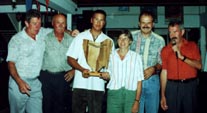 Four-time “Pattaya Mail PC
Classic” champion, Patrick Helms and friends (Dave/Gilbert at left) Four-time “Pattaya Mail PC
Classic” champion, Patrick Helms and friends (Dave/Gilbert at left)
For the anticipated big fleet of Optimist sailors, an ice-cold Coca Cola will be eagerly sought at the end of the racing while, for the bigger people
(marginally, in one particular case), what could go down better than a cold Carlsberg? That is actually a rhetorical question, for the immediate answer is TWO cold Carlsbergs.
Coca Cola, furthermore, will be providing all with superbly designed polo shirts, as the sailors land at the Royal Wing beach. Thereafter, the Royal Cliff
will provide refreshments and Panga Vathanakul, the charming managing director of the Royal Cliff Beach Resort, will preside over the awards ceremony right there on the
seafront.
The regatta will be organized by the Royal Varuna Yacht Club, which values its long-standing special relationship with the resort, located in the bay next
to the club at Pattaya Point.
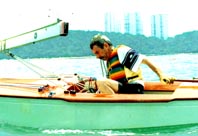 The old man and the sea: PC at
the end of his tether? The old man and the sea: PC at
the end of his tether?
Actually, many of Varuna’s races pass by the Royal Cliff and, as was the case last Sunday, the sailors rounded a mark placed in the Royal Cliff Bay.
However, it was but a fleeting glimpse of the yachts, as they beat south to the Varuna Club finishing line. The forthcoming regatta, in fact, will mark only the second time
that a race will be held right off the resort, the first being an event organized to celebrate the opening of the luxurious Royal Wing 15 years ago.
Richard van den Heuvel, the Royal Varuna sailing secretary, expects good fleets from the monohulls, the multihulls and the Optimists. Racing will be held
out off the Royal Cliff Beach Resort, with starts and finishes close in to the hotel beachfront, thus ensuring maximum exposure of this environmentally friendly and colourful
activity, for hotel guests and other spectators on the shore.
As in previous events, Dave Wales and Gilbert Leemann, the two veterans who rack up some 135 years and some 160 kg between them, will be ‘masters’ of
the day, either in control of the racing or in control of their faithful Enterprise dinghy. No doubt their presence will be most strongly felt, however, when the Carlsberg
starts to flow. They will have had a ‘practice’ run the week before at the Koh Larn Classic.
Royal Varuna Yacht Club Flag Commodore Don Mackenzie regards the Royal Cliff support and the Carlsberg, Coca Cola sponsorship as major contributions in
promoting sailing and yacht racing as a means of furthering Pattaya’s image as an ideal haven for marine sports generally. Don also sees this forthcoming regatta as a
forerunner of other yacht racing events supported by both the public and private sectors in Pattaya.
 Royal Varunians enjoy ‘happy
hour’. Don Mackenzie, Royal Varuna Yacht Club Flag Commodore (R) sees more support for sailing forthcoming Royal Varunians enjoy ‘happy
hour’. Don Mackenzie, Royal Varuna Yacht Club Flag Commodore (R) sees more support for sailing forthcoming
This will mark the seventh sailing of a race which has been held annually since 1995 to celebrate that fateful day when Peter Cummins, the old Pattaya
Mail scribe, reached the tender age of 60 years. Now, with the imprimatur of the Pattaya Mail, the Classic seems destined to continue.
Apart from his birth 66 years ago - about which he claims to have very little recollection - Peter recalls two main events in his life which are of similar
significance.
The first was when he left his native Tasmania in February, 1956 on a ship bound for Europe. His departure helped raise the then appallingly low IQ of the
islanders.
The second event was back in March, 1995 when he was ‘eased’ out of the United Nations in Bangkok, having reached the mandatory retirement age.
Likewise, this departure also helped raise the IQ of the 2,000 remaining staff there. Peter is still not too sure - even now - if any of the staff realize that he actually
has left!
“But these milestones were minor,” noted the scribe last week. “As long as there is an annual Pattaya Mail PC Classic and Dave/Gilbert to
organize it, I will know that I AM still alive - at least once a year!”
Sailing secretary Richard will issue the Notice of Race shortly. A starting time of around 13.00 hours is expected and there will be a pre-race briefing at
Royal Varuna at 12.00 hours. The Classic will be open to all yachts affiliated to Royal Varuna or any other registered yacht club.
The three class winners will be awarded wood replicas of the PC Classic permanent trophy, cut from native Tasmanian woods (“Black Heart” Sassafras),
with a beautiful Huon Pine base, hand-tooled into the shield-like shape of Australia’s island state. Exclusive medals will be presented for the minor placings in each
class.
A step back in time
by Lesley Warner
I decided to go searching for a local tourist attraction with a difference this time and I certainly found it at Wanasin Farm. To think that
I traveled for 8 hours to see the rice fields and we have one on our own doorstep only 2km down the Siam Country Club Road.
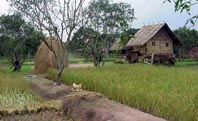 “Old style” Wanasin village “Old style” Wanasin village
I spoke with Bunga Puttansri, assistant to the managing director, who told me that there are still many knew plans for the farm in the next few months. The
idea is to create an example of the many Thai traditions from central and east Thailand. To do this they have created a village, vegetable garden and rice fields with
demonstrations in the old style, showing what happens to the rice before it gets to the dining table.
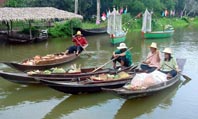 The floating market at Wanasin
Farm The floating market at Wanasin
Farm
Bunga told me that they were extremely fortunate to have the assistance of Chusak Dhitsayanan, a professor with the Tourist Authority of Thailand, to
assist with the design of the village and rice field.
There is also the traditional Thai house exhibiting ancient style fine arts and handicrafts rarely seen elsewhere. One can also enjoy the tastes of various
Thai foods from the floating market reflecting the Thai way of living from the past.
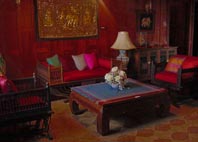 Beautiful Thai style house Beautiful Thai style house
In the evening one can relax in the beer garden, enjoying the buffet dinner while watching Thai folk dance (ram-wong) - and you can even join in.
The farm is open 6 days a week 9 a.m. - 6 p.m. Closed Tuesdays. (Open all public holidays) For more information telephone (038) 423497/428055.
Rotary Week in Pattaya
Mayor Pairat pledges total support
District 3350 Governor Chow Nararidh led his district conference organizing team to Pattaya to meet with organizers from Rotary district 340 to review the
further progress of preparations to hold one of the biggest events in the Rotary year in Pattaya.
This year two districts, namely 3340 and district 3350, will be holding their district conferences over two weekends, March 16-18 and March 23-25
respectively.
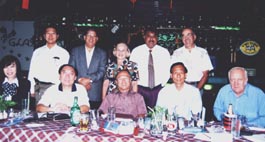 At the end of a successful meeting at the Green Bottle
Pub (Standing L-R) PE Tanat Apijiraphokee, RC Janawa, DG Chow Nararidh, President Erika Keller, PP Pratheep Malhotra, David Jeater, RC Jomtien-Pattaya. (Seated L-R) Catherine
Jiranpongsa RC Don Muang, President Sirichai Simasakul RC Bangrak, Prasert Chaimano Secretary Dist 3340, PP Chalaw Pharanand RC Pattaya and PP Dennis Stark RC
Jomtien-Pattaya. At the end of a successful meeting at the Green Bottle
Pub (Standing L-R) PE Tanat Apijiraphokee, RC Janawa, DG Chow Nararidh, President Erika Keller, PP Pratheep Malhotra, David Jeater, RC Jomtien-Pattaya. (Seated L-R) Catherine
Jiranpongsa RC Don Muang, President Sirichai Simasakul RC Bangrak, Prasert Chaimano Secretary Dist 3340, PP Chalaw Pharanand RC Pattaya and PP Dennis Stark RC
Jomtien-Pattaya.
The district governors Premprecha Dibbayawan and Chow Nararidh, realizing this was a great opportunity to promote the cause of Rotary to our community
during this period, decided jointly to announce it to be the “Rotary Week in Pattaya”.
Many activities are planned during the Rotary week, including the respective district conferences to be held at the Town in Town Hotel and at the Royal
Cliff Beach Resort.
With the assistance of the mayor of Pattaya and city hall, an area would be devoted to setting up a Rotary fair. Booths would be used to exhibit the many
Rotary projects in the service of the community. Rotarians would work in community projects paid for by funds raised in the various activities planned.
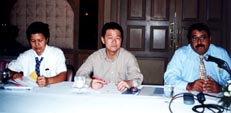 President Elect Alvi Sinthuvanik and chairman of the
“Rotary Fair in Pattaya” organizing committee Past President Pratheep Malhotra, of the Rotary Club of Jomtien-Pattaya, flank Mayor Pairat Suthithamrongsawat at the follow
up meeting held at the Town in Town Hotel. President Elect Alvi Sinthuvanik and chairman of the
“Rotary Fair in Pattaya” organizing committee Past President Pratheep Malhotra, of the Rotary Club of Jomtien-Pattaya, flank Mayor Pairat Suthithamrongsawat at the follow
up meeting held at the Town in Town Hotel.
Doctors would be on hand for children to have their eyes, teeth and general health checked at no cost. Road safety for our children would be highlighted,
too. Schools, both local and international, would put up displays of their community projects. They would also organize activities to help the underprivileged in our
community.
At a follow up meeting held at the Town in Town Hotel, Pattaya mayor, Pairat Suthithamrongsawat pledged his total support to guarantee the success of the
Rotary fair and the events relating to it. His positive response to the planned celebrations was a much-needed moral boost for Rotarians. Tentatively, some of the fundraising
projects would be golf and other sporting tournaments, a family walkathon, possibly a mini marathon and the much-heralded fundraiser the “Fun and Games Carnival”.
Local shows planned would be from the different regions of Thailand and other countries. Close to a 1000 Rotarians from two major districts, 3340 and 3350
are expected to attend. This will be complimented by Rotarians from other districts and from around the world. The plan is also to covert Pattaya into a Rotary Peace City
during the week.
Parades of school children, Rotarians, and members of the public would promulgate the purpose and ideals of Rotary by creating avenues for the opportunity
to serve our community, promote peace, friendship and world understanding.
PSC lays first cornerstone of new Administration building and Clubhouse
A small ceremony was held last Friday at the site of the new Pattaya Sports Club administration building on Pattaya 3 rd Road. On the auspicious occasion, Pattaya Sports Club president Peter Malhotra and founder member Sopin Thappajug carried out the prayer ceremony along with members
of the executive committee and building committee. Once the ceremony was completed, the North East column of the building was placed in the ground symbolizing prosperity and
strength. Members of the committee assisted in the placement of the column followed by placing coins in the foundations.
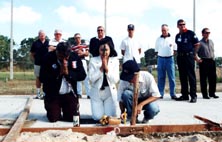 Peter Malhotra and Sopin Thappajug
pray for blessings for the new building Peter Malhotra and Sopin Thappajug
pray for blessings for the new building
The building was designed by architect Peder Gjelstrup, with Vutikorn Kamolchote of Rieckermann Thai Engineering Co., Ltd. providing the engineering
services and Nikorn Eiabsakul of B. Grimm Engineering Systems Public Co., Ltd. providing the electrical engineering services. Vutikorn, a member of the PSC building committee
will monitor the construction, which he expects will be completed around mid-year.
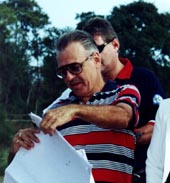 Chairman of the PSC Building Committee
Dick Caggiano pours over the building plans Chairman of the PSC Building Committee
Dick Caggiano pours over the building plans
The new building will contain administration offices and meeting rooms and will cost approximately 2 million baht. After completion, this will provide a
firm base to push the Pattaya Sports Club into the new Millennium. The new home will give the Pattaya Sports Club a venue for their regular business of raising funds for the
various charities on the Eastern Seaboard.
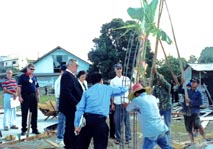 PSC members help erect the
north-east column of the new building PSC members help erect the
north-east column of the new building |
Girls win the PSC Classic - and not a ‘bogey’ in sight
by Peter Cummins
They were not even golfers, but a segment of Pattaya’s disadvantaged girls won the Pattaya Sports Club (PSC) Charity Golf Classic, without swinging a
club or even going anywhere near a green. Nevertheless, sometime this year these girls will have their own ‘green’ and par for the course will be the opening of a
Girls’ Home for Street Kids.
Last Saturday, Ron Herbert, secretary of the Pattaya Sports Club (PSC), accompanied by Bill Thompson and Peter Malhotra, went to the Redemptorist
facilities and presented a check of Baht 301,200 to Father Ray Brennan to build a Girls’ Home for Street Kids.
 Ron Herbert (R) and Bill Thompson
‘adorn’ Father Brennan with the big check, while PSC President Peter Malhotra looks on. Photo Peter Cummins Ron Herbert (R) and Bill Thompson
‘adorn’ Father Brennan with the big check, while PSC President Peter Malhotra looks on. Photo Peter Cummins
The money was raised from the 2001 PSC Charity Golf Classic - the results of which were extensively covered in last week’s Pattaya Mail - and was
a follow-up on the 2000 Classic during which the sum of Baht 410,000 was raised and donated to the Pattaya Orphanage Street Kids Centre. A Boys’ Home, which has been fully
operational for many months now, was built alongside the centre, on 18 rai of land close to the Elephant Farm on Country Club Road.
Now, with the money in hand, construction of the Girls’ Home will shortly begin on an extensive plot adjacent to the Boys’ Home and is expected,
according to father Ray, to be operational around mid-year.
Father Ray was most grateful for the donation which will help another of his projects materialize. “Without such generous assistance, we could not reach
out to our many disadvantaged children,” he said. “This contribution will allow the girls to have a home - a place to sleep.”
As he accepted the check, Father Brennan pointed out that he had been in Pattaya when the PSC was founded. “In fact,” he said, “I was made the
Honorary Chaplain to the Club. I still am,” he added with a broad smile and, “in this capacity, I can bless you all at the PSC.”
“Don’t cash this check just yet,” Peter cautioned Father Ray, “for there is a discrepancy between the writing and the figures,” he added with a
grin!
Author’s note: Actually, I had just arrived at the Pattaya Mail from Bangkok to find Peter ready to go and collect a “big check” to give to Father
Ray. He was not referring to the actual amount but, as the picture shows, it was literally a big check and it will be framed as a centrepiece in the lobby of the new girls’
home.
Antiques, Are They Genuine?
by Apichart Panyadee
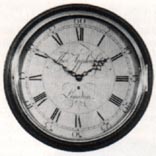
Clocks
Late 18th Century mahogany case dial clock
Wall clocks: The earliest form of English wall clock is the lantern, dating from c. 1620. Their age, simple construction and
desirability mean that they are the most commonly faked type of clocks. Early lantern clocks were fitted with balance wheel escarpments, but surviving examples are
practically unknown. In general, any lantern clock with a balance wheel has had its escapement restored. Many early lantern clocks were converted to short pendulum verge
escapement later in the 17th Century, and were further converted to long pendulum anchor escapement at a later date.
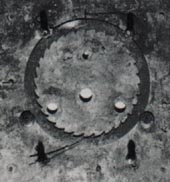 Back view of long case clock
dial, 18th Century Back view of long case clock
dial, 18th Century
Lantern Clocks: Lantern clocks originally ran on woven ropes, which were threaded over spikes on ratchet wheels. They were often later converted to run
on wheels. Pierced frets at the top of lantern clocks have sometimes been damaged and replaced. If a replacement has been fitted, its feet may not match the original holes.
Any signature at the base of the front should be checked for authenticity. In recent years the value of genuine lantern clocks has risen and counterfeits abound.
Dial Clocks: Dial Clocks were introduced into Britain in the mid-18th Century and were popular until the
early part of the 20th Century. Although they are not much faked, early examples are now valuable and merit careful scrutiny. The
first examples had painted wood or engraved and silvered dials similar to those of long case clocks. They were usually signed by a London maker. The cases were generally a
rich mahogany with a broad turned bezel and a substantial wood or brass ring securing the glass. The hands were of pierced blued steel, or very occasionally, brass. Check
that the clock belongs in the original case by examining the retaining screws in the edge of the dial.
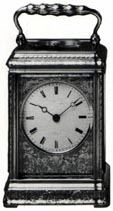 A fine quality French carriage
clock A fine quality French carriage
clock
Skeleton Clocks: There is no simple guide to establishing whether a skeleton clock is genuine, made up from old parts or an outright fake. Many fine
examples were produced during the 19th Century. It was common practice for provincial clockmakers to contrive a skeleton clock as
a window display. These clocks were readily made up by taking the wheels from an old dial or bracket clock and replanting them within a set of pierced, skeletonised plates.
They are as easy to make up now as they were then. All the wheels of superior clocks of this type are finely pierced, with as many as six spokes. The base can sometimes
reveal more than the wheelwork. A new wooden base is suspect. Oversized feet should be examined closely. This could be a sign of replacement or alteration. Skeleton clocks
were not usually signed on the movement for lack of space.
 A Victorian copy of 17th Century
lantern clock A Victorian copy of 17th Century
lantern clock
Carriage Clocks: These clocks were introduced in the early 19th Century and are modelled on the pendules
d officiers used by Napoleon’s commanders. Exceptional accuracy and the perfection of the lever escapement led to mass production of these clocks. English examples are
rare. French counterparts, hundreds of thousands of them, were made between 1850 and 1920. Beware of alterations to carriage clocks. Some clocks are stamped with serial
numbers on the back plate. If these number more than 5 digits the clock will not be very old. Although mass produced, these clocks were finely if not heavily gilded, and some
wear should be expected if the gilding is claimed as original. One particular “enhancement” to beware of is the alteration of a quarter-striking clock (petite sonnerie)
to a full (grande sonnnerie). This modification means that the clock will not strike in the full grande sonnerie mode throughout a seven day period. Therefore,
the way to buy a full grand sonnerie is on an 8 day trial basis.
Copyright 2001 Pattaya Mail Publishing Co.Ltd.
370/7-8 Pattaya Second Road, Pattaya City, Chonburi 20260, Thailand
Tel.66-38 411 240-1, 413 240-1, Fax:66-38 427 596; e-mail: [email protected]
|

The Rotary Club
of Jomtien-Pattaya

Skal
International

Pattaya
Fun City
By The Sea
|
