





 



|
Alcazar crowns Miss Alcazar Thailand
1999
Teakwood was the prime commodity which rendered the
northern part of Thailand prosperous some 40 to 60 years ago. It also enabled the villages
to display their astute talents for craftsmanship. The local wood adopted the name
"Golden Teakwood" because of its golden texture.
 Raseeka Thasanasiri (center), Miss
Alcazar 1999, is surrounded by all his closest competitors from 1st runner-up to 4 th
runner-up. Raseeka Thasanasiri (center), Miss
Alcazar 1999, is surrounded by all his closest competitors from 1st runner-up to 4 th
runner-up.
Thailand was then classed as the leading exporter of finest Teakwood in
the world. Today, all this is sadly and quickly disappearing. Much of the demise of the
industry is blamed on corruption. A severe lack of control from the authorities
responsible has caused the once abundant teak forests in Thailand to become depleted. Most
of the remaining wood used in the art of teakwood carving now comes from Burma.
During the Pattaya Festival, the teakwood carving sessions done by Khun
Narong Funmoon and organized by Mai Chaiyanit, Chairman of the Business Association of
Nongprue, attracted many passers-by.
Khun Narong Funmoon, aged 45 from Chiang Mai, told Pattaya Mail that he
began studying carving when he was a teenager from professor Samran Chaisena. It later
became a career and he now earns 15,000 baht a month, which is enough to support his
family of two.
 All the prize winners in the Miss
Alcazar Thailand Contest 1999 looking like the best dressed, best looking “women of
the 2nd category” on that stage. All the prize winners in the Miss
Alcazar Thailand Contest 1999 looking like the best dressed, best looking “women of
the 2nd category” on that stage.
Narong said that the time taken on each piece varies depending on the
size. Small jobs, such as carving a picture of elephants with a detailed background, may
take a few months. Others, such as a church door, could take years. One must possess the
virtue of patience when carving.
Many church doors and temple furnishing are hand carved teak wood.
There almost 30 carvers making up more than two hundred families. Narong continued, saying
that Teakwood is now very hard to come by. He usually carves left over pieces into a
valuable ornaments. The tool used for carving is called "Siew" and there more
than 200 sizes and shapes available.
Since the younger generation of today shows little interest in the art
of carving, eventually this art will become extinct. It takes many years for someone to
master the art. It may not pay a very healthy wage, but it certainly gives one great pride
when a piece is completed, as it is the only one in the world.
Those interested in learning about or buying carved teakwood can visit the pros from
Thoong Fah Harm Village in Chiang Mai, who will be opening a shop soon at the shopping
complex in front of the Dusit Resort.
The World’s Meanest Mother
I had the meanest mother in the whole world. While other
kids ate candy for breakfast, I had to have cereal, eggs, and toast. When other kids had
soda and french-fries for lunch, I had to eat a sandwich. As you might guess, my supper
was different from theirs, too. But at least I wasn’t alone in my sufferings, my
brothers and sisters had the same mean mother I did.
My mother insisted upon knowing where we were at all times. You would
have thought we were on a chain gang. She had to know who our friends were and what we
were doing. If we said we would be going out for an hour, she insisted it not be an hour
and five minutes.
I am nearly ashamed to admit it, but she actually struck us - not once,
but each time we did as we pleased. Can you imagine hitting a child just because he
disobeyed?
The worst is yet to come. We had to be in bed by nine each night and up
early the next morning. We could not sleep till noon like our friends. In fact, my mother
broke the child labor law by making us work. We had to wash dishes, make beds, learn to
cook, and all sorts of exhausting jobs. I believe she lay awake at night thinking of
things for us to do.
She always insisted we tell the truth, the whole truth, and nothing but
the truth, even if it killed us - and sometimes it nearly did.
By the time we were teenagers, our lives became even more unbearable.
There was none of this tooting the horn of the car for us to come running. She embarrassed
us to no end by making our dates and friends come to the door to get us. I forgot to
mention that while our friends were dating at 12 and 13, my old-fashioned mother refused
to let us date until the age of 16, that is if we dated only to go to school functions and
church services.
As you can see, my mother was a complete failure. None of us has ever
been arrested, divorced, or beaten his mate. And look at all the things we missed. We
never got to march in a protest parade, or take part in a riot, burn draft cards, and a
million and one other things that our friends did. And whom are we to blame? That’s
right - our mean mother. She forced us to grow up into God fearing, educated, honest
adults.
It is with this background that I have become a mother. When my three
children call me mean, I stand a little taller and filled with pride. You see, I can thank
God for the meanest mother on the whole world, and I want to be JUST LIKE HER.
author, Unknown
Mothers Day Is Sunday May 9
Contrary to popular belief, Mother’s Day
wasn’t invented by the greeting card industry. It was first observed at a church
service in Grafton, WV on May 10, 1908, in honor of Anna Jarvis’s mother. Carnations
were Mrs. Jarvis’s favorite flower and soon thereafter people everywhere began
wearing carnations to honor their moms.
The art of teakwood carving is alive
in Pattaya
Teakwood was the prime commodity which rendered the
northern part of Thailand prosperous some 40 to 60 years ago. It also enabled the villages
to display their astute talents for craftsmanship. The local wood adopted the name
"Golden Teakwood" because of its golden texture.
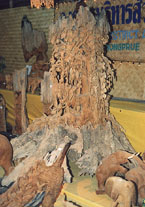 One of his completed carvings on
display. One of his completed carvings on
display.
Thailand was then classed as the leading exporter of finest Teakwood in
the world. Today, all this is sadly and quickly disappearing. Much of the demise of the
industry is blamed on corruption. A severe lack of control from the authorities
responsible has caused the once abundant teak forests in Thailand to become depleted. Most
of the remaining wood used in the art of teakwood carving now comes from Burma.
During the Pattaya Festival, the teakwood carving sessions done by Khun
Narong Funmoon and organized by Mai Chaiyanit, Chairman of the Business Association of
Nongprue, attracted many passers-by.
Khun Narong Funmoon, aged 45 from Chiang Mai, told Pattaya Mail that he
began studying carving when he was a teenager from professor Samran Chaisena. It later
became a career and he now earns 15,000 baht a month, which is enough to support his
family of two.
Narong said that the time taken on each piece varies depending on the
size. Small jobs, such as carving a picture of elephants with a detailed background, may
take a few months. Others, such as a church door, could take years. One must possess the
virtue of patience when carving.
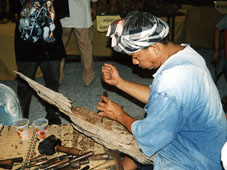 Professional wood carver Khun Narong
Funmoon from Chiang Mai carving a piece called “Nang Phaya Khotchasan” during
the Pattaya Festival. Professional wood carver Khun Narong
Funmoon from Chiang Mai carving a piece called “Nang Phaya Khotchasan” during
the Pattaya Festival.
Many church doors and temple furnishing are hand carved teak wood.
There almost 30 carvers making up more than two hundred families. Narong continued, saying
that Teakwood is now very hard to come by. He usually carves left over pieces into a
valuable ornaments. The tool used for carving is called "Siew" and there more
than 200 sizes and shapes available.
Since the younger generation of today shows little interest in the art
of carving, eventually this art will become extinct. It takes many years for someone to
master the art. It may not pay a very healthy wage, but it certainly gives one great pride
when a piece is completed, as it is the only one in the world.
Those interested in learning about or buying carved teakwood can visit the pros from
Thoong Fah Harm Village in Chiang Mai, who will be opening a shop soon at the shopping
complex in front of the Dusit Resort.
ISE Consert Wind Band shines at first
concert
The Concert Wind Band of the International School
Eastern Seaboard, 50 students aged between eight and sixteen, gave a truly outstanding
performance last Friday in their first concert at the Royal Garden Plaza. Outstanding,
because those very talented young people have only been playing together since last
October.
The talented band performed great, drawing a huge crowd at the Plaza on
three floors, since onlookers stopped their business even on the upper floors to look,
listen and enjoy the great performance.
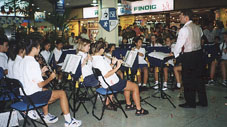 ISE students perform brilliantly at
their first concert near the fountain in the Royal Garden Plaza. ISE students perform brilliantly at
their first concert near the fountain in the Royal Garden Plaza.
Director and band leader Paul Leggat, who also plays trumpet, is, in
his ‘normal’ life, a music teacher at the International School Eastern Seaboard.
Paul’s wife Sandra, a teacher as well, helps by playing clarinet in the band.
Paul did a fantastic job, not only by directing but also by choosing
the program, which was made up of light classical music, film music and jazz. Pieces
played included: Watermelon Man, Jurassic Park, March Militaire, Pink Panther, Forgotten
Dreams, Wood Choppers Ball, Theme from Forest Gump, West Wind Overture, Somewhere Out
There, Rock Around the Clock, My Funny Valentine, Beethoven’s 9th symphony, and Royal
Fireworks.
Teachers and parents turned out in large numbers for this concert and were very proud
of the performers. It was also a wonderful experience for the entire audience to listen to
the sounds and look at the appearance of all these young children, showing the world how
perfect it can be seeing so many different nations finding the right tune together.
Fastest ice cream eater in the East?
Ripley’s Believe It or Not Museum in Pattaya and
Swenson’s Ice Cream gathered contestants from all over Thailand to attempt to find
the fastest ice cream eater in the land.
The current world record holder is Mr. Tony Dodeswel, who ate 1.5
kilograms of ice cream within 31.67 seconds.
 Mr. Phornthep Phathana became
Thailand’s first ice cream eating champion, receiving 20,000 baht and certificate
from Ripley’s with the distinction of eating the most ice-cream in the fastest time
on the hottest day in Thailand, on April 27, 1999. Mr. Phornthep Phathana became
Thailand’s first ice cream eating champion, receiving 20,000 baht and certificate
from Ripley’s with the distinction of eating the most ice-cream in the fastest time
on the hottest day in Thailand, on April 27, 1999.
Mr. Phornthep Phathana, age 25, from Lopburi Province became the first
champ in Thailand. Phornthep devoured his 1.5 kg’s in 2 minutes and 15 seconds, well
shy of the world record, but a valiant effort nonetheless.
The local contest took place on the afternoon of April 27th at the
Musical Fountain Area on the first floor of the Royal Garden Plaza. Ripley’s Believe
It or Not and Swenson’s Ice Cream co-sponsored the competition to see who could eat
the most ice cream the fastest on the hottest day in Thailand.
The competition was divided into two events, a singles and a team
competition. Participants were able to choose from four of Swenson’s ice cream
flavors: vanilla, strawberry, coffee, and chocolate. The judges were from both
Ripley’s Museum and Swenson’s Ice Cream.
After Chonburi Governor Sujarit Pachimnan presided over the opening
ceremonies, the fun began with the team competition.
Four teams participated in the fun, one each from Maybe, Alcazar, Royal
Garden, and MCOT.
Points were awarded for the most creative way the participants ate the
ice cream, and were deducted for spillage. All had to be eaten by the members of each team
in the fastest time and each team had its own method of devouring the frozen cream.
The Royal Garden Team was judged to be the winner in this event,
finishing in 3 minutes and 9 seconds. They received a prize of 5,000 baht, along with a
certificate from Ripley’s Museum honoring and guaranteeing their strange act.
Ten participants took part in the singles event, with only one being a
female. Each participant was a finalist from various regions in Thailand, certainly making
this competition a national event. The grand prize was 20,000 baht and the distinction of
being recorded in Ripley’s records world-wide.
When the single’s participants were ready, 1.5 kilograms of
Swenson’s ice cream was placed in front of each participant in two containers. When
the signal to begin sounded they began devouring the ice-cream like there was none left on
the planet.
Two participants seemed to eat spoon for spoon and gulp for gulp, bringing cheers from
the ice cream fans. In the end, Phornthep Phathana from Lopburi Province eagerly swallowed
his way ahead of the field to become Thailand’s first ice cream eating champ.
International Secretary’s Day
celebrated on April 24th
On Saturday, April 24th, the working-world celebrated
International Secretary’s Day. No-where in Pattaya was the celebration more fun than
at the Vanda Room of the Montien Hotel.
A sumptuous buffet lunch, live entertainment by Uan and Pop, the
resident duo of Montien’s La Mer Restaurant, lucky door prize drawing and a fashion
show held by Wabi Fashion House of Bangkok were on the program, as were giveaways from
Covermark at the entrance. Seeing the happy faces of all the hardworking secretaries, it
was obvious that everything was much appreciated.
 At the international Secretary’s
Day celebration at the Montien Hotel, secretaries were honored for their hard work and
exceptional importance. At the international Secretary’s
Day celebration at the Montien Hotel, secretaries were honored for their hard work and
exceptional importance.
It was the second time the Montien organized the event, and Andrew Low,
General Manager of the Montien, said he believes that it will become an annual event.
Khun Achara, owner of Montien Hotel, honored the event with her presence. Greg
Oliveiro, tutor and instructor of Montien Hotel’s staff, gave a warm welcoming speech
and introduced Khun Sukanya Nimmanheminda, President of the Women Secretaries Association
of Thailand. Khun Sukanya addressed the audience in a partly humorous, partly serious
speech about all the fun, excitement and sometimes problems a good secretary has to face.
Forget marriage, see the world first
by Imtiaz Muqbil,
Executive Editor,
Travel Impact Newswire
Want to tap the multi-million dollar youth travel market? Be at the
World Youth Student Travel Conference in Bangkok this September. WYSTC Secretary-General
Peter de Jong says those who dismiss youth travellers as being ‘low-quality
backpackers’ don’t know half the story.
The Asia-Pacific Travel & Tourism industry will get a major chance
to tap into the multi-million dollar potential of the global youth market when the World
Youth and Student Travel Conference convenes in Bangkok from 26 September to 2 October
1999.
Nearly 1,000 travel agents, accommodation operators and owners and
suppliers to the global youth travel market are due in Bangkok for the first major travel
event of its kind in Asia in the last decade. Before and after the conference, organizers
of youth travel arrangements will be exploring Thailand, the Greater Mekong Sub-region and
other ASEAN countries in search of new products catering specifically to this lucrative
market.
And quite a market it is. In a presentation at the March 1999 ITB in
Berlin, Peter de Jong, secretary-general of the Federation of International Youth Tour
Operators debunked claims that backpackers and student travelers were low-spending,
‘low-quality’ visitors not worth paying any attention to.
The reality, he said, "is that they have average to above-average
spend, are long staying, loyal to deserving suppliers, environmentally/socially sensitive,
generate low ‘leakage’, pioneer new places and products, and have a half-century
shelf life!
"They stay in local hostels, eat at local noodle-shops, use local
bus and rail transportation and buy locally-made products more than the brand-name goods.
On a per capita basis, they leave more money behind in a country at the grassroots level
than other visitors staying in five-star properties," he said.
If ‘young travelers’ are classified as those aged 15-24,
Thailand received 745,643 of them in 1998, an increase of 3.31% over 1997. If the 25-34
age-group is included in the definition, the number grows by 2,122,148, for a total market
share of 37% of all visitor arrivals to Thailand in 1998.
Not surprisingly, the weakening of the baht and increase in
Thailand’s value-for-money destination appeal paved the way for extensive growth in
budget-conscious young travelers, especially from Europe, North America, Australia, New
Zealand and even Japan.
De Jong says Asia is only scratching the surface of young travelers. In
Europe, more than 80 million international trips per year are made by young people,
representing one-fifth of all international travel and perhaps as much as one-quarter of
all leisure travel.
"By the beginning of the new millennium, it is expected that this
number of young travelers will have risen to 125 million. The youth travel market is
forecast to grow faster than the average growth projected for mainstream travel
world-wide," he said.
He identified several main reasons: The group of 17 to 30-year-olds has
the highest propensity for travel of any age group. There has been a rapid rise in Europe
of young people in tertiary education and formal job training. Young people are postponing
formal relationships and marriage, permanent jobs and family planning in favor of an
opportunity to travel and see the world.
They also assign priority to long-haul travel to places which may be
out of reach once they settle down. Moreover, it is increasingly popular to take a year
off between graduate and post-graduate education or between tertiary education and
settling down.
In spite of this potential, the Travel & Tourism industry dismisses
young travelers as part of a ‘low yield syndrome’. "Too few of our
professionals (and I refer to accommodation and transportation providers, tour operators,
travel retailers, national and local tourist offices, national/regional tourism planners)
take the youth travel sector sufficiently seriously."
This also creates unfortunate side effects: An industry-wide lack of
knowledge, information and research of the youth travel market; an acute marketing
difficulty; an inadequate control of standards, including safety; a regrettable lack of
official recognition and support; and difficulty to organize funding partnerships.
Rather than insultingly dismiss them as part of the ‘low-yield
syndrome,’ Mr de Jong suggested a shift to the ‘pioneer syndrome’ in order
to take advantage of their main psychological trait - their readiness to experiment.
Young people, Mr de Jong said, are known for:
— A desire to explore new places (Koh Samui, Silk Route,
rain-forests, Myanmar);
— Visits to ‘high risk’ destinations (Luxor after the
terrorist atrocity, South Africa despite bad media);
— Preference for ‘unconventional’ print media (such as
Lonely Planet) and new electronic media;
— New products (such as windsurfing, paragliding, rafting,
abseiling, bungee jumping;
— ‘Jo jo’ jump on jump off bus services (such as haggis
backpacker, slow coach, blue banana);
— Readiness to adopt politically correct causes (ecotourism,
charity fund raising, Third World aid, protection of endangered species);
— Preference for ‘secret’ products identified only by
trusted members of the peer group; and, finally,
— Fixation with products which satisfy the need for ‘look at
me’.
By not recognizing the ‘pioneer syndrome,’ the industry
becomes the victim of a ‘confusion syndrome’, he said. "This results from
suppliers’ ignorance about their markets. Among the principal symptoms we recognise:
— Uncertainty over the validity of traditional age bands;
— Misunderstanding about the origins of ‘word-of-mouth’
info;
— Failure to understand young peoples’ use of the Internet;
— Persistent tendency to treat young consumers as low spending
members of a transient population, rather than valuable individuals at a transient stage
in a long, high spending life; and
— Failure to recognise that young people increasingly continue to
behave as young people well into their thirties."
The ‘confusion syndrome’ also creates some side-effects which
include:
— An almost universal failure of suppliers to market their
products successfully and a reciprocal failure among young people to get the information
they need; and
— Widespread ‘tunnel vision’ in the travel industry,
which restricts the youth market to budget travel, thus failing to appreciate the wide
extent of a market which also includes special interest travel, skills improvement
(language-learning, sports and business skills), au pair and work exchanges, adventure
travel, gap year and tertiary study abroad.
Mr de Jong pointed to another reality of the youth travel market, viz.,
that ‘young people’ are ‘getting older’. He said, "If the age
limit once was 25, it may now be at 30 and may soon be at 35. Many of us prefer being
‘youthful/young at heart’ to being ‘middle aged’ and many of
today’s youth travel products are increasingly bought by this new, youthful and
adventurous, group of ‘older young consumers’."
Suppliers now recognise that these so-called syndromes reflect a single
under-lying disorder: Ignorance. Said Mr de Jong, "The required treatment for this
disorder, quite simply, is the replacement of ‘misunderstanding’ by
‘understanding’. I am convinced that the youth travel sector is now acquiring
the strength, status and will to carry out this task of industry education."
By bringing its annual conference to Bangkok, the WYSTC is hoping to do
exactly that for the Asia-Pacific region at large.
People are the heart of the new
constitution
by Gen. Saiyud Kerdphol
I noticed a sign put up by someone which said in Thai " àÃÒµéͧäÁèÊÔé¹ËÇѧ¡ÒÃàÁ×ͧä·Â".
We must not lose hope in Thai Politics. This reminded me of a saying by a scholar that the
worst enemy of a democratic form of government is that people get bored and do not
participate in the process. As the old saying goes – all that is necessary for the
triumph of evil is that good men do nothing. It was an identical situation and
people’s attitude before the 1986 general election, which strongly motivated me to
form the neutral or non partisan group called - ASA PRA CHAMUTI, to urge the people to participate in monitoring the
election. This later became known by the name of poll watch or Ongkorn Klang in
Thai. This same group of people participated in campaigning hard for the new (reformed)
constitution.
I fully understand why people are getting bored with politicians, as
every one has seen the newspaper headlines and listened to the no-confidence debate in
parliament and its aftermath. We believe that both government and opposition groups put
their own interest first, rather than the national good. They argue as to who is more
honest and do not discuss what they should do to help the country during the economic
downturn.
The question seems to be: what could we do about it? We have got a new
constitution - the people’s reformed constitution. The new constitution alone will
not change anything. But the significance of the new constitution is that it gives the
people more choice and more opportunity to participate. Therefore, the people must
participate to bring about the changes, particularly in the coming general election. Under
the new constitution we have got a neutral, independent election commission, called the
Election Commission of Thailand (ECT or Koh Koh Toh in Thai). According to the
ECT’s law (art. 20) the entire hope is pinned on the volunteers of NGOS to
participate in monitoring the general election process. Thus the poll watch foundation,
with the other NGOs, agreed in September 1998 to set up the People Network for Election in
Thailand (PNET) with financial support from the Poll Watch Foundation, Asia Foundation and
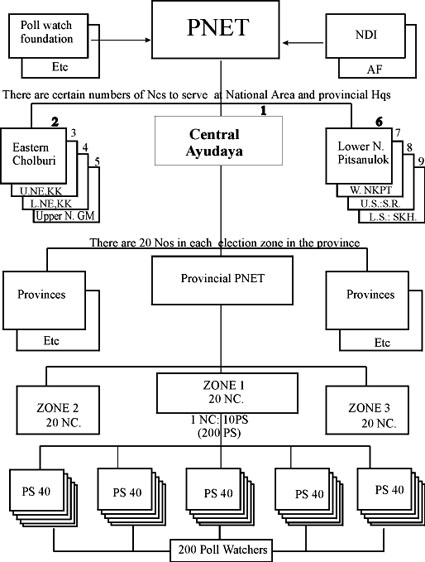
NDI (National Democratic Institute). The PNET follows a 6-step plan: First, by organizing
the PNET HQ in Bangkok. Secondly, setting up the 9 Area’s HQs. Third and forth –
organize and train the Network Coordinators (NCs) to serve at the area HQs. About 450 NCs
should finish this training by the end of Mar ’99. Next, the fifth step is to
organize and train NCs to serve at the provincial and local election zones, with about 20
NCs per zone (that will be 400x20 =8,000 NCs in total), including some NCs that may serve
at the provincial HQ. This should have been finished by the end of April ‘99.
The sixth and final step, starting in May, will recruit poll watchers
to be posted at every polling station - numbering about 60,000 – 70,000 throughout
the country.
I would like to call on you and urge you as the community leader in
your community, if you are still neutral and / or non-partisan, to participate in this
PNET by being the poll watcher in your respective poll stations. Please help to make the
coming general election the best one ever, the most free and fair.
May I give you some idea about the role of the poll watcher, which is
extremely important as I have dreamed for a long time. He or She is the most popular,
respected person in the polling area. By being at the poll station and highly visible, no
doubt this will deter a lot of malpractice. Really this is a major honorable service which
senior citizens and respected persons in the community like you can give to the country,
and is a very responsible job. If there are any obvious or potential wrong doings the NC
should be called and instructed to take action according to the network’s established
rules.
May I conclude my presentations by quoting the old saying "The
smallest good deed is better than the grandest intentions." With your smallest deed
you will never get bored. That will not only save our democracy but will move it forward.
Thank you
People Network for Election in Thailand - PNET |
|
Poll Watcher: Manned by the local Volunteer
Senior respected Citizen in their respective polling Area. |
Copyright 1998 Pattaya Mail Publishing Co.Ltd.
370/7-8 Pattaya Second Road, Pattaya City, Chonburi 20260, Thailand
Tel.66-38 411 240-1, 413 240-1, Fax:66-38 427 596; e-mail: [email protected]
Created by Andy Gombaz, assisted by Chinnaporn Sangwanlek. |
|