by Chalerm Raksanti
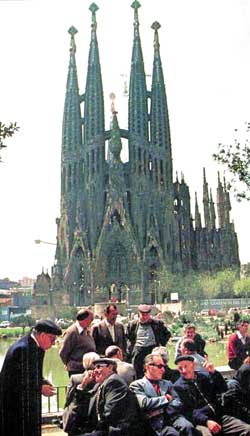 Sandcastle
architecture, Barcelona’s Church of La Sagrada Famillia stands in the
heart of the city.
Sandcastle
architecture, Barcelona’s Church of La Sagrada Famillia stands in the
heart of the city.
Language is the soul of Catalonia. Under Generalissimo
Franco, the use of Catalan, the province’s unique language, was
suppressed. After the dictator’s death in 1975, the government
recognized Catalan as co-official with Spanish. A Romance tongue related
to this special region, Catalan is the vernacular across the eastern
Mediterranean coast of Spain. In the 13th and 14th
centuries, Catalonia’s influential domain extended all the way into
Greece. A trade center since antiquity, this region has been periodically
ruled by outsiders, including Spain’s dominant Castilians, who excluded
Barcelona from lucrative New World trade until 1778. But the port always
took advantage of its Mediterranean setting.
Since the Spanish Civil War of 1936-39, when the
Barcelona was a stronghold of anti-Franco forces, the resourceful
Catalonians have reconstructed their region into one of Spain’s leading
industrial hubs. The relatively small province stair-steps from the
semi-tropical coast, spreads across the plains, creeps high into the
Pyrenees. But most of its inhabitants live in Barcelona.
Spain’s premier port, Barcelona vibrates with a
liberal, cosmopolitan spirit. Cabdrivers are as likely to argue world
politics and opera as they are to discuss football. Shoppers stroll
through the bookstalls, cafes and flower marts that line the Ramblas, the
promenade near the medieval quarter of Barrio Gotico.
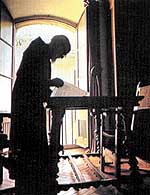 Benedictine
monk studies the Holy Scriptures in the 1,000 year old monastery of
Montserrat.
Benedictine
monk studies the Holy Scriptures in the 1,000 year old monastery of
Montserrat.
Sand-castle architecture has symbolized Barcelona for a
hundred years since architect Antioni Guadi designed the Church of La
Sagrada Familia. Spires suggest Catalonia’s mountains, a reflecting
pool, and the seacoast. Biblical figures were modeled after workmen.
Catalans always smile on the avant-garde, from Joan Miro to onetime
resident, Pablo Picasso.
The heart of Catalonia, many believe, lies in the
monastery of Montserrat, tucked high in rocky bastions 40 kilometers from
Barcelona. For at least a thousand years Benedictine monks have occupied
this site. The monastery is famed for its shrine to the Black Virgin, its
boy’s choir, and its music school.
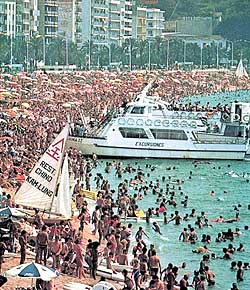 Catalonia’s
Costa Brava is packed with vacationers from around the world.
Catalonia’s
Costa Brava is packed with vacationers from around the world.
Congested as America’s Coney Island, the Costa Brava,
which means ‘rugged coast’, teems with sun worshipers from around the
world in July and August. But native Catalans will tell you that they are
really a separate nation from the rest of Spain. They know there is a
ripeness here that they cannot find elsewhere. Like an apple picked
freshly from an orchard, it has a distinctive flavor.