

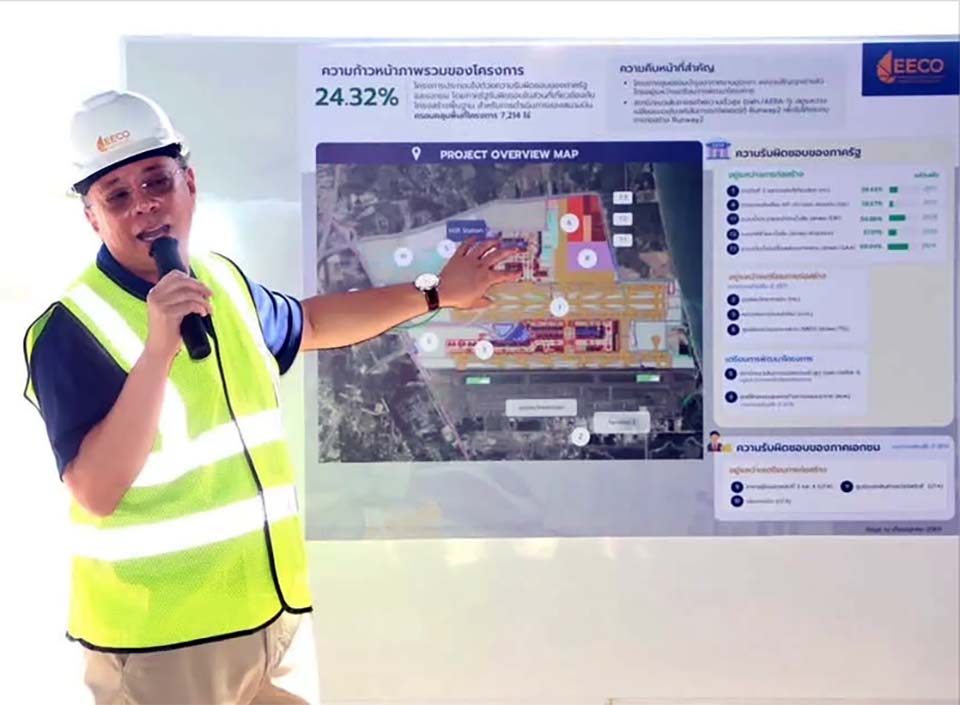
RAYONG, Thailand – U-Tapao International Airport is targeting completion of its second runway, new passenger terminal and major aviation infrastructure by 2031, with commercial operations at the expanded airport expected to begin in early 2032. The Eastern Economic Corridor Office (EECO) said the overall development of U-Tapao International Airport and the Eastern Aviation City had reached 24.32% progress, with some delays but the project remaining within its main implementation framework.
EECO Secretary-General Chula Sukmanop said the public-private development covers 7,214 rai within the Eastern Economic Corridor (EEC). Once construction is completed, the airport will undergo aviation safety inspections and certification before opening for commercial services.
The second runway, being built by the Royal Thai Navy under a contract worth 13.14 billion baht, has reached 28.09% progress. Italian-Thai Development is the contractor, with construction scheduled to take 1,095 days.

The 3,505-metre-long and 60-metre-wide runway is expected to be completed, tested and handed over in November 2028. However, it is not expected to enter service until 2031, when the new terminal and associated systems are ready and the Civil Aviation Authority of Thailand has granted the necessary safety certification.
The project is financed through an Asian Development Bank loan covering 85% of the construction cost, with the remaining 15% coming from the government budget. Other supporting infrastructure projects are also progressing. The Department of Highways’ 3-billion-baht extension of Motorway 7 towards the passenger terminal is 28.57% complete and scheduled for completion in 2028.
East Water’s water supply and wastewater treatment systems have reached 54.98% progress, while B.Grimm Power’s electricity and chilled-water systems are 27.51% complete. The latter includes 18 megawatts of solar power and an 80-megawatt co-generation system. The aviation fuel system, jointly developed by Bangkok Aviation Fuel Services (BAFS) and PTT, has reached 69.94% progress. It includes three storage tanks, each with a capacity of five million litres.
Thai Airways commits 7.6 billion baht to first MRO phase
A major component of the aviation city is the aircraft maintenance, repair and overhaul (MRO) centre, where Thai Airways International is preparing a first-phase investment of 7.638 billion baht.
The airline has signed a 50-year lease for 210 rai with the EECO, with its subsidiary, Thai MRO Services Company, responsible for the project. Boeing has joined as a partner to assist with planning and design. The first phase will include a smart hangar capable of accommodating three wide-body aircraft and five narrow-body aircraft simultaneously, together with a paint shop able to handle one wide-body and two narrow-body aircraft.
Chula said Thai Airways began its land lease on October 1, 2026, and had already paid the rental fee. The company is preparing its design and revised business plan for submission to the EECO in January 2027. The first phase is expected to open by 2031, in line with the airport’s wider development.
A second phase will add further hangar facilities, with the full 210-rai site expected to be developed within 10 years. The smart MRO concept will focus on three areas: artificial intelligence and drone technology, cybersecurity and environmental sustainability.
70 rai offered for smaller aircraft maintenance hub
The EECO also plans to offer 70 rai for another MRO development specialising in smaller aircraft, private planes and specialised aircraft used for medical evacuation, flight training and military operations.
The office expects to invite bids in early 2027 and select a developer within three to four months. The land will be divided into smaller plots, allowing operators to lease more than one plot if required.
Chula said the Asia-Pacific region was expected to receive around 500 new aircraft over the next five years, creating greater demand for maintenance facilities. He said several countries had already shown interest in U-Tapao, which could develop into a regional MRO centre, particularly for smaller aircraft.
Passenger terminal plan revised to three million capacity
The airport operator, U-Tapao International Aviation Co. (UTA), issued its Notice to Proceed on April 3, 2026. It has proposed reducing the first-phase passenger terminal capacity from 10 million to three million passengers annually.
The terminal is targeted for completion in 2031, with the airport’s longer-term development designed to accommodate up to 60 million passengers annually. The revised proposal is due to be presented to the EEC Policy Committee in December 2026 before being submitted to the Cabinet for acknowledgement.
Chula said UTA needed to begin marketing the airport well in advance, since airlines generally require two to three years to prepare for adding or changing destinations. The EECO is also encouraging UTA to attract passengers to the existing terminal first, helping build familiarity with the airport before the new facilities open.
U-Tapao currently handles approximately 400,000 passengers annually, down from around one million to 1.5 million before the COVID-19 pandemic. Chula said increased investment in the EEC over the next three to four years could generate additional demand, particularly from business travellers and new direct flight services.
New air traffic control tower planned
The Aeronautical Radio of Thailand Ltd. is preparing to build a new air traffic control tower at U-Tapao at an estimated cost of 1.25 billion baht. Deputy Managing Director Montri Sukonthaman said the tower would stand 49 metres high, or 59 metres including its base. Construction tenders are expected to open in early 2027, with a two-year construction period and system testing planned for 2028–2029.
The company is also reviewing the scope of work for navigation equipment and systems, while preparing staffing, training and certification plans for air traffic controllers. The aim is to ensure a smooth transfer of operations between the existing and second runways, supporting full airport operations in 2033–2034.
High-speed rail tunnel alignment adjusted
Chula confirmed that a rail connection to U-Tapao remains necessary, although the high-speed railway linking three airports is still facing difficulties. Progress depends on clarity over the termination process for the existing joint investment contract. The EECO and State Railway of Thailand are studying an alternative rail service operating at around 160 kilometres per hour, connecting Bangkok with U-Tapao and potentially extending the network towards Rayong and other eastern provinces at a lower investment cost.
The proposed approach would follow the model of the Airport Rail Link serving Suvarnabhumi Airport. The high-speed rail tunnel alignment has also been adjusted, moving it approximately 500 metres north of its original route beneath the runway. The revised alignment will pass clear of the runway and connect with the passenger terminal, avoiding interference with runway construction.