

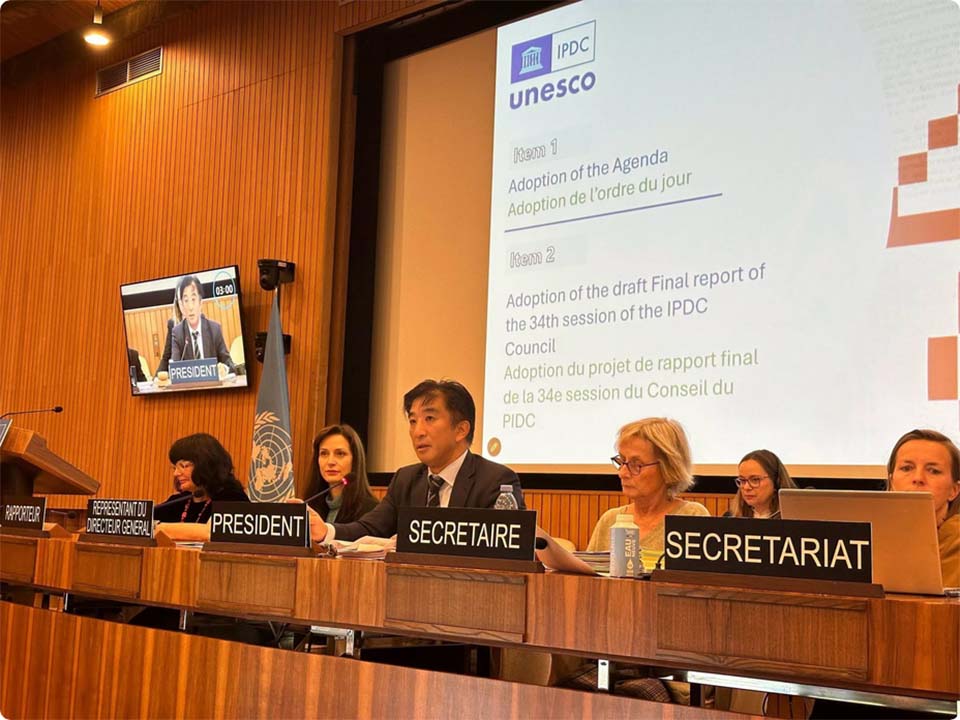
PARIS, France – Thailand has advocated accurate, timely, and accessible information to help communities prepare for conflicts, emerging threats, and climate change. Nutthanun Rajanakorn, executive director of the Foreign Affairs Office at the Government Public Relations Department (PRD), presented the country’s preventive communication approach at the 35th session of the Intergovernmental Council of the International Programme for the Development of Communication (IPDC), held November 19–20, 2026, at UNESCO headquarters in Paris. Media professional Kavi Chongkittavorn and PRD officials joined representatives from 37 council member countries to discuss communication development, media freedom, journalist safety, and artificial intelligence (AI).

Citing Thailand’s recent floods, Nutthanun explained how the government simplified emergency warnings and used multiple channels, including community loudspeakers and local public address systems, to deliver timely information and help residents take appropriate action. She also thanked the IPDC for its continued support in training Thai media professionals and reaffirmed Thailand’s readiness to improve public communication in everyday situations and emergencies.
During discussions on AI, Kavi addressed its integration into journalism and the media’s role in crisis response. He called for fair treatment of news organizations when technology companies use their content, proposing that UNESCO coordinate cooperation among member states. IPDC Chairperson and Japan’s Permanent Delegate to UNESCO, Takehiro Kano, stressed international collaboration in journalist training, environmental reporting, and journalist protection in conflict zones.
UNESCO Assistant Director-General for Communication and Information Mariya Gabriel advocated skills development for young journalists, greater participation of women in the media, and ethical AI use supported by human fact-checking. (NNT)