
BANGKOK, Thailand – Prime Minister Anutin Charnvirakul chaired a meeting of the National Disaster Prevention and Mitigation Command (NDPMC) to address and prevent water contamination nationwide, whether domestic or cross-border.
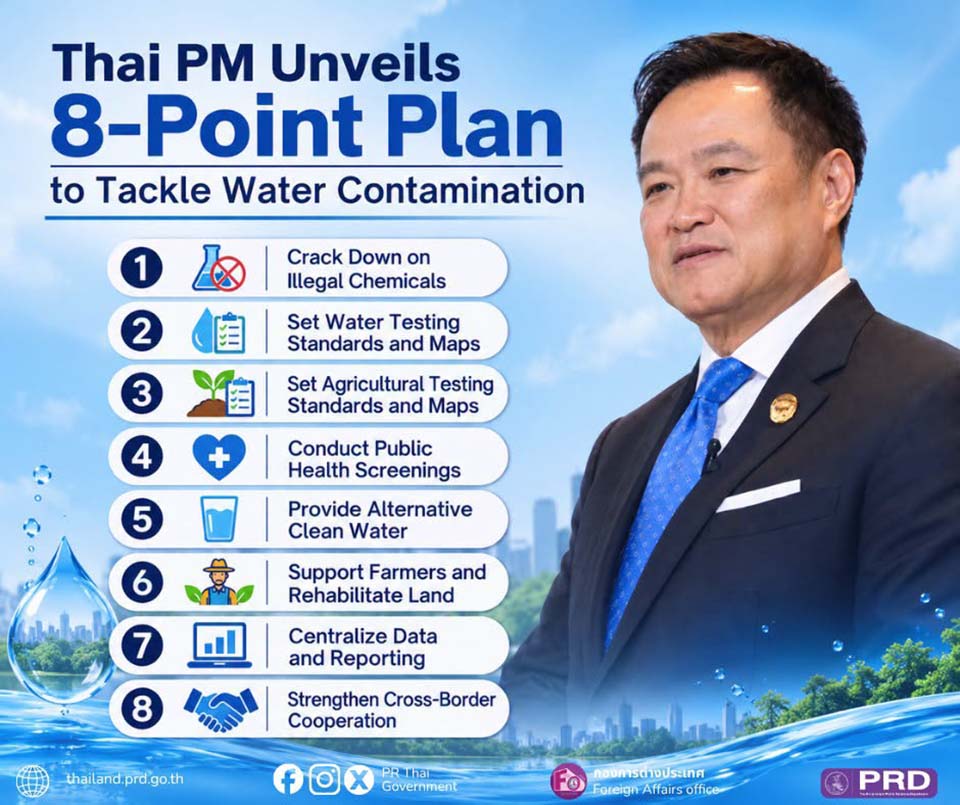
To tackle the crisis head-on, the Prime Minister laid out an eight-point action plan:
Crack down on illegal chemicals: Provincial governors will lead joint efforts to inspect and suppress the illegal import, possession, and transport of water-contaminating hazardous chemicals.
Set water testing standards and maps: The Ministry of Natural Resources and Environment (MNRE)—supported by the Ministry of Higher Education, Science, Research and Innovation (MHESI), the Ministry of Interior (MOI), and the Ministry of Public Health (MOPH)—will set water testing standards and map out contaminated and safe zones.

Set agricultural testing standards and maps: The Ministry of Agriculture and Cooperatives (MOAC), supported by MHESI and MOPH, will establish testing standards for agricultural produce and map out affected and safe areas.
Conduct public health screenings: MOPH will deploy medical teams to check residents’ health in high-risk areas and provide safety guidance.
Provide alternative clean water: MOI, MNRE, and MOAC will jointly supply clean water via central distribution points or mobile drinking water units in affected communities.
Support farmers and rehabilitate land: MOAC and the Ministry of Commerce (MOC) will suspend farming in contaminated zones, restore the land scientifically, assist affected farmers, and clearly communicate impact areas.
Centralize data and reporting: The Department of Disaster Prevention and Mitigation (DDPM) and the Public Relations Department (PRD) will collect and report ongoing data on water quality, produce, and public impact.
Strengthen cross-border cooperation: The Ministry of Foreign Affairs (MFA) and MNRE will use international mechanisms to trace contamination sources, share water quality data, and prevent transboundary pollution at its root.
In addition, the Prime Minister instructed northern provinces to prepare for PM2.5 haze by strictly enforcing bans on open burning. In contrast, southern provinces were ordered to establish proactive flood response plans and field support. These directives reflect the government’s resolve to protect public health, ensure safe water and agricultural supplies, and prevent future environmental crises nationwide. (PRD)