
BANGKOK, Thailand – A preliminary transport assessment has found the proposed southern MR10 motorway corridor between Laem Chabang and Phetchaburi to be significantly more economically viable than the proposed Thai Bridge across the Gulf of Thailand, with the latter facing a much higher investment cost and weaker economic returns.
The assessment, attributed to the Office of Transport and Traffic Policy and Planning (OTP) and shared by Progressive Thailand, compares the two proposed infrastructure projects in terms of engineering, investment costs, travel times, environmental impacts and economic performance.
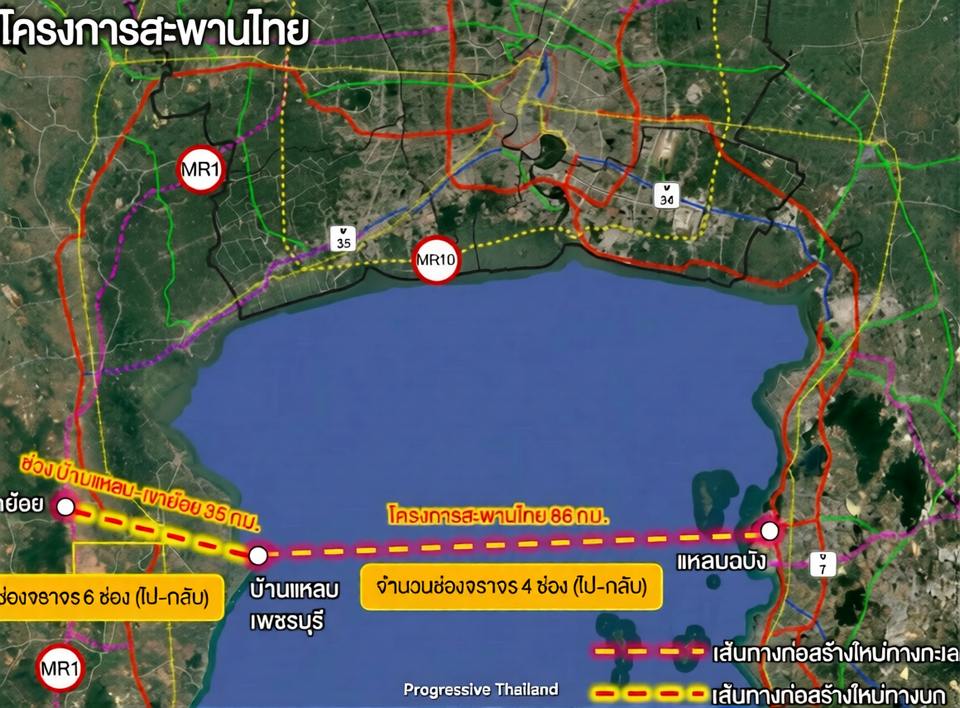
The proposed Thai Bridge would connect Chonburi and Phetchaburi through an approximately 86-kilometre route across the Gulf of Thailand. The project envisages a four-lane elevated bridge, an artificial island roughly 30 kilometers offshore and tunnel connections at both ends. Construction is estimated to take approximately seven years.
 The project is intended to shorten travel between the Eastern Economic Corridor (EEC) and southern Thailand by around three to four hours, improve freight connections between the southern region and Laem Chabang Port, promote tourism around the Gulf and reduce congestion along Highway 35, or Rama II Road. It could also encourage more international tourists to travel between the eastern and western coasts, benefiting hotels and tourism businesses in Phetchaburi and Prachuap Khiri Khan.
However, the proposed bridge raises environmental concerns, including potential disruption to marine ecosystems, natural water circulation and sediment patterns. The bridge’s numerous support structures could affect the movement and feeding patterns of fish, including mackerel, as well as endangered marine species such as Bryde’s whales. Seabed excavation for foundations could also disturb sediment and affect sunlight penetration, potentially damaging nearby seagrass beds and coral ecosystems.
 The alternative, the southern MR10 motorway corridor, would connect Highway 34 with Highway 35, providing a new transport route between the Eastern Economic Corridor and the southern region. The proposed alignment would incorporate adjustments to motorway and rail routes to minimize impacts on surrounding communities. The infrastructure would comprise six to eight lanes, with elevated and ground-level sections and a parallel railway corridor.
MR10 is expected to improve freight connectivity between southern Thailand, Laem Chabang Port and industrial estates in the eastern region, while easing congestion on major roads and in urban areas. It would also reduce transport times, fuel consumption and vehicle operating costs, forming part of the broader MR-MAP multimodal transport network. Potential impacts include drainage and flood risks in low-lying areas of Samut Sakhon and Samut Prakan, particularly if ground-level construction obstructs natural water flows. Construction could also generate dust, noise and vibration, while land acquisition may affect agricultural land and local ecosystems.
The preliminary investment and maintenance estimates over 30 years put the southern MR10 corridor at 230,009.82 million baht, compared with 1,615,304.03 million baht for the Thai Bridge project. From an engineering perspective, the MR10 route combining Laem Chabang, the eastern MR10 corridor, southern MR10 and the M81 Ban Phaeo–Cha-am motorway would cover approximately 356 kilometers, with an estimated travel time of four hours. Although it involves a longer route and construction in populated areas, it would require extensive elevated structures, interchanges, land acquisition and utility relocation.
 The Thai Bridge would cover approximately 86 kilometers and offer an estimated travel time of one hour and 30 minutes. Its shorter route would involve technically complex marine construction, including elevated structures, underwater tunnels and an artificial island designed to address structural stability, erosion and wave protection. Construction would also be affected by monsoon conditions and require restrictions on navigation around the construction area. The preliminary economic assessment gives MR10 an Economic Internal Rate of Return (EIRR) of 12.55%, a Net Present Value (NPV) at 7% of 150,405.46 million baht and a Benefit-Cost Ratio (B/C) of 2.10.
In contrast, the Thai Bridge recorded a preliminary EIRR of -0.64%, an NPV at 7% of -558,058.40 million baht and a B/C ratio of 0.30. Under conventional transport economic assessment criteria, the findings suggest MR10 offers stronger economic justification and should be prioritized, principally because of the recurring travel-time and transport-cost savings it could generate for road users.
The assessment nevertheless recognizes that the Thai Bridge could serve a different purpose as a strategic national infrastructure project, potentially supporting long-distance connectivity, logistics resilience and reduced reliance on existing transport routes. It suggests that the bridge should not necessarily be judged solely by conventional economic indicators, but should also be evaluated against broader strategic considerations, including economic security, transport continuity, logistics resilience and long-term national development objectives. The findings are preliminary and do not represent a final government decision on either project. Source: Office of Transport and Traffic Policy and Planning (OTP)