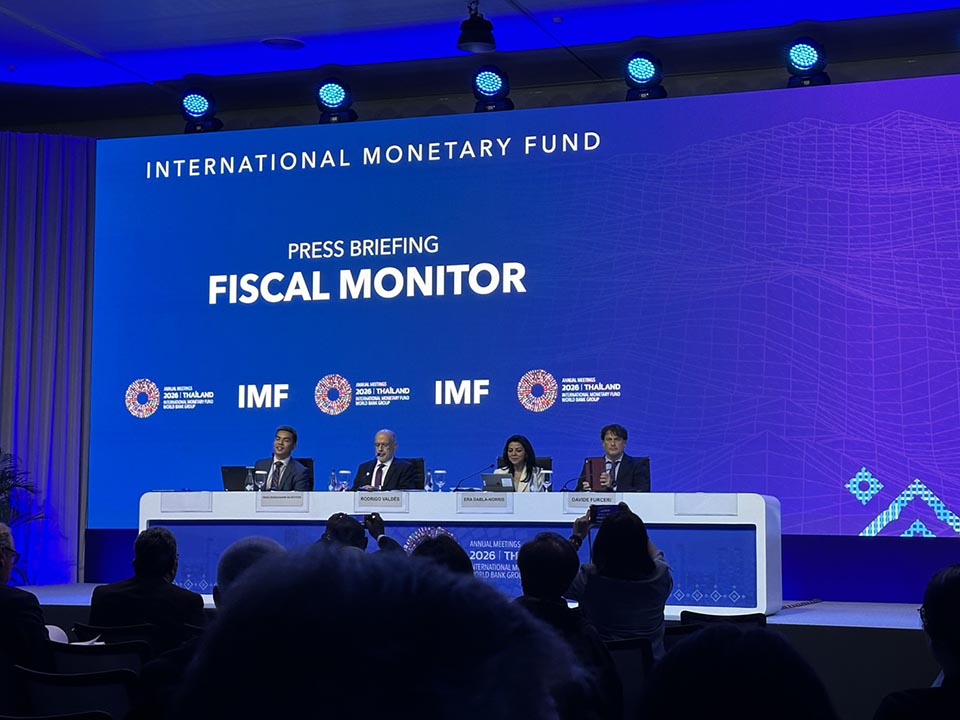
BANGKOK, Thailand – Global public debt is projected to reach 100% of gross domestic product by 2029, the International Monetary Fund (IMF) warned on October 14, urging governments to strengthen public finances as rising interest costs, energy subsidies and geopolitical tensions increase fiscal pressures.
Rodrigo Valdés, director of the IMF’s Fiscal Affairs Department, presented findings from the latest Fiscal Monitor during the 2026 IMF–World Bank Group Annual Meetings in Bangkok, saying economic activity had remained remarkably resilient this year despite worsening government finances.
The global fiscal balance deteriorated by around 0.4 percentage points of GDP, matching the deterioration recorded in the previous year, he said. Global public debt reached 94% of GDP in 2025 and is expected to approach 100% by 2029, driven largely by the world’s biggest economies.
Governments face mounting spending pressures from social welfare, defense, strategic self-reliance and rising interest payments, leaving less room to respond to future economic shocks.
Higher interest rates bring delayed but growing costs
The impact of higher interest rates on public debt does not emerge immediately because governments refinance much of their borrowing gradually as bonds mature.
However, with global interest rates elevated, more countries are entering a period in which borrowing costs exceed economic growth rates. This can steadily increase debt-servicing costs and make public finances harder to manage.
Energy subsidies add to fiscal pressures
The IMF also warned that responses to this year’s energy crisis were adding to government spending. While some countries have allowed higher oil and energy prices to reflect market conditions, others have introduced broad-based subsidies and price controls rather than directing temporary assistance towards vulnerable households.
The cost of such measures worldwide is estimated at around 0.5% of global GDP, according to the report. The IMF warned that broad subsidies can place a heavy burden on public finances while distributing benefits unevenly.
Fiscal pressures linked to conflict in the Middle East have added to the risks. Meanwhile, structural changes in government debt markets, including the growing role of highly leveraged non-bank financial intermediaries and the declining safety premium on US government bonds, are leaving markets vulnerable to repricing.
IMF outlines three priorities for governments
The IMF recommended three main policy responses to improve fiscal resilience.
First, governments should improve tax collection and redesign public spending and taxation to support economic growth without sacrificing revenue. Better-designed tax systems should reduce economic distortions, encourage investment, employment and productivity, and protect government income.
Second, countries with high debt or significant fiscal risks should begin credible fiscal consolidation plans to prepare for potential external shocks. These plans should use realistic assumptions and operate within strong, transparent fiscal frameworks.
Third, governments should allow energy prices to reflect actual scarcity. Where assistance is necessary, it should be temporary, targeted and limited to vulnerable groups rather than relying on costly universal subsidies.
The IMF’s warning highlights the growing challenge facing governments: maintaining economic stability and supporting vulnerable households while containing debt and preserving the capacity to respond to future crises. (TNA)