

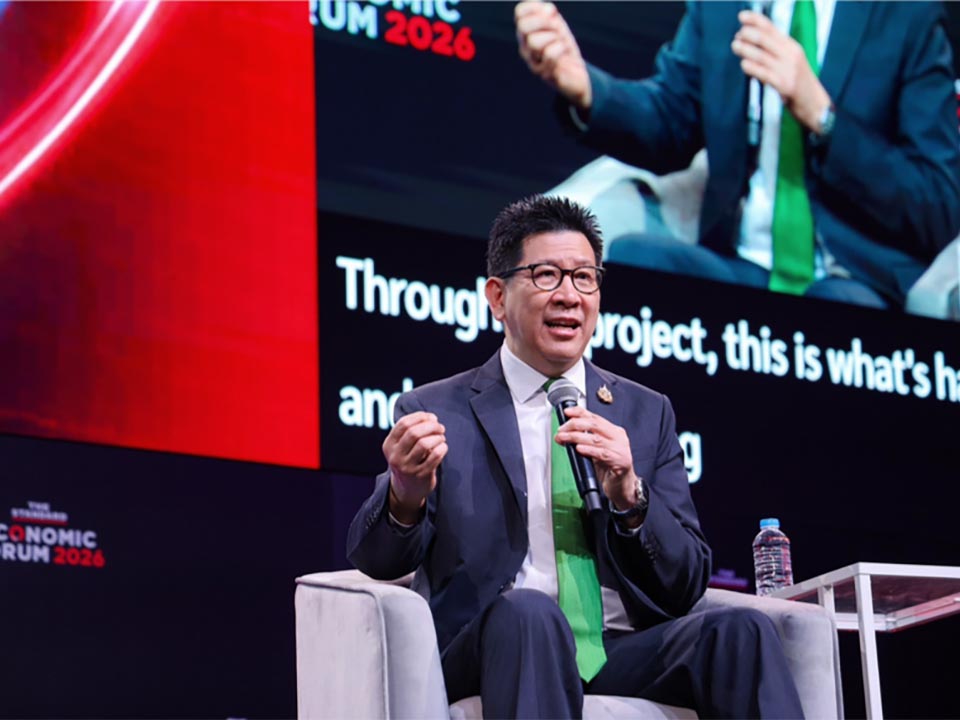
BANGKOK, Thailand – Deputy Prime Minister and Finance Minister Ekniti Nitithanprapas has outlined plans to make Thailand’s economic growth more inclusive, saying the government must turn the country’s K-shaped economy into a V-shaped recovery by bringing struggling businesses and lower-income groups onto a stronger growth path.
Speaking at The Standard Economic Forum 2026: Reinvent Thailand on November 4, Ekniti said Thailand was in a position to attract investment as global economic and geopolitical divisions reshape trade and business. However, the benefits of growth remain unevenly distributed.
He described the economy as K-shaped, with some sectors expanding while others continue to struggle. Artificial intelligence and modern industries represent areas of opportunity, but he said the government’s task was to lift the weaker side of the economy.
The Board of Investment (BOI) will play a key role in attracting investment in new industries, while linking investment promotion to skills development, technology transfer and employment for Thai workers. Ekniti said more than 120,000 jobs requiring new skills had already been created.
The government is also working with the Joint Public and Private Sector Consultative Committee on seven priority industries: agriculture and food processing, automotive, retail and trade, smart electronics, medical and wellness, tourism, and the creative economy. The committee is scheduled to announce performance indicators for each sector on November 9.
Ekniti reported that actual investment in the third quarter had increased by 27%, which he attributed to the Thailand FastPass programme and cooperation with the private sector.
The government has set three economic ambitions: annual GDP growth above 3%, raising investment from 22% to 30% of GDP, and reaching the world’s top 20 in competitiveness within four years.
A further announcement is scheduled for November 11, when the Finance Ministry will unveil its STI DEE reform strategy, intended to improve the ministry’s operations and public services.
The STI component stands for Stabilize Today, Transition Now and Invest for Tomorrow, focusing on fiscal stability, economic transition and future investment.
The DEE component covers Disclosure, including publication of five years of government procurement data; Easy, using digital systems to make public services more accessible; and Efficiency, with government agencies focusing on activities where they can deliver effective results.
Ekniti said the reforms would require close coordination between the government and private sector, with the aim of making economic growth more broadly shared and moving Thailand towards high-income country status.