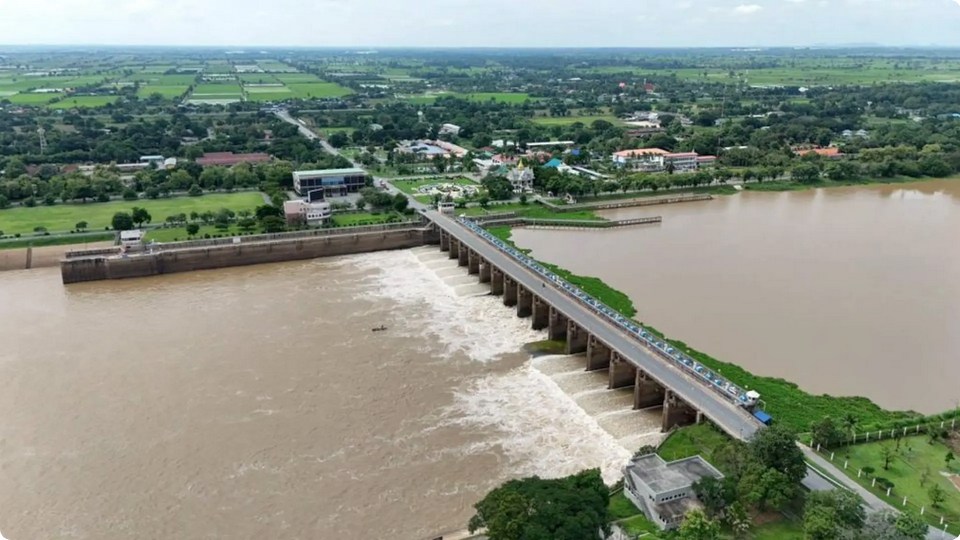
BANGKOK, Thailand – The Royal Irrigation Department (RID) will gradually increase discharge from Chao Phraya Dam as upstream water volumes continue to rise following heavy rainfall. At 8:00 p.m. on September 30, Station C.2 in Nakhon Sawan recorded a flow of 2,565 cubic meters per second, while the Sakae Krang River at Station Ct.19 in Uthai Thani recorded 554 cubic meters per second. The dam was releasing 2,200 cubic meters per second, with the upstream water level at 17.77 meters above mean sea level.
Flow at Station C.2 is forecast to reach about 3,010 cubic meters per second on October 2. With another 700–750 cubic meters per second expected from tributaries, the total upstream flow could reach 3,600–3,700 cubic meters per second. Irrigation networks on both sides of the river are expected to receive about 550–580 cubic meters per second.
Following approval from the National Water Resources Committee, discharge through the Chao Phraya Dam will be gradually increased, with a maximum of 2,500 cubic meters per second. The adjustment began at 9:00 p.m. on September 30, increasing from 2,200 to 2,300 cubic meters per second by 2:00 a.m. on October 1, at a rate of about 20 cubic meters per second per hour. The 2,300-cubic-meter rate will then be maintained until further adjustments are required.
The increased discharge could raise water levels by 15–30 centimeters in low-lying areas outside flood-protection embankments in parts of Ayutthaya, Ang Thong, Sing Buri, and Chai Nat. The RID will use irrigation networks and available upstream areas to temporarily hold incoming water while accelerating drainage to the sea through Khlong Lat Pho, in line with tidal conditions. Communities along the Chao Phraya and Noi rivers are advised to closely monitor water levels and official updates. (NNT)