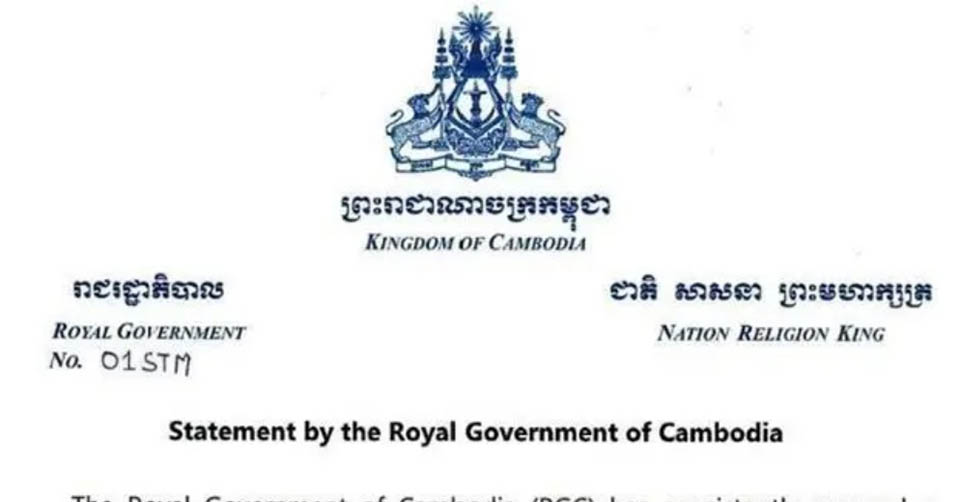
BANGKOK, Thailand – The Cambodian government, in a statement dated 4 June, condemned the recent armed clash with Thai soldiers and announced that it will submit the territorial disputes at four locations to the International Court of Justice (ICJ), opting not to include the matter in the agenda of the upcoming Thailand-Cambodia Joint Boundary Committee (JBC) meeting scheduled for mid-June.
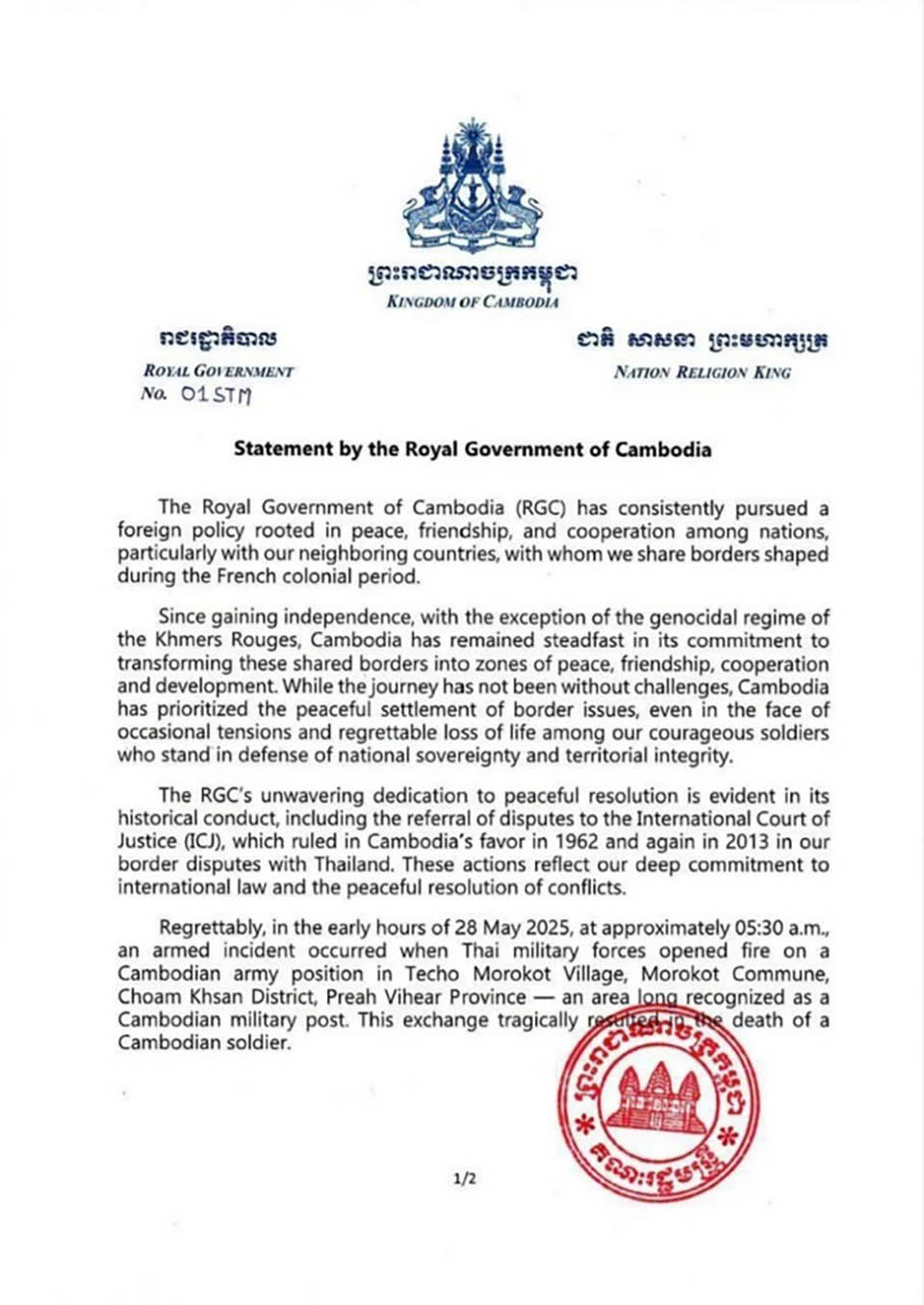
Cambodian Government Statement
The Royal Government of Cambodia has consistently conducted its foreign policy based on the principles of peace, friendship, and international cooperation, particularly with neighboring countries sharing colonial-era demarcated borders.
Since gaining independence—except during the Khmer Rouge genocide period—Cambodia has remained committed to transforming its borders into zones of peace, friendship, cooperation, and development. Despite challenges along the way, Cambodia has prioritized peaceful resolution of border issues, even during times of tension and the loss of brave soldiers defending the nation’s sovereignty and territorial integrity.
Cambodia’s unwavering commitment to peaceful dispute resolution has been evident through its previous actions, including the submission of disputes to the International Court of Justice (ICJ), which ruled in Cambodia’s favor in 1962 and again in 2013 regarding its border dispute with Thailand. These actions reflect Cambodia’s dedication to international law and peaceful conflict resolution.
However, it is with great sorrow that Cambodia reports an incident that occurred in the early morning of 28 May 2025, at approximately 05:30 AM. Thai soldiers allegedly opened fire on Cambodian troops in the area of Techo Mreakot Village, Morakot Subdistrict, Chom Khsan District, Preah Vihear Province – a location long acknowledged as a Cambodian military post. The incident tragically resulted in the death of a Cambodian soldier.
The Cambodian government formally protested this unprovoked use of force, describing it as a serious violation of Cambodia’s sovereignty, territorial integrity, and the principle of good neighborliness outlined in the 2000 Memorandum of Understanding (MoU) between the two countries.
This incident is among several worrisome events that highlight the limitations of the existing mechanisms for resolving border disputes. Therefore, in the interest of seeking a fair, impartial, and sustainable solution, on 2 June 2025, the Cambodian government decided to submit the disputes over four sensitive areas—namely the Emerald Triangle area, Ta Muen Thom Temple, Meun Tot Temple, and Ta Kwai Temple—to the ICJ in The Hague.
These four locations remain unresolved in terms of ownership and are considered sensitive areas that could escalate tensions if not addressed properly.
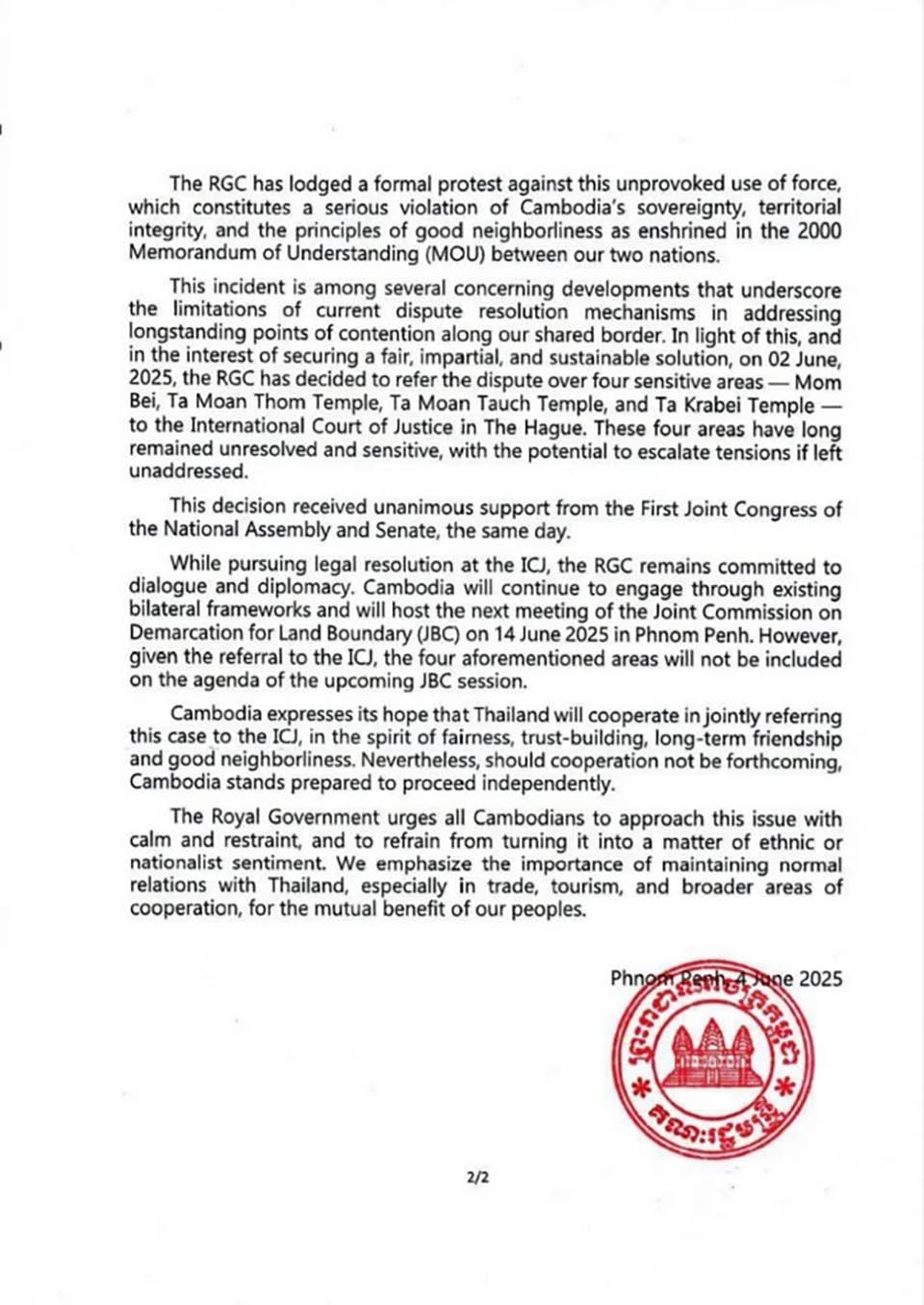
This decision received unanimous support during the first joint session of the National Assembly and Senate on the same day.
While the legal process at the ICJ proceeds, the Cambodian government remains committed to diplomatic discussions and existing bilateral mechanisms. Cambodia will continue participating in the next Joint Boundary Committee (JBC) meeting on 14 June 2025 in Phnom Penh. However, due to the ICJ submission, the four disputed areas mentioned above will not be included on the agenda of the upcoming JBC meeting.
Cambodia hopes Thailand will cooperate in good faith regarding the ICJ process—guided by justice, trust-building, long-term friendship, and good neighborly relations. However, if such cooperation is not forthcoming, Cambodia is prepared to proceed independently.
The Cambodian government urges all Cambodian citizens to acknowledge this matter with calmness and restraint, and to avoid turning it into an issue of ethnic or nationalistic sentiment. It emphasizes the importance of maintaining normal relations with Thailand in trade, tourism, and other forms of cooperation for the mutual benefit of both nations’ peoples.
Phnom Penh, 4 June 2025 (TNA)