

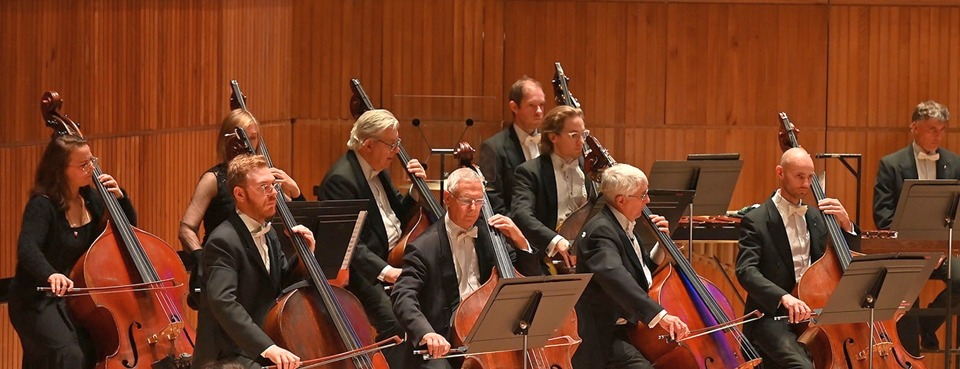
When I was a music student back in the Old Country a long time ago, I did some instrumental teaching to earn a bit of extra money. Most of us students did some part-time teaching, even though we were barely qualified. For a time, I taught cello at a school just outside London. One day, the Head of Music at the school asked me to teach double bass to a couple of students. I agreed, because the students were complete beginners, and with a bit of private practice, I could stay a few lessons ahead of them. As a young student, I had no moral or musical scruples about teaching an instrument I could barely play. In any case, I needed the money.
The double bass is also known as the upright bass, acoustic bass, bass fiddle, string bass, contrabass, or simply the bass. Of all the bowed strings, the double bass is the largest and most unwieldy. Yet the instrument appears in folk music groups from around the world, in jazz of all styles and in almost all orchestral music. I sometimes wonder why people decide to play this elephantine object. You see, a double bass weighs between 20 and 25 pounds, and because it’s easily damaged, it’s carried in a case that adds another 45 pounds. The instrument stands at about 6 feet high and cannot be squeezed into a small car. I know this, because I’ve tried. Ideally, it requires a van, especially if the player is going to travel with it. Compared to violin strings or guitar strings, double bass strings are thick and require quite a bit of finger strength to hold them down.
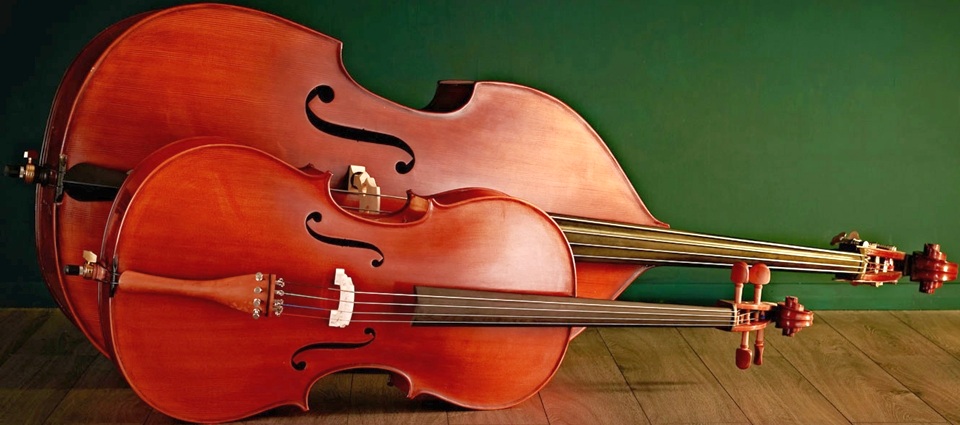
From a distance, the bass looks like a larger version of the cello. While the double bass is somewhat similar in construction, it has some features of the much older viol family. Like the viol, the “shoulders” of the body slope, allowing the player to reach higher notes. Bass strings are tuned in fourths, whereas all other orchestral strings are tuned in fifths. As a result, cello and bass fingering are completely different. In fact, the bass strings are tuned to the same notes as the bass guitar. Like all other bowed string instruments, you have to learn exactly where the notes lie on the fingerboard, for there are no frets or other markings to help you hit the correct position. This is why players of bowed string instruments need an excellent musical ear – they have to rely on their ears alone to decide whether each note is in tune.
And yet, despite all these setbacks, people continue to take up studying this gargantuan instrument. It’s just as well, because the bass performs an essential role in the orchestra. Unless you are a fisherman, the word “bass” is pronounced the same as “base”, which hints at the instrument’s main role. For much of the time, in all musical styles, the double bass provides the harmonic foundation of the music. In the 18th century, the double basses in an orchestra simply doubled the cello part throughout, which explains the word “double” in the name. By the middle of the 19th century, the double bass was often given a more adventurous part, but its role as the “base” of the orchestra remained.
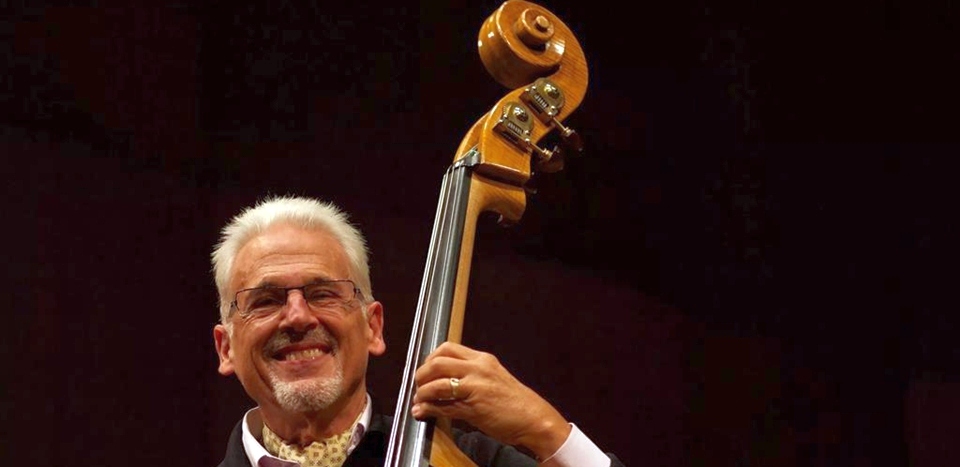
The lowest note of the standard double bass is a low E, and to produce it, the string vibrates at about 40 times every second. Scientists call vibrations per second “hertz” (Hz). The lowest sound that we humans can hear is about 20 Hz, or 20 vibrations per second. To put this in context, the lowest note on a piano keyboard is about 28 Hz. Because these frequencies approach our lower limit of hearing, the lowest note on a keyboard sometimes sounds more like a dull thud than a note. To some people, the bottom note of a double bass sounds like a disembodied alien grunt. Incidentally, some large pipe organs can produce exceptionally low tones at about 16 Hz. Sounds at extremely low frequencies are “felt” rather than “heard”, and experienced as a deep vibration, rumbling, or pressure rather than a specific pitch. Some animals, notably whales and elephants, can famously hear sounds well below the human threshold of hearing.
The modern double bass stands around six feet tall, and players either stand behind it or sit on a high stool with the instrument leaning against their body. Half-size and quarter-size basses are available for young learners. The half-size bass is actually only about 15% smaller than a full-size model. A small instrument known as a “mini-bass” is often used by children, making it easier for them to handle.
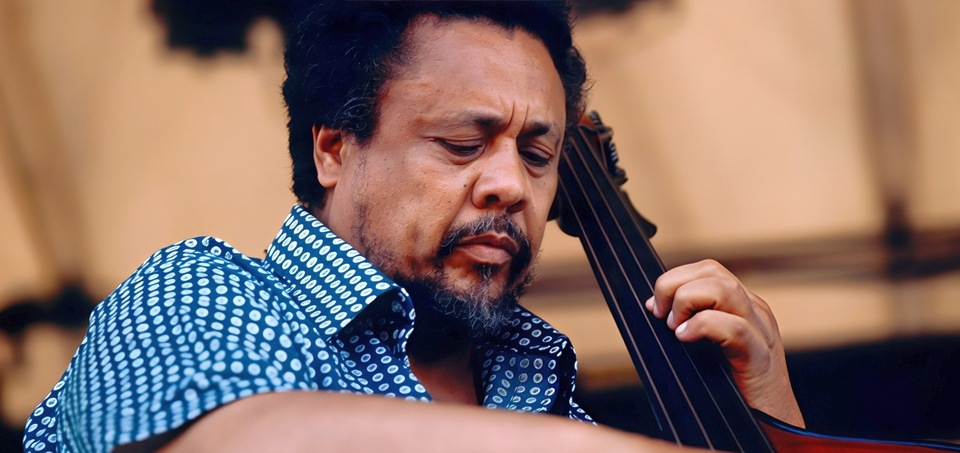
You may have noticed that not all bass players hold their bows the same way. This is because there are two distinct types of bass bows: the French and the German. You can tell them apart by the way they are held. The French bow is held similarly to the violin and cello bow, but the German bow is held in a hacksaw position. German bows are increasingly common in Asian and American orchestras. I wish I could tell you the reason, but I can’t. Another double bass feature you might notice is an extra section of fingerboard mounted at the top of the instrument. Most professional orchestral players use this so-called C extension, which allows a few extra low notes.
For much of its history, the double bass has had no fixed number of strings. Some early instruments had only three, and during the 17th century some basses had five or even six strings. If you are old enough, you might recall the short-lived “tea-chest bass”, popular in British skiffle groups in the late 1950s. It was a home-made thing, with a single string held taut between the chest and a broom handle. The string was plucked, and the pitch was adjusted by pulling on the handle. The resulting notes were rarely in tune. The modern orchestral five-string bass emerged around 1880, with the lowest string tuned four notes lower than the conventional instrument. Even so, most players still use the standard four-string design.
In any musical genre, the double bass was never popular as a solo instrument. Few concertos were written for the instrument, partly because the lower notes don’t project easily over the orchestral sound. To avoid this problem, composers often use the instrument’s highest notes, which are difficult to play.

Giovanni Bottesini (1821-1889): Concerto for Double Bass No. 2 in B minor. Mikyung Sung (db), Bradetich Competition Orchestra, cond. Clay Couturiaux (Duration: 16:57; Video: 1080p HD)
One of the most enduring double bass concertos was written by Giovanni Bottesini – not to be confused with the painter Botticelli, who didn’t write any. Written in 1845, it remains a standard repertoire piece even today. As a teenager, Bottesini studied the violin and probably would have continued doing so had a curious opportunity not arisen. Milan Conservatory was currently offering two scholarships for double bass and bassoon, and the young Giovanni wanted a place. Within weeks, he had become good enough on the double bass to be admitted to the College. He eventually became an exceptional player and began an international career as “the Paganini of the Double Bass”. Not only did he develop bass technique enormously, but he also composed many works for the instrument, some with challenging technical demands.
This performance, by South Korean bassist Mikyung Sung, is phenomenal because she has faultless technique and produces a beautiful tone on the instrument’s difficult upper notes. Sometimes, the instrument produces an extra-rich cello tone. She makes the technically challenging piece sound effortless.
Serge Koussevitzky (1874-1951): Concerto for Double Bass Op. 3. Luis Cabrera Martin (db), Netherlands Philharmonic Orchestra, cond. Nil Venditti, conductor (Duration: 15:59; Video: 1080p HD)
The Russian composer and conductor Serge Koussevitzky is usually remembered as an orchestral conductor, especially for his long stint with the Boston Symphony Orchestra from 1924 to 1949. It’s often forgotten that he began his musical career as a bass player. At the age of fourteen, he received a scholarship to attend Music College in Moscow and was good enough to join the Bolshoi Theatre Orchestra at the age of twenty.
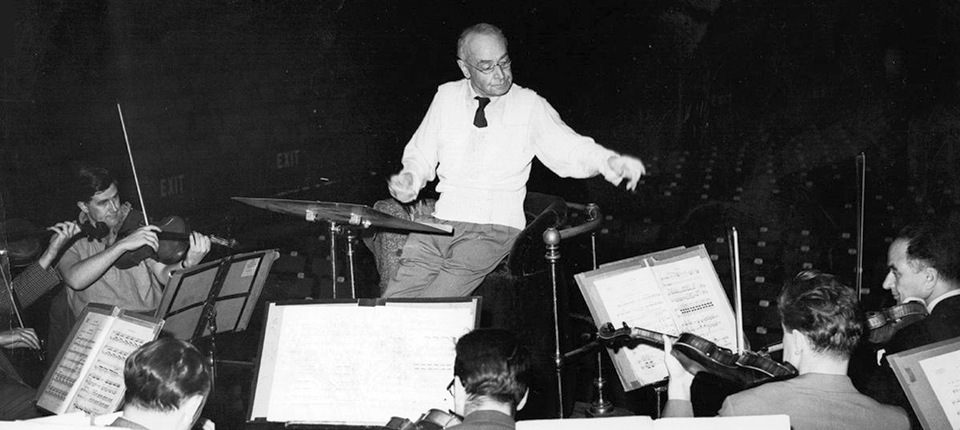
This three-movement concerto dates from 1902 and was greatly influenced by Dvořák’s music. The opening theme bears a remarkable resemblance to the main theme of the New World Symphony, which Dvořák wrote nine years earlier. The similarity is so startling that one wonders how Koussevitzky got away with it. Koussevitzky was the soloist in the world premiere of his concerto in Moscow on 25 February 1905 with the Moscow Symphony Orchestra. He later played it in Germany, Paris, and Boston. It is an attractive work and has become one of the best-known double-bass concertos by a Russian composer. It features brilliant, virtuosic writing, and the superb Spanish bass player Luis Cabrera Martin performs the work with thrilling, expressive flair.