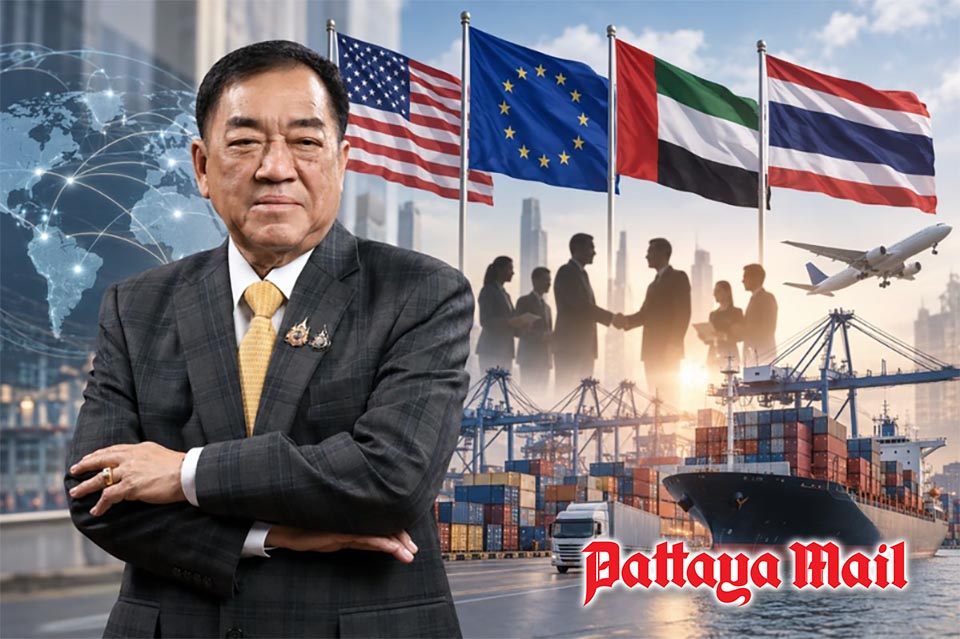
BANGKOK, Thailand – The Thai Chamber of Commerce is urging the government to accelerate three major trade agreements with the United States, European Union and United Arab Emirates, saying successful deals could open new export markets, attract foreign investment and technology, and connect Thai businesses more closely with global supply chains. The three priority negotiations are the Thailand-US Reciprocal Trade Agreement (ART), the Thailand-EU Free Trade Agreement (FTA) and the Thailand-UAE Comprehensive Economic Partnership Agreement (CEPA).
Thai Chamber of Commerce and Board of Trade of Thailand chairman Poj Aramwattananont said the three agreements are at important stages and could become significant tools for expanding markets and upgrading Thailand’s economic structure. “FTAs today are not simply about reducing tariffs. They are tools for upgrading the economic structure through new markets, attracting FDI, technology transfer and connecting Thai businesses to global value chains,” Poj said.
He said that if the agreements are concluded and accompanied by appropriate supporting measures, they could potentially increase the size of Thailand’s economy by more than 2% of GDP within three years of taking effect.
Thailand-US trade talks
For the Thailand-US ART, the Chamber supports the government’s efforts to accelerate negotiations and provide greater certainty for exporters and investors, particularly on tariff rates, rules of origin, trade facilitation and products requiring special treatment. The Chamber identified agricultural products, processed food, processed seafood and premium pet food among sectors requiring particular attention, with the aim of keeping tariffs at levels that allow Thai products to remain competitive with regional rivals.
Poj also called for Thailand to use its engagement with the United States to attract major companies to invest in targeted industries, including semiconductors, advanced electronics, digital technology and AI, clean energy, healthcare, processed seafood, premium pet food and food innovation. Such investment, he said, should be linked to technology transfer, workforce development and greater participation by Thai companies in supply chains so that foreign investment generates wider economic benefits.
Thailand-EU FTA enters key stage
The Thailand-EU FTA is also approaching a critical stage, with the 10th round of negotiations scheduled to take place in Phuket from September 28. Thailand and the EU had concluded 15 of 24 chapters by the end of the ninth round, leaving the remaining issues to be negotiated.The Thai Chamber is calling for both sides to resolve the outstanding issues and move towards legal scrubbing as soon as possible.
Poj said the EU is not only a major high-income market but also an important source of investment and technology. A completed FTA could therefore make Thailand more attractive as a production base for companies seeking access to the European market.
A study cited by the Chamber estimates that the Thailand-EU FTA could increase Thailand’s GDP by about 1.28% and exports by about 2.8%, equivalent to roughly 350 billion baht. The Chamber also called for sensitive products to be carefully managed and Thai businesses to be prepared for higher European standards.
UAE deal could open Middle East gateway
The Thailand-UAE CEPA is another priority, with more than 80% of negotiations reportedly completed and both sides preparing to return to the negotiating table. The agreement could create opportunities for Thai food, halal products, agricultural goods, rubber, textiles, electrical appliances, vehicles and parts to enter the UAE market, while also opening opportunities in transport, finance and business services.
The UAE’s position as a regional hub for trade, investment, logistics and distribution could also give Thai businesses greater access to markets across the Middle East, Africa and South Asia. The Chamber sees opportunities to attract UAE investment into Thai infrastructure, energy, food, logistics and future industries.
More trade deals in the pipeline
Beyond the three priority agreements, the Thai Chamber is also calling for faster progress on the Thailand-South Korea CEPA and the ASEAN-Canada FTA. The aim is to diversify export markets, reduce exposure to global economic volatility and create more opportunities for Thai agricultural, processed food and industrial products in high-purchasing-power markets.
Poj stressed that market opening must go hand in hand with safeguards for sensitive products, preparation for SMEs and greater use of domestic raw materials, components and services.
“The private sector is ready to work fully with the government and Ministry of Commerce to turn trade agreements into real orders, investment, employment and technology in Thailand,” he said.
The government has separately been pushing Thai SMEs to make greater use of existing FTA benefits, with Thai exporters using FTA privileges worth US$48.07 billion in the first half of 2026, up 7.33% year on year. (Ministry of Culture)