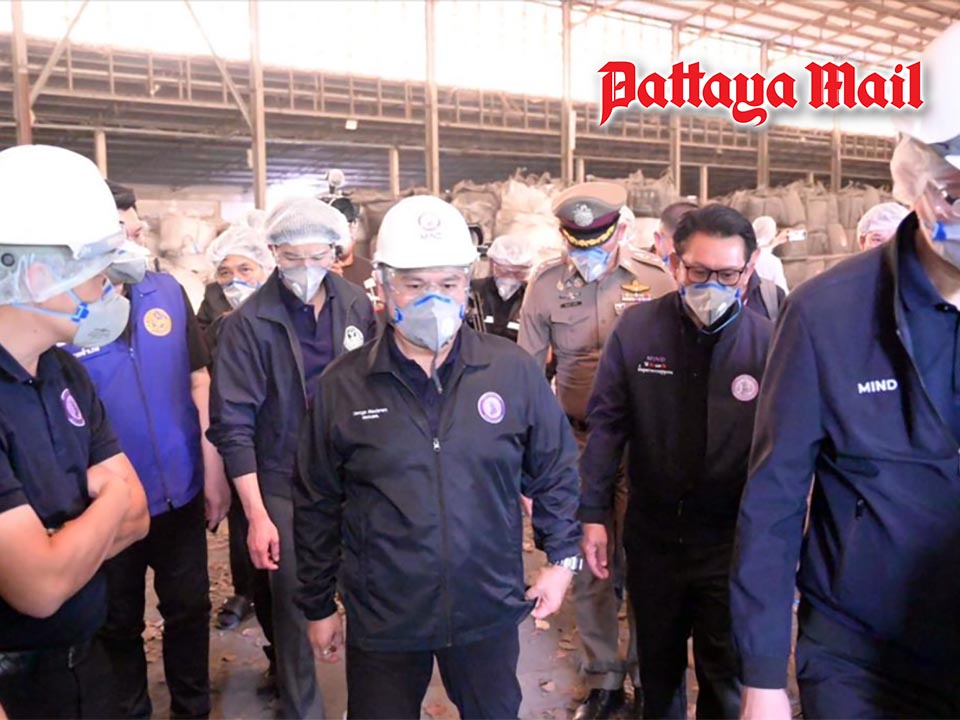
NAKHON PATHOM, Thailand – Thailand’s Industry Ministry is seeking urgent action to remove or dispose of more than 12,000 tons of seized aluminum dross from an abandoned factory in Nakhon Pathom after leaks, foul odors and fire concerns began affecting the surrounding community.
Industry Minister Varawut Silpa-archa inspected the facility on August 21 alongside House Industry Committee chairman Supachok Srisukjorn and relevant local agencies following complaints from residents about unpleasant odors coming from the abandoned aluminum dross processing plant.
The factory, operated by AY 2021 Co., Ltd. in Phrong Maduea subdistrict, Muang Nakhon Pathom district, was previously prosecuted for operating without authorization under the Factory Act and for possessing Category 3 hazardous aluminum dross without permission under the Hazardous Substances Act.
Authorities had seized and sealed materials found inside and outside the factory. However, the seized aluminum dross has since begun leaking and producing foul odors intermittently, raising concerns about its impact on nearby communities and the risk of fire. During the inspection, officials found that the factory was no longer operating and had no workers or caretaker, leaving the site effectively abandoned. Two furnaces used for metal-dross smelting remained inside, while the air-pollution control system was no longer operational. Officials also found large industrial bags containing what was believed to be aluminum dross stored both inside and outside the building.
In total, authorities found approximately 8,258 big bags weighing about 12,387 tons. Parts of the building had deteriorated, with leaks in the roof allowing rainwater to reach the aluminum dross.
Aluminum dross is a waste product from aluminum smelting and recycling. Authorities classify it as a Category 3 hazardous substance. Contact with moisture or water can potentially release toxic and flammable gases, creating risks of fire or explosion and possible respiratory hazards. Varawut instructed the Nakhon Pathom Industry Office to coordinate with police to determine how the seized material can legally be moved or disposed of as quickly as possible.
He said authorities wanted to address the risk before a more serious incident occurred, while ensuring that any removal or disposal complies with all relevant laws. The Industry Ministry also plans to accelerate proposed amendments to the Factory Act and Industrial Waste Act for consideration by the Cabinet and Parliament. The proposed measures would strengthen the Polluter Pays Principle, requiring operators to bear the costs of preventing and addressing environmental damage rather than shifting the burden to communities or the government.
Other proposed measures include requiring certain high-risk factories to provide financial guarantees for initial compensation related to damage to people, property and the environment, establishing an industrial-waste remediation fund, reducing administrative discretion in licensing decisions and increasing penalties for legal violations.