BANGKOK, Thailand – Thailand’s leading private sector executives have outlined the country’s economic challenges and opportunities under the changing global landscape, saying political stability has helped restore investor confidence while urging faster action on workforce skills, SME development, energy reform and new industries.
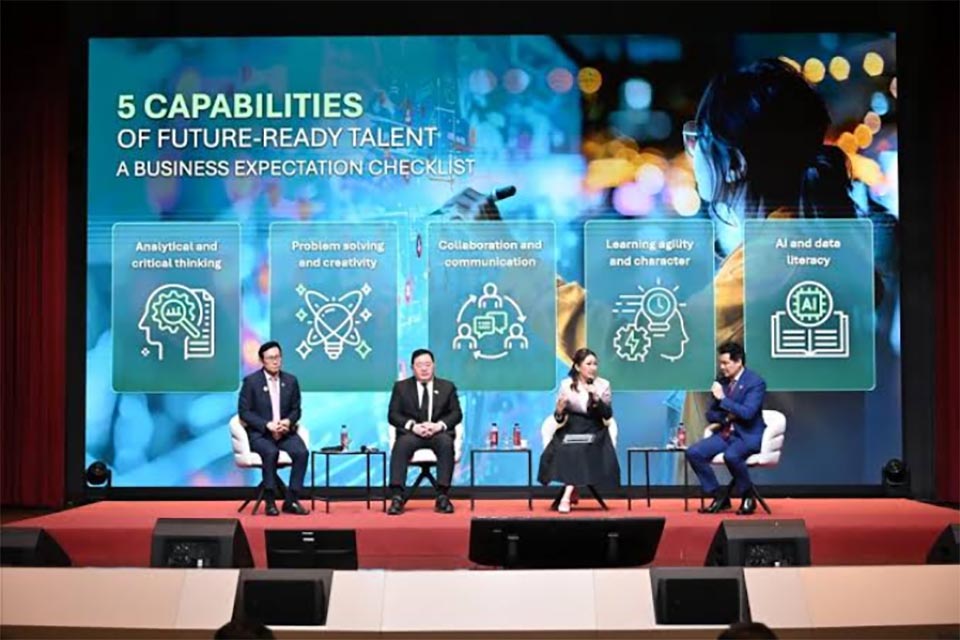
Speaking at The INTANIA Forum: “SURVIVING UNDER THE NEW WORLD ORDER,” business leaders said Thailand is beginning to see positive signals from foreign investors, reflected in capital inflows, improving market sentiment and rising investment applications, particularly in emerging industries such as electric vehicles (EVs) and data centers. Kattiya Indaravijaya, Chief Executive Officer of Kasikornbank, said investor confidence has started to recover following greater political stability in Thailand. She said foreign investors had previously expressed concerns over political uncertainty, but recent developments have created more positive momentum, with improvements seen in the stock market, capital movements and foreign direct investment, particularly in EV manufacturing and data center projects.
Kattiya said strong growth in investment applications submitted to the Thailand Board of Investment (BOI) demonstrates that Thailand remains capable of attracting investment in new industries.
However, she stressed that attracting factories alone is not enough. Thailand must ensure that new investment creates wider economic benefits through employment opportunities, workforce development, software capabilities, energy improvements and the use of data to support innovation.
“The challenge is not only having EV factories or data centers, but creating an ecosystem that allows Thai businesses and workers to benefit from these industries,” she said. Kattiya added that Thailand’s economic transition under the new global order requires a stable government with a clear national strategy and sufficient time to address outdated regulations and structural issues, as many reforms require long-term implementation.
SMEs Need Support to Stay Competitive
Thammasak Sethaudom, President and CEO of Siam Cement Public Company Limited (SCC), said large industries have increasingly adapted to global competition, but small and medium-sized enterprises remain a major concern. He said many SMEs within supply chains face difficulties accessing capital, adopting new technologies and managing higher financial costs compared with larger companies. “If SMEs cannot survive, large companies will also face challenges because supply chains depend on strong domestic partners,” he said. Thammasak called for cooperation between the government and large corporations to strengthen Thai SMEs through lower energy costs, wider use of solar power, green business transformation and carbon credit development.
He also suggested that Thailand strengthen its domestic market while expanding regional opportunities within ASEAN to compete with rising production capacity from China.
Thailand, he said, should focus on becoming a base for premium-quality production while leveraging the strengths of neighboring countries within regional supply chains.
Energy Reform Key to Future Growth
Auttapol Rerkpiboon, adviser to the Prime Minister, said energy security remains a key factor in maintaining investor confidence and national competitiveness. He said Thailand must balance three priorities: energy security, environmental sustainability and affordable prices for consumers and businesses. Thailand has improved energy risk management by diversifying fuel import sources and reducing dependence on any single supplier, while continuing to develop renewable energy, solar power, smart grids and clean energy technologies.
These efforts will be essential to support Thailand’s Net Zero goals and attract future industries, including data centers that require reliable and sustainable energy supplies. The executives agreed that Thailand still has strong economic potential, but the country must accelerate reforms and build a stronger foundation through skilled workers, competitive SMEs, clean energy and innovation-driven industries. They said these measures will determine whether Thailand can secure a stronger position in the evolving global economy.