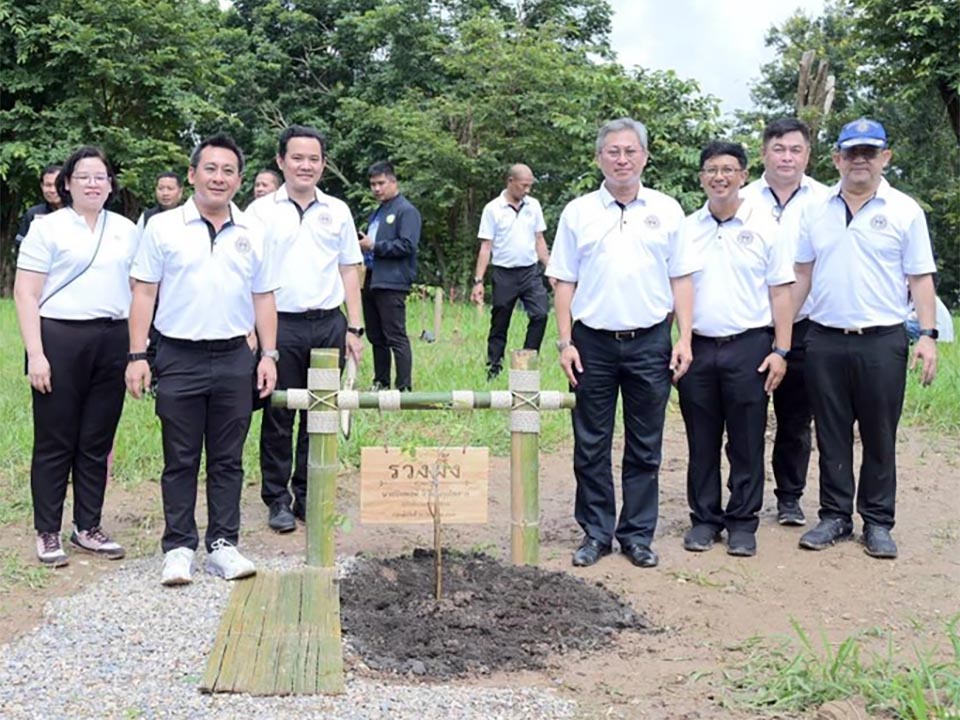
CHIANG MAI, Thailand – Thailand’s Department of Highways has unveiled an ambitious environmental initiative aimed at transforming the country’s road network into a low-carbon transport system by expanding roadside forests, installing solar power systems, upgrading to energy-efficient LED lighting and increasing recycled construction materials. The new “Highways Carbon Sink: Prao Model” was officially launched on July 31 in Prao district, Chiang Mai, where highway reserve land is being converted into a model carbon-absorbing green space. The project forms part of the department’s broader strategy to help Thailand achieve its national Net Zero emissions target by 2050.
Department of Highways Director-General Piyapong Jiwattanakulpaisan said the initiative demonstrates that infrastructure development can go hand in hand with environmental conservation. The pilot project has already surveyed and measured 1,008 existing trees along Highway 1001, which are estimated to absorb approximately 555,577 kilograms of carbon dioxide equivalent each year. Authorities have also planted 159 additional trees, expected to absorb a further 1,510 kilograms of CO₂ equivalent annually once fully grown.
Officials selected Prao as the first pilot location because Chiang Mai continues to experience severe seasonal air pollution and PM2.5 problems, while the district also serves as an important watershed area capable of becoming what officials describe as a natural carbon sink. The project operates under Thailand’s Low Emission Support Scheme (LESS) administered by the Thailand Greenhouse Gas Management Organization. Beyond tree planting, the Department of Highways is accelerating several nationwide initiatives designed to reduce emissions across its operations.
Plans include expanding roadside green areas by more than 10,000 rai, installing 6 megawatts of rooftop solar panels on highway offices and rest areas by 2027, replacing conventional street lighting with energy-efficient LED fixtures capable of cutting electricity consumption by 50–60 percent, and increasing the reuse of recycled road construction materials from the current 10–20 percent to at least 50–60 percent within the next 15 years.
The department also plans to introduce a national carbon-monitoring platform in 2027 to measure emissions generated by road construction and maintenance, traffic congestion and office operations, allowing officials to better target future emission reductions. The initiative supports the Department of Highways’ declaration to become a low-carbon and sustainable highway agency by 2040, contributing to Thailand’s broader climate commitments while improving environmental quality alongside the country’s transport infrastructure.