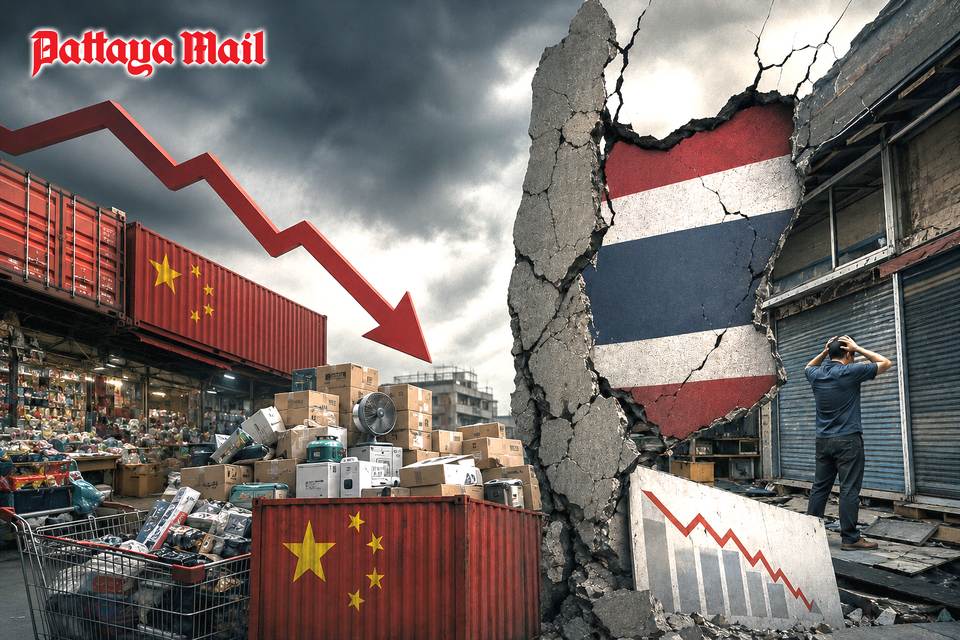
PATTAYA, Thailand – From the perspective of a Law and tax expert, and as a Thai citizen closely monitoring corporate landscape shifts, another severe economic crisis quietly dismantling domestic commerce is the calculated deflationary pressure originating from China. Facing substantial domestic economic stagnation and massive overcapacity, Chinese industrial structures are aggressively exporting heavily subsidized, low-cost surplus goods directly into the Thai marketplace. This phenomenon is not standard free-market competition but a systemic disruption that exploits free-trade vulnerabilities and customs loopholes to dump sub-standard products at prices below authentic raw material costs. Consequently, this predatory pricing has completely shattered Thailand’s domestic price architecture, forcing widespread factory closures and bankruptcies among local manufacturers who cannot survive against artificial cost baselines.
The modern mechanism utilized to destabilize the domestic price structure relies heavily on cross-border e-commerce platforms and automated logistical networks bypassing traditional wholesale models. By leveraging local free-trade zone warehouses to minimize customs duties, evading value-added tax structures, and distributing goods that entirely bypass mandatory industrial product certifications, these foreign entities execute hyper-deflationary pricing across essential consumer sectors. This unmitigated influx strips domestic enterprises of their pricing power, forcing Thai businesses into zero-margin liquidations or compelling them to abandon manufacturing altogether to become mere distributors of Chinese imports. In the long term, this structural regression completely erodes Thailand’s industrial self-sufficiency and permanently damages macroeconomic stability.
From a regulatory and statutory enforcement perspective, the government’s recent implementation of a flat seven percent value-added tax on all low-value imported goods from the first baht remains an insufficient, reactionary measure. The core legal challenge involves combating foreign state-subsidized capital structures that routinely operate through domestic nominee networks. These illegal configurations utilize grey accounting practices and proxy logistics shells to manage unauthorized warehousing and distribution hubs inside Thailand. Eradicating this predatory pricing architecture requires the aggressive enforcement of anti-dumping and countervailing duties, executed in tandem with the systemic dismantling of the domestic proxy networks that legally insulate these illicit operations.
The definitive strategic insight I must convey to the Thai business community amidst this unprecedented supply shock is that competing on a pure cost-per-unit metric against global overcapacity is an operational dead end. Survival requires a total paradigm shift away from low-margin commodity trading toward high-value corporate differentiation. Domestic enterprises must focus heavily on secure product standard certifications, localized after-sales support structures, and the rigorous utilization of intellectual property and trade defense laws to insulate their operations. Transitioning upward into heavily regulated, premium market segments remains the unique proactive mechanism for local capital to escape underpriced market displacement and secure long-term commercial viability.