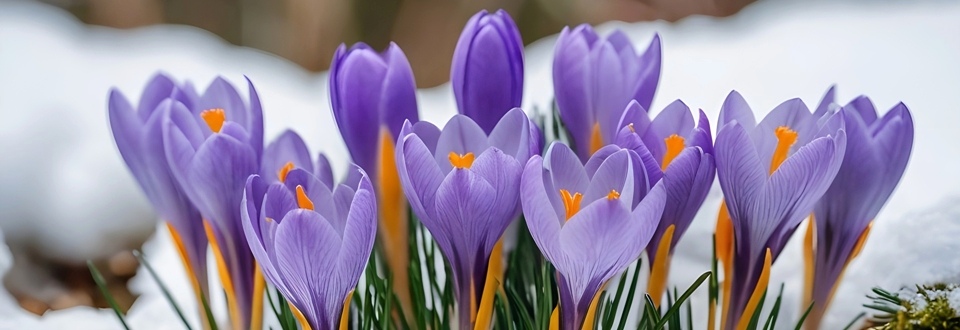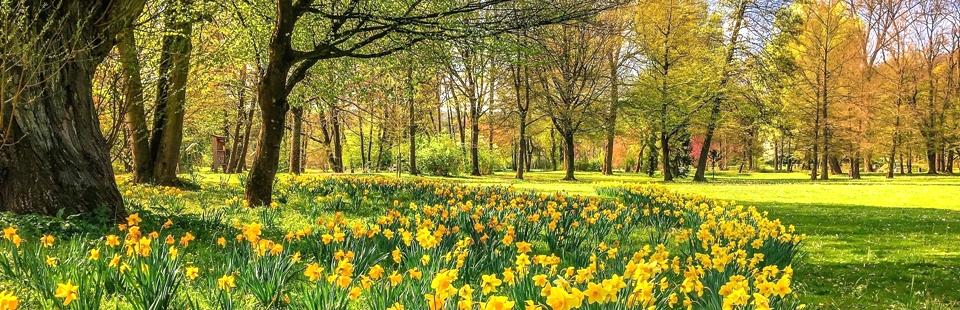
There can be no other season that brings such a mood of joyful expectation as the spring, especially in countries that suffer the grey and cheerless northern winters. We tend to think of spring as the season of rebirth and renewal. One of the few aspects of British life that I miss (apart from The Sunday Times, The Spectator and the Chinese take-aways) are the crisp spring mornings and the welcoming appearance of daffodils in the fields. I miss the little snowdrops and crocuses too, which in a mild year, can bloom even in late February.
Daffodils usually make their appearance a bit later and I used to marvel at the swathes of vibrant yellow in the fields and woodlands of southern England. Daffodils herald the end of the dismal, cold and rainy winter. They are the harbingers of spring. And yes, now you mention it, there’s that poem by William Wordsworth about daffodils, which in a moment of breath-taking imagination, he entitled Daffodils. It’s the one that begins “I wandered, lonely as a cloud”. The poem – or at least its first couple of lines – was probably recognised by most children in Britain, in the days when poetry was taken seriously in education.
There must be dozens of other poems about spring, including that lovely one by Emily Dickinson entitled A Light Exists in Spring which subtly captures the way that the dawning year seems to slowly appear in our consciousness. As the Canadian poet Catherine Pulsifer writes, “Spring has a way of lifting our spirits. After months of cold days and long nights, we start to notice the small changes that bring hope. A little green on the trees, a bright sky, a bird song at the right moment.”
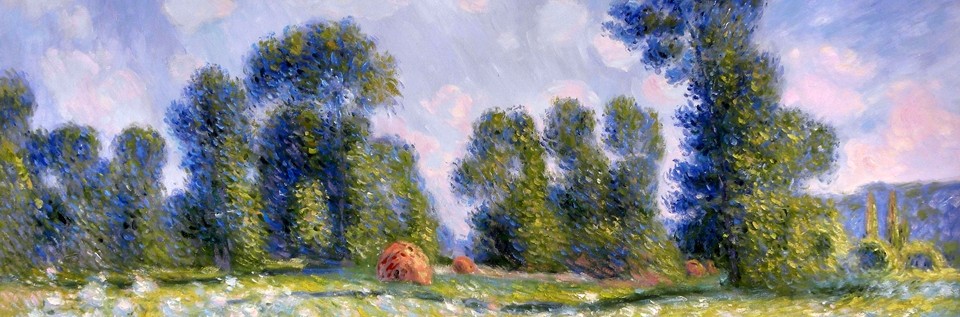
And yet. And yet. Don’t you find that the arrival of Spring can also bring a touch of melancholy? Philip Larkin understood this well when he wrote the poem Trees, which includes the line, “The recent buds relax and spread, their greenness is a kind of grief…” He later asks whether the leaves are “born again” as we ourselves grow old, but then he reminds us that they die too. Music is a perfect medium to convey the feelings of melancholy like this: a feeling of joy and lightness on the surface but lingering feelings of discomfort and sadness lurking beneath.
You might have come across that lovely orchestral piece On Hearing the First Cuckoo in Spring by the English composer Frederick Delius. The optimistic title would suggest a joyous piece imbued with gaiety and sparkle. But no. Delius too understood the melancholy of spring. The music is soft and gentle and seems steeped in a profound sadness. Even when we hear the cuckoo imitation on the clarinet, it’s played in the low register with a sense of lugubrious bleakness. His short and remarkably beautiful orchestral tone-poem Spring Morning conveys a similar wistful feeling.
Spring has been celebrated in European music at least since the sixteenth century and possibly even earlier in English and Italian madrigals. Both Robert Schumann and Benjamin Britten wrote a Spring Symphony and Johann Strauss II acquired fame through his waltz Voices of Spring. Albert Roussel wrote Pour Une Fete De Printemps and Alan Hovhaness gave us O Joy at the Dawning of Spring.
The Russian composer Ippolitov-Ivanov left us his Spring Overture and Roy Harris composed his sprightly Kentucky Spring for orchestra. Of course, there are countless other works inspired by springtime. The most influential 20th century composition on the theme was undoubtedly Stravinsky’s The Rite of Spring written in 1913 for Sergei Diaghilev’s ballet company, Ballets Russes. It caused a sensation at its first performance in Paris and there was a near-riot among of the audience. I first heard the work decades later when I was about fourteen and thought it was one of the most thrilling and captivating pieces of music ever written. I still do.
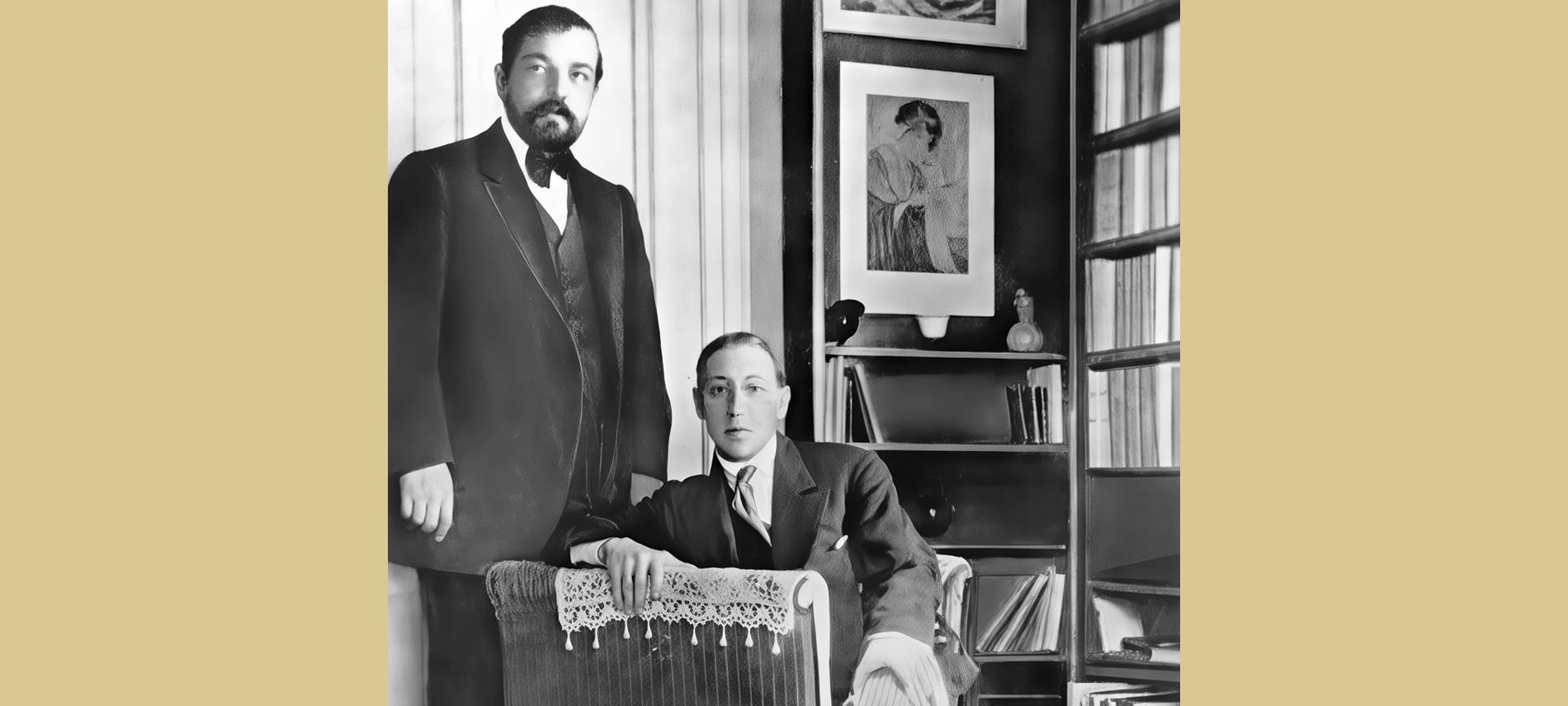
Claude Debussy (1862-1918): Printemps (Suite symphonique). Orchestre National de France cond. Emmanuel Krivine (Duration: 16:06; Video: 1080p HD)
The French word for spring (printemps) derives from Latin primum tempus which means “the first time” or “the first season”. Compared to the brittle and grinding harmonies that characterize Stravinsky’s The Rite of Spring, Debussy’s orchestral essay on the theme seems somewhat genteel. He was among the most influential composers of the late 19th and early 20th centuries but in is younger years was considered “excessively progressive” by the conservatively-minded Fine Arts Academy in Paris.
By today’s standards, the music is entirely approachable and immensely enjoyable. Spring was always a source of inspiration for Debussy and this was a student work, originally sketched out for piano duet. Debussy didn’t get around to getting an orchestral version prepared until 1913 but it’s glorious music, and it bears hallmarks of the composer’s later style with rich post-Wagnerian harmonies and of course, masterful orchestration for which the composer was renowned.
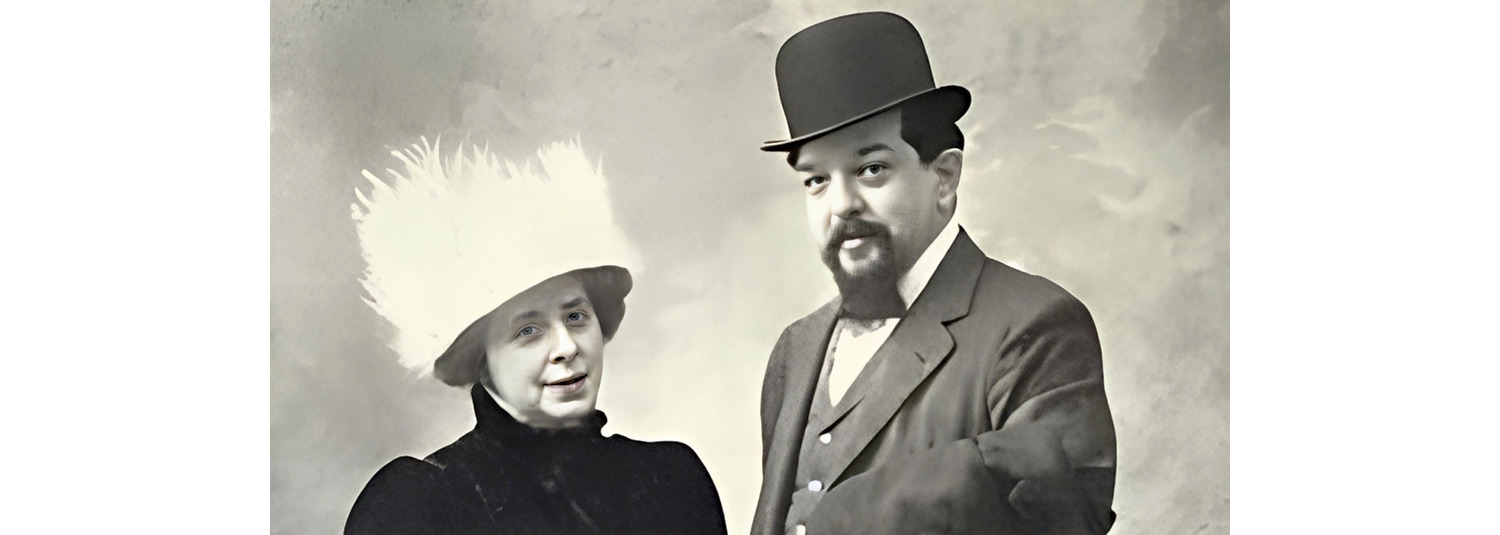
Debussy described the music as representing “the slow, laborious birth of beings and things in nature, and then their blossoming outward and upward, and finally a burst of joy at being reborn to new life.” The music is in two contrasting movements and the second one is full of attractive, infectious melodies.
Li Huanzhi (1919-2000): Spring Festival Overture. Philadelphia Orchestra & Shanghai Philharmonic Orchestra cond. Liang Zhang. (Duration: 05:48; Video: 720p)
The year after Debussy died in Paris, Li Huanzhi was born on the other side of the world in Hong Kong. He was to become one of China’s major composers of the twentieth century who also wrote text books on music and composition. He studied at the National Music College in Shanghai and later went to Yan’an where he studied at the Lu Xun Arts College. After the outbreak of the war of resistance against the Japanese, he composed propaganda songs against Japan. Li Huanzhi wrote over four hundred compositions and was Chairman of the China Musicians’ Association for many years.
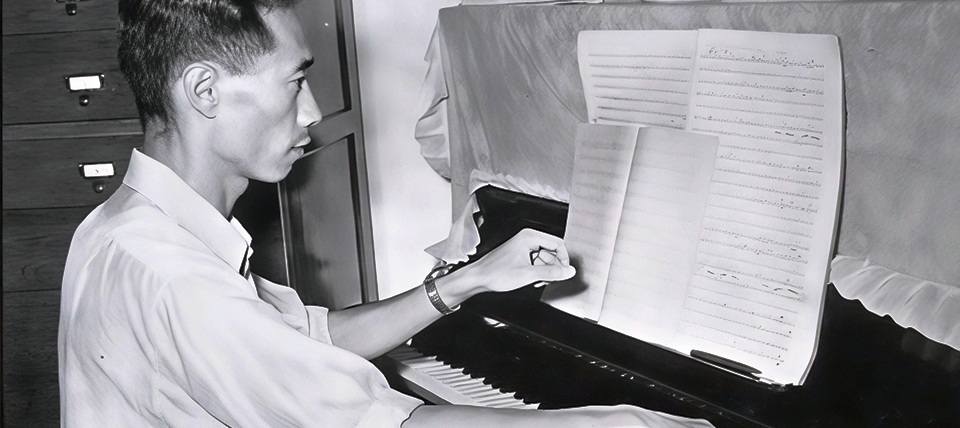
One of his best-known works is the orchestral suite Spring Festival, composed between 1955 and 1956. The main melody is popular in mainland China and appears frequently in school music textbooks and heard at various festive occasions. The best-known movement of the suite is the first one, which over the years detached itself from the rest of the suite and became known as the Spring Festival Overture.
Li Huanzhi’s notion of spring is a rather more boisterous affair than Debussy’s and reflects the high spirits of Chinese New Year. To be more precise, the music depicts the effervescent revelry that surrounds the New Year Spring Festival in the region of Shanbei, which lies in the northern part of China’s Shaanxi province. While it’s written in a kind of plink-plonk pentatonic modern-Chinese style there are some catchy tunes. There’s a lovely lyrical middle section too with pleasing woodwind solos.
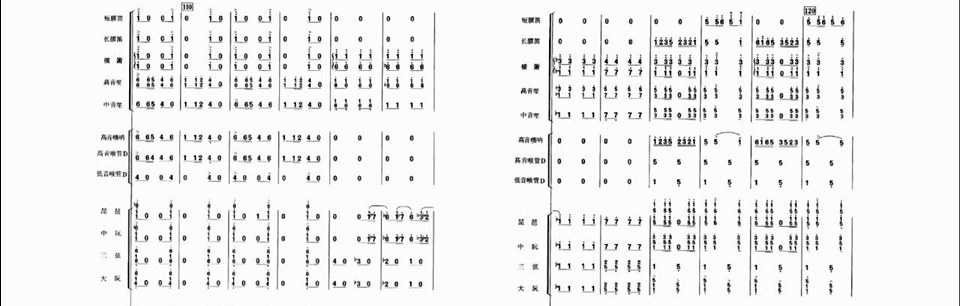
The work is clearly held in high regard in the People’s Republic of China because in 2007, it was selected to be taken into space by China’s first lunar probe which marked China’s first attempt to travel beyond Earth orbit. No doubt to everyone’s relief, the probe finally achieved lunar orbit, and to mark this auspicious occasion, it transmitted a selection of classical Chinese songs as well as Li Huanzhi’s Spring Festival Overture. “To whom?” one wonders. To its credit, the little probe successfully created the first high-resolution three-dimensional map of the entire lunar surface. Named Chang’e after the Chinese Moon goddess, it operated successfully for 494 days, before unceremoniously hurtling into a lunar crater in March 2009.
Li Huanzhi composed an impressive quantity of nationalist music with uplifting titles like March of the Foundation of a New Democratic Country, March of the Youth of New China and the charmingly poetic Socialism is Good. I suspect that the composer either had an acute sense of humour or none at all.