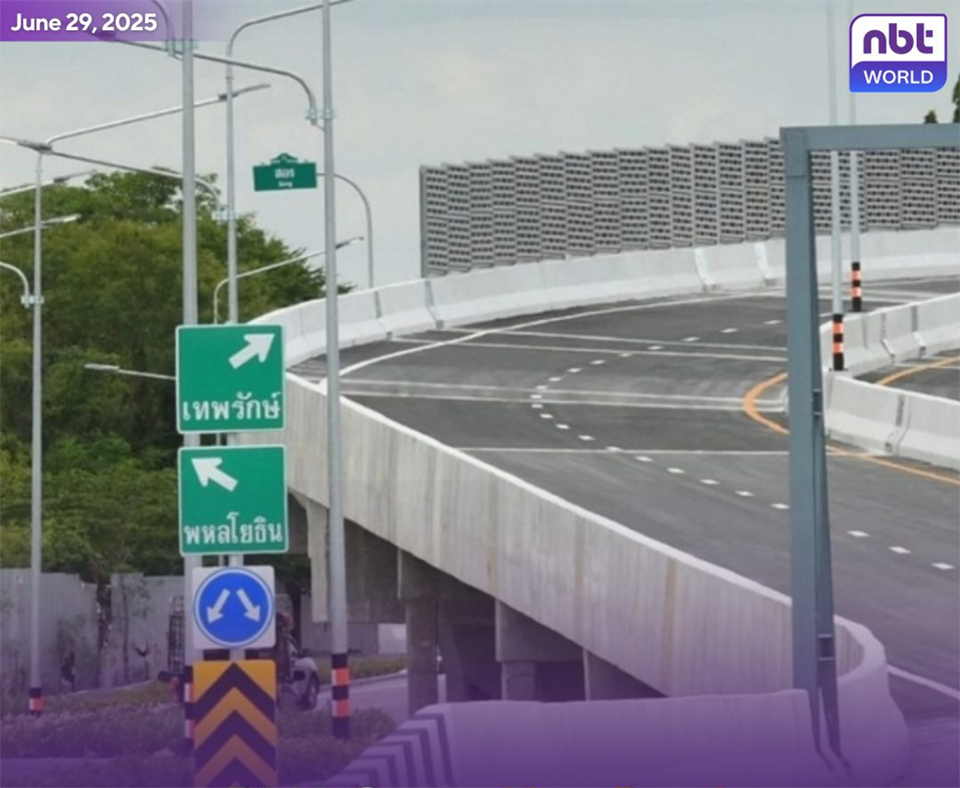
BANGKOK, Thailand – The Bangkok Metropolitan Administration officially opened a new connecting road on June 29, linking Vibhavadi Rangsit Road with Phahonyothin Road, to ease congestion in the Don Mueang area and improve access to Don Mueang Airport. The route provides a direct passage, helping reduce travel times by eliminating the need for looping routes or traffic signal delays, and is expected to improve overall traffic flow across northeastern Bangkok.
The new road begins at Soi Vibhavadi Rangsit 72 and runs through to Phahonyothin Road, continuing to Theparak Road. The new extension connects several major arteries, including Watcharaphon, Ramintra, and Sukhaphiban 5 Roads, and links with key transport infrastructure such as the Uttaraphimuk Elevated Tollway, Chalong Rat Expressway, Motorway Route 9, BTS Green Line, and SRT Red Line.
The surrounding infrastructure has also been upgraded, featuring improved sidewalks, bicycle lanes, new traffic signage, and enhanced landscaping. Trees such as Ratchaphruek, as well as flowering plants such as bougainvillea and oleander, have been planted to enhance the road’s appearance and provide shade.
Construction was divided into two phases. Phase one covers the stretch from Vibhavadi Rangsit to the Lat Phrao Canal Overpass and includes a 1.6-kilometer section with five to six traffic lanes, a four-lane overpass with a parallel bridge, and a one-lane elevated ramp leading directly to Don Mueang Airport. Phase two extends from the canal overpass to Theparak Road, featuring a four-lane elevated road over one kilometer and a 1.2-kilometer ground-level section.
The BMA is also promoting a bike-sharing program to support first-mile and last-mile connectivity. Rental bicycles will be available for use between homes, bus stops, train stations, and the new road, encouraging eco-friendly travel and reducing the use of private vehicles. (NNT)