





















|
GIS Opens New
Foundation Centre
Garden International School celebrated the successful
completion of its Foundation Centre on Friday, 7th September. Parents,
past and present, were welcomed to the centre and given a tour of the new
facilities.
The centre now houses Early Years (2-3 years),
Foundation 1 (3 and 4 years) and Reception (4 and 5 years). Early Years
hours are 8 a.m. to 12 p.m., while Foundation 1 and Reception are 8 a.m.
to 1.15 p.m. A ‘Mums and Toddlers’ group makes use of the Foundation
Centre facilities every Thursday from 10 a.m. - 12 p.m. A warm welcome is
extended to any mums who would like to meet and interact with other mums
and toddlers.
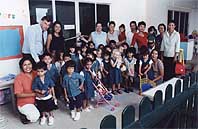 Parents,
staff and children at the ribbon cutting ceremony Parents,
staff and children at the ribbon cutting ceremony
Ruth Grant, Head of Primary, was first to cut the
ribbon on the Early Years gate, declaring it well and truly open. The
Reception doors were officially opened by GIS Principal Ken Sly. The
parents were then invited to a buffet lunch and a discussion with their
child’s teacher regarding the British Foundation Stage.
Jo Steel, Head of Foundation said, “Parents are very
aware these days that the Foundation Stage is a time when their child
begins their journey through learning. How that occurs, and with whom is
so important. The Foundation Stage curriculum is a wonderful document to
work with because it understands how children develop in all aspects of
their lives.”
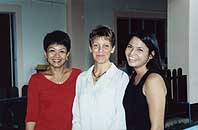 Retno
Cheah, Jo Steel, and Oanh Nguyen - staff of Garden Foundation Centre Retno
Cheah, Jo Steel, and Oanh Nguyen - staff of Garden Foundation Centre
The Garden Foundation Centre (GFC) offers a curriculum
incorporating: personal, social and emotional development, communication,
literacy and language development, mathematical development, creative
development, physical development, and understanding of the world.
The Foundation Centre believes in working in
partnership with parents, as they acknowledge that parents are their
child’s ‘first educators’ and that learning is not limited to the
confines of a school.
The teaching staff at the GFC welcomes visitors at any
time and look forward to seeing you in the near future.
“If you can give the children a love of learning at
this vital stage, then they have a love of learning for life.”
Garden International School is located at 188/24 Moo 4
Pala-Ban Chang Road, Tambol Pala, Amphur Ban Chang, Rayong, 21130, tel.
(038) 880 360, fax (038) 630 735, email: [email protected],
website: www.gisthailand.net
Great news from the
Camillian Center in Rayong
by Helle Rants้n – welfare coordinator of Rayong Ladies Circle
In May this year I wrote an article about the Camillian
Center, which was published in Pattaya Mail. It was to inform the
population in Pattaya and Rayong that the welfare team from the Rayong
Ladies Circle had arranged an open day at the Camillian Center with the
purpose of finding sponsors for the HIV-positive children’s medicine.
When we started the sponsor project the price of
medicine per child per month was 15,000 baht. For lots of reasons, like
being able to buy the medicine cheaper in India, the price for medicine
per child per month is now 6,000 baht.
The response to our plea to find medicine sponsors has
been fantastic. 10-12 members of the Rayong Ladies Circle have said yes to
sponsor with the result being 5 children now have their medicine
sponsored.
But it is not only about collecting money. Some of the
women choose to hand over their sponsor money themselves and at the same
time visit their sponsor child. It gives them a chance to witness the
great change in their child’s life after it has received the medicine.
When the child arrives at the Camillian Center it
cannot run, play, or eat and has all sorts of medical problems, like hair
loss and skin diseases, just to mention a few. But after some months
taking the medicine, having regular meals and receiving love and care from
the staff working at the Camillian Center their lives begin to charge.
They can run, play, eat and be just like ordinary children.
The Camillian Center, with currently 24 children in
their care, still needs medicine sponsors. If any of the readers of the Pattaya
Mail are interested in sponsoring a child’s medicine or want more
information, please contact me: Helle Rants้n – welfare
coordinator of Rayong Ladies Circle, 038 - 88 07 65 or email [email protected]
Moral Support for Thai Youth
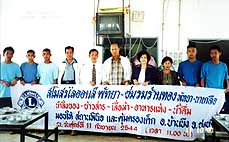 Pattaya
Lions Club president, Somchai Manothaworn, who is also the chairman of the
Pattaya-Naklua Gold Shop Committee, along with Phratumnak Lions Club
member Somsak Nakson and Juvenile and Family Court Associate Judge Sopin
Thappajug, donated B35,000 worth of food supplies to Surakij Angkunrat,
the director of the Chonburi Juvenile Correction Facility. The delegation
also visited with the youth and gave moral support. Currently, 303 young
people are residing at the facility. Pattaya
Lions Club president, Somchai Manothaworn, who is also the chairman of the
Pattaya-Naklua Gold Shop Committee, along with Phratumnak Lions Club
member Somsak Nakson and Juvenile and Family Court Associate Judge Sopin
Thappajug, donated B35,000 worth of food supplies to Surakij Angkunrat,
the director of the Chonburi Juvenile Correction Facility. The delegation
also visited with the youth and gave moral support. Currently, 303 young
people are residing at the facility.
English language training
within schools needs to be improved
As global communication increases, more Thai people are
starting to recognize the need for English. Very few Thai English speakers
have developed their proficiency to a pre-intermediate/intermediate
conversational level without going abroad.
English language training within schools needs to be
improved. The best method would include native speakers who could conduct
exercises, activities, & games with groups of students in English
which would complement the Thai-English teachers’ grammar lessons.
Thai children’s first year of schooling should focus
upon learning how to read and write the language that they have been
exposed to since birth. The Thai language uses 44 letters which have
distinctive sounds. English uses only 26 letters but incorporates over 40
phonetically different sounds, and it also uses capital letters which can
add confusion. Thai children would have a better chance of learning
English if they were given more time to learn and appreciate their own
language before starting to learn another language.
For many teachers and students, it is not clear as to
when the Thai grammar is recognized and taught. The lack of unified
structure for teaching the home language makes it difficult to introduce a
second language.
The majority of English books that are currently used
within schools are European based in format and not always easily
appreciated by Thai children, or taught by Thai teachers because of their
different cultural aspects. The majority of Asians who use English do so
with fellow Asians. English can be taught in such a way as to mediate
cultural differences.
Charts have been compiled with over 750 Thai words that
are used and taught at elementary level and with English translations.
Furthermore, a listening course is being created which focuses upon all
the sounds used in English - not just the 26 letters of the alphabet. This
book will be at least 80 pages in length and include further translations
as well as over 200 illustrations. Native English speaking children are
helping with the cassette recording and a lot of the exercises distinguish
sound differences as well as models for practicing pronunciation. The
majority of the grammar used throughout the exercises has been limited to
an elementary level. Chants and songs have also been included.
The English words on the charts and in the books are
hyphenated so as to show syllables, and the stressed syllables are
underlined. In both languages all the nouns are in black, verbs-red,
adjectives-blue, prepositions-turquoise, determiners-light green,
adverbs-pink, personal pronouns-crimson, and question words-dark green.
Putting these charts upon the walls of classrooms will
greatly assist both teachers and students. In the 1st grade they will
assist the Thai teacher with the Thai language, and give the children
passive exposure to English. Introducing English properly (beginning with
the alphabet and numbers) in the 2nd grade will mean that children have a
comparative base to work from and therefore enable more productive
learning.
Training guidelines have also been developed for
teachers and will definitely benefit those who need to change traditional
teaching styles in order to properly facilitate teaching a second
language. There is strong emphasis on frequent interaction and
conversation. A lot of the games and activities in the guidelines can be
used with 1st grade students with their own language.
A grammar supplement complements this book in which all
examples use the same colour coordination as the charts, and it will
definitely be a strong support for teachers. Training will also be made
available for teachers if they are interested.
It is hoped that someone who recognizes the need for
improvement in language teaching within Elementary schools will provide
assistance. Thai people are required to ensure that the materials that
have been prepared are accurate.
I need your help to make this project successful.
Interested parties who would like to contribute and assist can contact:
Steve Martin, [email protected]
Copyright 2001 Pattaya Mail Publishing Co.Ltd.
370/7-8 Pattaya Second Road, Pattaya City, Chonburi 20260, Thailand
Tel.66-38 411 240-1, 413 240-1, Fax:66-38 427 596; e-mail: [email protected] |
|
