










|
Family Money: The
continued case for offshore funds
By Leslie Wright
Last week we started looking at the benefits of
investing in offshore funds. Assuming you agree that these collective
investment instruments have many advantages over direct investment, the
question then becomes: “Which ones to choose?”
A wide range of choice
In the past 10 years the number of offshore funds has
more than tripled. Nowadays there are well over 14,000 of these funds in
existence, with more being designed and launched almost daily.
While all these collective investment instruments may
be termed “offshore” funds, with the general aim of maximising
investment returns while limiting the amount of risk, the similarities
largely end there.
While there is no shortage of choice for investors, it
is important to understand what any particular fund can and cannot do -
and you cannot always tell just by its name.
Each fund has its own pre-set parameters - what it can
and cannot invest in. As a simple and obvious example, a US equity fund
may not invest in the Japanese stock market; conversely, a Japanese equity
fund may not invest in the US.
A Global Managed fund may, within certain limits,
invest almost anywhere in almost anything. But even then, it typically has
restraints on the amount its managers may invest in any single market or
asset class: how much in equities, how much in bonds, how much (if
anything) in commodities or futures.
These restraints vary widely from one fund to another;
and within these parameters, the fund managers have greater or lesser
degrees of discretion over the individual assets they may acquire for
their particular fund. This latitude will greatly influence both the
relative return and volatility of the fund in question.
The term ‘relative’ is significant because it is
important to compare apples with apples, not oranges. The performance and
volatility of, for example, a European equity fund should be compared
against other European equity funds, not against an Asian equity fund or a
bond fund.
The relative performance within a particular sector is
important as an indicator of management skill in limiting risk as well as
producing the fund’s return. This is especially important when the
market in question suffers a downturn.
The top performer within any given sector last year
will probably not be the top performer over a three or five year period.
This may be because of the restraints and parameters of that particular
fund, or simply that the fund manager got lucky last year.
The question then arises as to whether this will carry
forward to next year. It rarely happens.
Evaluating risk
Similarly, just looking at past performance figures
will not necessarily give a true indication of whether a particular fund
is suitable to your needs or not. It is important to remember that when
constructing your portfolio, you are trying to guess the future. And your
capital may be at risk if you get it wrong.
Thus the first and most important rule in portfolio
construction (or fund selection, if you like) is to evaluate and recognise
how much risk you can accept in relation to your expected return.
Paradoxically, those with limited resources - who should be taking on the
least risk with their capital - are often those who take on the most, to
try to make a quick “killing”. All too often, they succeed only in
killing their chances of building up their capital to a meaningful sum.
If high risk always produced high gains, Las Vegas and
the Hong Kong Jockey Club would have closed down years ago.
Not operating alone
Fund managers don’t operate alone, but typically have
teams of skilled analysts to help them in making their trading decisions -
but sometimes are persuaded to join competitive financial institutions,
taking their whole teams with them. This can of course drastically
influence the future performance of the funds in question.
The size of each offshore fund varies tremendously also
- from less than US$1 million to over $8 billion. For example, George
Soros’ famous (or some would say infamous) Quantum Fund managed out of
New York has over $4.8 billion in assets, while the oldest offshore equity
fund, Robeco, has assets exceeding $7.3 billion.
Size alone does not necessarily equate to success. Some
small funds are highly specialised and highly successful, while others can
become victims of their own success, and grow to the point where they have
simply too much money for their managers to place effectively within the
parameters set for the fund in question. Such a fund can become unwieldy,
and unable to meet its performance expectations.
On the other hand, some aggressive funds may be able to
wield sufficient resources to affect the movement of a whole market. These
latter are often criticized - especially by government commentators and
apologists - for manipulating markets, and are sometimes blamed for
causing market crashes - although in most cases the fund managers were
simply doing their job of identifying market weaknesses and taking
advantage of them to their investors’ benefit. One might well argue that
if the respective governments had equally skilled people managing their
economies or financial institutions, the funds would not be able to
manipulate the markets and have no weakness to exploit. But that’s a
subject for others to debate elsewhere.
Needless to say, most amateur investors do not have the
resources available to them, nor in most cases the time or expertise to
make the judicious investment decisions needed to optimise returns while
limiting risk. The solution for most is a suitable mix of tax-efficient
collective investment instruments which can be acquired inexpensively,
rearranged swiftly as market conditions change, and managed relatively
easily. In other words, a basket of well-chosen offshore funds.
The question that remains, though, is which funds are
likely to do well in the coming three, six, or twelve months... and
that’s where a professional adviser’s help and guidance may be useful.
If you have any comments or queries on this article, or
about other topics concerning investment matters, contact Leslie Wright
directly by fax on (038) 232522 or e-mail [email protected],
or write to him c/o Family Money, Pattaya Mail. Further details and back
articles can be accessed on his firm’s website on www.westminsterthailand.com.
Leslie Wright is Managing Director of Westminster Portfolio Services
(Thailand) Ltd., a firm of independent financial advisors providing advice
to expatriate residents of the Eastern Seaboard on personal financial
planning and international investments.
The Computer Doctor
by Richard Bunch
From James Burke, Pattaya: We
have a computer at home, which the whole family uses. My daughter is now
becoming increasingly interested and I allow her to use the computer, albeit
supervised. I have taught her to use some programs and about the Internet. I
want her to use this as a learning tool rather than entertainment. With this
in mind, I would like to find some interesting sites for her to look at. I
wonder if you can recommend any?
Computer Doctor replies: One site that may be of
particular interest to you is Encyclopaedia Britannica. This is from
the widely respected Britannica people and perhaps of interest to you it is
also free. The site can be found at www.Britannica.com
From Charles Hodgson, Pattaya: A question for the PC
Doctor for his column in Pattaya Mail. What is the procedure to re-direct
mail in web-based Hotmail to an e-mail address that uses POP3? I thank you
for your assistance.
Computer Doctor replies: The good news for you is
that it is now possible using Microsoft Outlook Express 5 to access your
Hotmail account. Once you have configured Outlook Express correctly you will
be able to: Send and receive all of your messages at once. Store Hotmail
messages on your local disk drive. Send messages with different font styles,
sizes and colours using the enhanced composition tools included in Outlook
Express. Use Hotmail offline and on the web, and keep the two views
constantly synchronized.
The procedure is: if you have not already installed
Microsoft Internet Explorer 5 you will need to download it first, otherwise
follow these instructions.
In Outlook Express, select the Tools menu and choose
Accounts. Click Add and choose Mail. Enter your name and click Next. Type in
the e-mail address of your Hotmail account, such as [email protected] and
click Next. Choose “HTTP” from the menu labelled “My incoming mail
server is”. If HTTP is not available as a choice, the version of Outlook
Express you’re using does not support Hotmail accounts. In this case you
will need to upgrade your version of IE5 by downloading from Microsoft’s
web site. If Hotmail is available from the “My HTTP mail service provider
is” menu, choose it. Otherwise, choose Other. Type http://services.msn.com/svcs/hotmail/httpmail.asp
in the incoming mail server field and click Next. Type your Hotmail account
name and password and click Next. Your account name is the first half of
your Hotmail e-mail address. For example, if your e-mail address is [email protected],
your account name would be “charles”. Click Finish. The new account will
be named http://services.msn.com/svcs/hotmail/httpmail.asp. To rename this
account, make sure it is selected in the Internet Accounts window and click
Properties. You will see this name under Mail Accounts. Select it and type a
new name, such as “Hotmail”. Click OK, and then click Close to close the
Internet Accounts window. You will see the newly created account in the
folder list.
Send your questions or comments to the Pattaya Mail at
370/7-8 Pattaya Second Road, Pattaya City, 20260 or Fax to 038 427 596 or
E-mail to [email protected].
Richard Bunch is Managing Director of Action Computer Technologies.
Successfully Yours: Pauline
Dalton
by Mirin MacCarthy
Pauline Dalton, of the infectious laugh and impish nature,
is one of the more go-getting expat ladies in our community. A founder of the
Yes! Shop, she is very well known for her fashion parades in Pattaya.
A “tomboy” originally from the UK, she is a world
traveller with many an interesting time between falling out of trees in
Cheshire as a young girl to falling into dress shops in the Royal Garden
Plaza!
As the middle child in a family of three, Pauline grew up
in the countryside where her father was a farm worker. In those days, Mums
stayed at home to look after the family, but Pauline’s also found the time
to be a skilled dressmaker. But it was no lace and gingham for Pauline, “It
was shorts and no frocks for me,” she said, chuckling away to herself
recalling the childhood memories of roller skating, and climbing hay bales.
Following school she took on secretarial positions.
Marrying early to an accountant in the oil industry took her away from the UK
to the new sights and smells of Kuwait, Saudi Arabia and Cameroon.
The life was exciting, but the marriage wasn’t. Pauline
and her husband thought it was the expat life that was making them drift
apart, so they returned to the UK to meet the awful truth that it was the
marriage that was wrong - not the overseas tours of duty! “Anyway, he was
much too organised for me,” said the blithe, free spirited Pauline.
It was back to UK secretarial life, but quickly she got
bored. “I sold my Mini and my windsurfer and went to Europe!” There she
fiddled around through Spain, France and Italy, living the life of the rich
and famous until the money ran out, also quickly.
Loving the life, but not the penury, she took a job
delivering cars and trucks from Munich to other European countries. This at
least kept her in Europe, but after having her passport and money stolen on
several occasions, she decided to retreat to the safety of England.
Landing a job in sales she wrote out contracts for two
years till she met Peter, a petro-chemical engineer. Following a whirlwind
romance, they were married in ten weeks and overseas, settled in Greece within
six months.
The dust had hardly settled on their whitewashed Greek
residence when Peter was offered a job in Thailand, which he accepted, and
they have now been here for ten years.
 The first three years were in Bangkok. She worked in
welfare for the British Women’s Group, started a badminton club and
generally enjoyed her time there, but towards the end, life in the capital
began to pall. So where next? “I met some Pattaya people who seemed to be
having a much better time than me.” The first three years were in Bangkok. She worked in
welfare for the British Women’s Group, started a badminton club and
generally enjoyed her time there, but towards the end, life in the capital
began to pall. So where next? “I met some Pattaya people who seemed to be
having a much better time than me.”
Fortunately, with Peter’s contract, it was possible for
them to easily relocate, and they have settled here, building their own house.
She has “no plans to move anywhere else.”
Initially she went to work in real estate, but found that a
very stressful occupation. It was then that her flair for clothes and artistic
design came out, perhaps even a throwback to her mother’s dressmaking
skills, Pauline muses. On a holiday to Bali she purchased a load of shoes and
ladies waistcoats and offered them for sale on her return to Pattaya. The
entire shipment was sold out in two hours. “I figured I was on to
something!”
She certainly was. That “something” eventually turned
into the very successful Yes! Shop which Pauline runs with her Pattaya
International Ladies Club (PILC) associate, Arlette Cykman. Where did she get
the name for the shop? “From watching people trying on clothes. All of a
sudden you can see them say, Yes!”
Yes! Shop is now in the Royal Garden Plaza and she finds it
gives her something positive to do every day. In case she gets bored again,
she is also arranging a fashion show which will be held on November 13th,
using the ladies of the PILC as the models.
Pauline’s personal ambitions are simple - “A healthy,
happy life. Health is the most important thing and I try to achieve that on a
daily basis.” Towards that aim, she goes to the fitness club every day.
She has no regrets not having a family. “I have never
wanted children. I have Jake the dog and two cats.”
The vivacious Pauline says she has had a certain amount of luck, coming
here. “So much more is possible in Pattaya. It has given me such an
opportunity.” However, opportunity alone is not enough to guarantee success.
There is a certain degree of skill, talent and expertise that has to be
applied as well. Pauline Dalton has shown that she has all three elements.
Yes! Yes! Yes!
Snap Shots: The
camera never lies!
by Harry Flashman
If that were only true. The camera always lies, so here’s a
few photographic tricks to try this weekend. Take a look at the photo this week.
This is one taken a couple of years (or so) back, but it still creates interest
whenever it is brought out. The reason it immediately arouses curiosity is
because the model is apparently ripping her own blouse open - to reveal a
scorpion underneath!
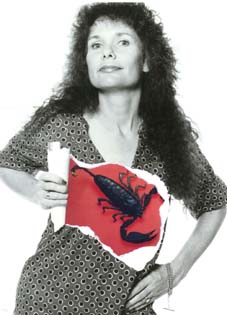
Unfortunately, in the black and white rendition in newsprint
you cannot see this extra item, but the model was photographed in Black and
White, but the scorpion is photographed in colour on a red background. The end
result is a photograph with more than one intriguing questions attached to it.
So how was it done? Fairly simply, actually, and if you
follow Harry here, you can produce a similar one yourself. This photograph is
actually made in five stages. The first is obviously to photograph the model. In
the case of this photograph, it was done on Black and White film, but you can
use ordinary colour print just as easily. Make a roll of roughly torn paper,
around 300 mm wide, like the one in Harry’s print and get your model to hold
it in her hand. Take a few shots of this, with the hand held roll in slightly
different positions. Get this film developed and printed.
Now you select the best print and get two enlargements done.
Suggest that 10x8 is the best, and easiest to work with. Why two prints? Just in
case you make a mistake!
Step 2 is to, with care (and a sharp scalpel), cut along the
right side of the roll and then tear the actual print itself going across
towards the right side of the photograph. Try to tear it so that you can get a
broad, “feathered” edge. This is really the only tricky bit in the entire
process, getting the authentic looking torn edges. Harry took a couple of
attempts to get it right, so now you can see why the two enlargements were done.
The third step is to select a shot to place under the torn
out section of the 10x8 of your model. In this instance it was a scorpion, but
you can let your imagination run riot. You could even have a drawing of a
skeleton under it. The choice is limitless and is yours. Now arrange the two
prints to your visual satisfaction and tape the lower one in place. You are now
almost finished.
Step 4 is to take the assembled artwork outside, into the
bright shade (you do not want direct sun on it) and photograph it. If you have a
Macro setting, then this is the time to use it. If not, just get as close as you
can, keeping the camera parallel (square on) to the print. This stops
distortions occurring. If possible, make the print fill the viewfinder frame as
well. It makes the production of the final print easier.
Finally, step 5 is to process the film and get your
enlargement done. I would recommend that this shot is definitely worth ending up
as 10x8 and hanging on the wall. Then just wait for the people asking, “How
did you do it?”
More on Photo Processing
Good news for those who shop in Royal Garden Plaza. The Kodak outlet on Beach
Road next to McDonalds has changed its mind and has renewed its lease. The
pleasant staff all came back too. So you now have a choice - Beach Road or
“Easy Express”, on Pattaya Second Road, close to Golden Beach Hotel. Both
places do excellent work. Tell ‘em the Pattaya Mail’s Harry Flashman sent
you!
Modern Medicine: Gender
Benders
by Dr Iain Corness
In Pattaya we have a couple of very famous “gender
bender” shows, with “women” who were born as males, performing in
lavish productions. Some of these performers are so exaggeratedly female
in their anatomical superstructure as to be almost travesties, rather than
the commonly used term, “transvestites”.
However, it is very easy to get confused in the gender
stakes, so in an attempt to set the records straight, let us look at the
different situations that abound.
The first thing to do in any field such as this is to
define our terms. “Sex” is used to describe the genetic state, while
“Gender” is taken to represent how one thinks of one’s self.
There are three main groups that appear to get
confused. The first is people who are Hermaphrodites. These unfortunate
folk have a genetic problem and can end up with both male and female
organs. Both sets of organs can produce hormones, so you can have a person
who appears female, but is a man as well. With some Hermaphrodites, their
gender may correspond with their predominant sex, so they may live their
lives unaware of their duality.
The next group to understand is the Transvestites.
These people will wear the clothing of the opposite sex, but are not
convinced that their gender is the same as the clothes they wear. This is
sometimes called “cross dressing”. These people also do not wish to
alter the physical shape of their bodies as they do not have the
conviction of their apparent gender. Confused? Don’t worry, many of them
are too!
The last group are the Transsexuals. These people do
have the conviction that their gender is the opposite from their sex.
Transsexuals will dress as the opposite sex just to be more comfortable in
expressing themselves in their preferred gender.
For these people, males as well as female transsexuals
(generally taken as 4:1), they are often condemned to live their lives
locked in a body of one sex, while feeling all the time that they were
given the “wrong” body. For a true transsexual, the inappropriateness
is generally felt from around the age of three years.
It is this group who will submit to surgery to attempt
to get their sex to correspond with their gender, and sex reassignment
surgery is now quite common. However, this is not a recent phenomenon and
the first recorded sex change was done in 1931 when a Danish artist Einer
Wagenar became Lili Elbe. In 1951, the British public were shocked when ex
R.A.F. pilot and racing driver Robert Cowell became Roberta after similar
surgery. However, in 1953, the most publicised case was ex-G.I. George
Jorgensen who became Christine. Her doctor received 465 requests for sex
change following this case.
Gender confusions are not something new. There are many
famous cases in history such as the Assyrian ruler Assirbanipal who was a
cross dresser in the 7th century BC. Transsexualism was known in ancient
Rome, and even Julius Caesar did a little cross dressing himself. Or what
about the Englishwoman who became Pope John the 8th in 855? Joan of Arc
has had much publicity, as has Dr. James Barry, the Inspector-General of
Army Hospitals in the Crimean whose true sex was only discovered after
death.
Perhaps those of us without gender recognition problems
should be thankful that we do not have to make sacrifices, just to live
happily with our own bodies.
 Dear
Hillary, Dear
Hillary,
You seem to be getting a lot of “food” questions
recently, so perhaps you can answer this one for me. I have seen people
eating what looks like an egg “parcel” with meat inside it. What is
it? And would it be too spicy for someone like me who is a little afraid
of spicy food?
Spicy Sue
Dear Sue,
I am sure you are referring to a Thai Omelette, called
“Kai Yat Sai”. Generally it is pork based, but you can get chicken as
well - ask for “Kai Yat Sai Gai”. It comes with a little bowl of red
ketchup - but beware, it is chili, not tomato! Around 50 Baht at most food
carts. Enjoy!
Dear Hillary,
I notice that you have published letters to your good
self which have occasionally been uncomplimentary. Firstly, let me say
that I think you are a brave lady to do this, but secondly, why would
people write in just to be rude or complain? Surely they are the sick
ones, not you?
Jack
Dear Jack,
You said it. Hillary couldn’t say it any better
without getting bitchy.
Dear Hillary,
I have started to use the street corner motorcycle
taxis recently and have two questions. Is it safe to use them? How much
should I pay for shortish trips? I have found them very handy and they
will drop me exactly where I want (especially off the Baht Bus routes),
but I am a little concerned about the correct fare.
Minnie Mouse
Dear Minnie,
Never mind the correct fare, worry about your life.
Taxi bikes are the most suicidal form of transport in Thailand! However,
if you have heavy accident and medical insurance plus a decent crash
helmet and brave pills, go for it. The local drinkers tell me it doesn’t
hurt so much if you are tanked when you fall off! A short trip around
downtown Pattaya should cost around 40 Baht, but the fare must be
bargained and agreed to before you get on. Wear a good helmet. As the old
saying goes, “If you’ve got a $10 head, wear a $10 helmet.”
Dear Hillary,
We live in Jomtien and often go to the beach there as
it seems to be very popular with the Thais, as we see them swimming there
a lot. Why do the Thai people wear clothes when they go into the sea?
Sometimes it looks like shipwreck survivors from the Titanic. Some Thais
wear bikinis, but they are in the minority. I even see them going in
wearing jeans! Why, Hillary please tell us.
Ian
Dear Ian,
There a two reasons to this hilarious puzzle. 1. No
Thai ever wants to become sunburned or darker in skin tone, as they all
equate light skin with beauty. They all believe the most beautiful Thai
girls come from Chiang Mai as they are so light skinned! Isn’t it a
crazy world? Most farangs want to become tanned and most Asians want to
become white. Nobody is ever satisfied! 2. The second reason is for
modesty, jing, jing! No proper decent Thai woman will ever display their
bodies in public. It is absolutely antiethical to Buddhist philosophy and
Thai societal values. Believe me, the bar-girls and boys have to make a
lot of merit to atone for their displays. Thai girls are born in bras!
Dear Hillary,
Why do the shops open so late in Pattaya? The main
shopping centres officially open at 11, but many of the shops are still
setting up at 11.30. I am sure they must lose an awful lot of business
with this late opening. Can’t the shopkeepers get out of bed in time?
I’m intrigued.
Dear Intrigued,
That’s the way Thailand is! (T.I.T. This is
Thailand!) It works just fine for night owls and late night shoppers, but
I must admit it is infuriating when Hillary wants to go out to get a
hang-over cure at 8 a.m. in the morning!
Dear Hillary,
When I walk down to the end of the street, many of my
neighbours say to me “Buy nai” (or that’s what it sounds like).
Since I don’t speak much Thai I get embarrassed and just nod and keep
walking. I thought “Sawasdee” was “Good Morning”, so what are they
saying? Am I being rude by just nodding? I don’t want to look like a
snobby farang.
John
Dear John,
They are saying, “Where are you going?” The acceptable reply is
“Bai teeo”, which literally means “I am going to have fun.” Having
fun is important in Thailand. The expression “Bai nai” is just a
greeting like the saying in English, “How are you?” To which the
acceptable reply is “I am very well thank you.” It is not the done
thing old chap to reply with a list of ailments. Same with “Bai nai”,
it is just a greeting and not really an enquiry as to your destination.
You can always cover any embarrassment anywhere in Thailand with a smile.
The Thais do it all the time, it works.
GRAPEVINE
Sad ending
Frenchwoman Claire Maupassant, 61, is
disappointed after asking an unregistered Pattaya lawyer to check out
her dear sister’s sudden death in the city last November. Madame
Maupassant explained she had come to Pattaya to try to solve the
mystery for her own peace of mind and had turned to the legal
profession as a last resort. After parting with 20,000 baht, she did
receive a phone call after five weeks. “So far as we know,”
announced the lawyer, “your sister is still dead.”
Unwanted cash
Rural Cambodian bandits staged a daring
robbery in broad daylight this week. They attacked foolhardy Hungarian
tourist Ferenc Salazy as he lay sleeping in his makeshift hammock near
the border crossing at Sa Kaew. Ferenc explained he had tried to put
up a fight but one of the robbers trod on his glasses before escaping
with several large Hungarian banknotes, four Bulgarian coins and his
father’s war medal. Several hours later, the bandits returned and
asked him if he knew where they could change the money.
Under new management
The Greenway driving range, on Sukhumvit
Highway, reopened earlier this month. Golfing enthusiasts say it is
worth a visit. The range has been substantially refurbished and the
restaurant upgraded. There are teaching pros on site and a nine hole
mini golf course to check if you have learned anything. Most times,
you can even get your car washed and for free.
Thai carriers cleared
It is welcome news that Thai Airways and
Bangkok Airways have been declared Y2K problem free after a test
flight in which computers were rolled forward to the new millennium.
But one wonders about the situation in a neighboring country where a
businessman phoned the national carrier to ask what they were doing
about the year 2000 bug. “Don’t worry,” said the lady on the
line, “We will continue spraying the aircraft to kill all
insects.”
Best buys
Fawlty Towers on Soi Seven has a variety of
hot soups on offer at a very fair 30 baht… Lotus Superstore has big
boxes of wooden golfing tees in the sports area for 75 baht and their
cartons of cigarettes are cheaper than most of their competitors…
Friendship Supermarket has stocked up again on its wide variety of
chocolate bars selling at 10 baht… Sportsman Restaurant in Soi
Yodsak offers a satisfying portion of fish and chips on Mondays after
15.00 hours for 89 baht. |
Legal eagle
Reader TG asks whether it is Thai law that
farangs deported after serving their sentence must be returned to
their home country. Not in every case. Deportees, who must pay for
their own air fare, are commonly sent to the country on their
passport, particularly if the crime is serious (drugs, child sex,
etc.) or if Interpol is involved or if the person’s embassy requests
it. More minor offences such as visa overstay can result in a local
deportation, say to Penang. However, the police evidence is that this
option is less commonly available than a few years ago.
Horror movie
Sick wierdo and far right leaning farang
Werner A. Best, from Vienna, got his come uppance when he bought an
under the counter video in Central Pattaya entitled “Three On A
Meathook”. Rushing home, he eagerly placed the video in his machine
only to discover it contained five instructional lessons for trainee
butchers and shop assistants wanting to assist their customers to buy
the choicest cuts.
Merman frolics
A successful class of Pattaya divers had a
graduation ceremony on Saturday which certainly caused a splash. All
the students in their diving gear received their diplomas 26 feet
underwater in a calm sea off Rayong. But the splendid idea was not
without its critics. Russian swimmer and entrepreneur Boris Vlasov
said he was disappointed not to be able to wear the impressive black
cap and gown he had specially ordered from Classic Tailors.
Stupid sayings
The lift is being fixed for the next day.
During that time we regret you will be unbearable. (Sign in
Bucharest hotel)
Government to concentrate on exterminating school
sex, organized violence next year. (Headline in Korea Times)
Rare, out of print and non existent books are here.
(Pattaya store)
A zebra cannot change its spots. (Al Gore) |
Dining Out: Kaburi -
The Hitchhikers Guide to Japanese Cuisine?
by Miss Terry Diner
The eagle eyed readers will have noticed that the first floor
Benihana Restaurant in the Royal Garden Plaza has expanded. This new food outlet
is called the Kabuki Sushi Bar, modelled after the very popular Sushi bars in
Japan (and incidentally, world wide these days).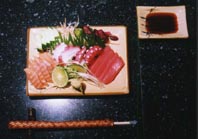
To say it is just a Sushi shop is incorrect as the menu has
additional items from the Sashimi, Tempura and Teriyaki categories. There are
also soups (50 - 80 Baht), appetizers (70 - 90 Baht), rolls, noodles and rice
dishes. Another section in the place mat menu is for what are called the Kabuki
Special Sets (150 - 220 Baht) which include soup, pickles, steamed rice and a
dish such as Tempura combo, Teriyaki chicken, beef or steamed salmon. There is
even a small illustration on how to eat Sushi. A most informative and
comprehensive place mat!
The concept of the Sushi bars is to provide eateries for
convivial dining. These are places to go to sit and chat with friends while
nibbling and noshing on several dishes. Kabuki is certainly built for that
purpose and we sat around the refrigerated bar and watched as the skilled cooks
prepared our food. We were fortunate to have the Royal Garden Resort Resident
Manager Bjorn Richardson with us who could also assist with choosing the items
and some background information.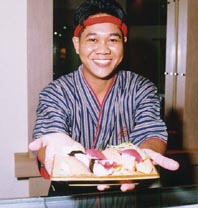
Bjorn’s first tip was on how to differentiate between Sushi
and Sashimi. Easy! The Sushi items come wrapped around vinegar rice, while
Sashimi has no rice. Our first dishes were a selection of seafood items that
included fine slices of salmon, tuna and octopus. With the dish comes a small
pat of a green mustard. This is made from Wasabee root and is hot. Use sparingly
with each Sushi mouthful and dip the selected piece into the Soya sauce supplied
and pop in the mouth. Mmmm - delightful!
We next tried the Miso soup. This came in a beautiful lacquer
ware container and is a bean paste soup with bean curd. In traditional style,
you drink your soup directly from the bowl, so do not look for a spoon! This was
actually a very pleasant and different dish.
Another of the dishes we tried came from the Kabuki Special
Sets and comes under the name of Ton Kutsu. This was deep fried, breaded pork
and is similar to the Chinese Sui Yuk.
Our next foray into the Japanese cuisine was a seafood
Tempura. This was a deep fried battered assorted seafood item which is eaten
with a sauce you make yourself from Soya and grated turnip and ginger which
comes on the Tempura plate. Once again a flavoursome and different taste.
The next item was my pick of the evening. A Teriyaki beef,
with bite sized pieces of very, very tender beef. Real melt in the mouth meat.
Mention should be made of the mayonnaise that comes with many
of the dishes. This is a special form, with a very nice “tang” to it. Do try
it!
We finished with a Negi Maki, sometimes called a Californian
Roll, which is rolled up rice with beef, spring onion and Teriyaki. Again, you
use the chopsticks and dip into the sauce every time.
By the way, there is a full wine and beverage list, including
that often hard to get item, Singha Gold beer!
It certainly was a very relaxed and conversational way to dine and the Dining
Out Team could see just why the Sushi Bar concept is so popular. Kabuki is open
for lunch between 12 and 2 and again for dinner from 5.30 through till 10. Get a
convivial crowd together and enjoy a different cuisine and eating style. Don’t
worry if you are a novice with Japanese food - the place mat tells you what to
do!
Animal Crackers: An
Aussie garden - a reader’s story
by Mirin MacCarthy
Happiness was an old drainpipe, upended, with a large
earthenware saucer on top. We stood it in our garden and filled it with
water. It provided happiness as well as a life sustaining need for the
flying folk who shared that garden in the hot Queensland climate.
This feathered community, like any other, had its share
of eccentrics. There was Calamity the lorikeet, who never seemed to master
flight. At bath time she would come wobbling out of the trees shrieking a
warning to those below before she fell flat on somebody, temporarily
submerging them. There was never any retaliation; however, it seemed to be
generally accepted that Calamity flew by a different airline.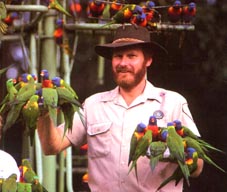
The Romans had their Bacchanalia, we Scots have our
Hogmanay, and when the red Callistemon trees were in bloom, the lorikeets
enjoyed what seemed to be a combination of both. Judging by their
daredevil antics and kamikaze flying it must have been heady stuff in
those crimson flowers.
Late in the day the lorikeets would plunge, sated and
sticky, into the bath by the dozen. Drunk as Lords they screeched and
caroused, until at last nectar sated and waterlogged they would leave,
flying lumbering to the nearest fence, anything higher being quite beyond
reach. There they would preen off and cope with a seemingly giant
hangover.
Great forbearance was shown on these occasions by the
rest of the feathered world, who waited patiently until the seasonal
carousal was over. Even the aggressively territorial butcherbirds showed
commendable restraint during these festivities. I suppose, who wants to be
mobbed by a dozen drunken lorikeets?
It was at one such spree that we met Mad Mac. Bathtime
over and seeing my husband mowing the lawn on his ride on mower, he made
his unsteady way to Alan’s wide brimmed straw hat. Then, after a
frenzied sort of reel around the brim, he clambered into the indentation
in the crown and settled down to sleep it off, impervious to mower noise,
petrol fumes, pipe tobacco smoke and humans.
Seeking a different sort of relaxation I frequently
turned off the television and watched the birdbath instead. In that scene
was all the drama and humour I could ever hope for, and the absence of
violence made it well nigh perfect. We humans perhaps have a great deal
yet to learn.
Ella, Banffshire, Scotland.
Please send in your short animal stories or queries and when possible I
will print and credit them in this column. Contact me at animal [email protected]
or fax 427 596.
Auto Mania:
Factory Power!
by Dr. Iain Corness
We are seeing a resurgence in the major
manufacturers’ interest in motor sport. The factories are realising that
you have to be in it to win it, so to speak. Ford, Peugeot, Renault (Supertec),
Honda, Ferrari, and Mercedes (Ilmor) are already there. Next year we will
see BMW enter the fray and the following year should see Toyota as well.
Vast sums of money are being spent on the design of these race engines and
even more vast sums on their production. Ford and Ferrari are the only
current teams to run their own engines (Honda were to run their own cars
and engines, but shelved the programme after the death of designer Harvey
Postlethwaite), while the other entrants have to either buy (or lease)
their engines or form an association with an engine supplier. McLaren did
just that with Mercedes, while next year Williams and BMW team up.
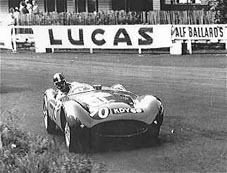 Autotrivia
Quiz: Who is the driver of this Elva Climax Mk II (circa 1956)? Autotrivia
Quiz: Who is the driver of this Elva Climax Mk II (circa 1956)?
BeeEmm are of course no strangers to motor sport,
having been right to the top on more than one occasion (last time 1987).
For the group to return to the top echelon of F1 in conjunction with Sir
Frank Williams means much more than half-hearted commitment. BMW are
obviously meaning business.
There is already a GP Williams running round in BeeEmm
livery (see photo) but whether this will be the new millennium colour
scheme I do not know. This particular chassis is a ’98 Williams,
modified to be a mobile test bed for the 2000 season BMW engine. It is
also interesting to note that next year’s cars will be called BMW
WilliamsF1. The Germans are serious about this foray and with Ralf
Schumacher now on a $25,000,000 contract over three years they have a
stable chassis and an up and coming German driver combination. Do not be
surprised to see Williams on top again. They have done it before and the
Munich masters would like to see it again. BMW are not saying that they
will be all-conquering in the 2000 season, but by 2001 expect to see
Beemers on the front row again.
Elle va!
I was reminded of a famous name in motor sport by
Hawaii Pete the other day. That was Frank Nichols, the “father” of the
Elva marque. Elvas were interesting little cars and the road going
versions were very popular.
The Elva production began with Frank Nichols modifying
his own race car in 1954, fitting an OHV conversion to the flat head
British Ford engine of the day. This modification was a collaboration with
Harry Weslake, the same Weslake who went on to become one of the most
famous designers of motor sport engines.
Nichols found that the public not only wanted the OHV
engine, but copies of his car as well. These new cars he decided to call
Elva’s, coming from the French “Elle va” or “she goes”.
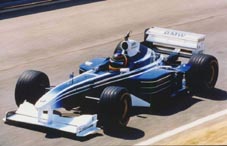 BMW
WilliamsF1 - this one with a ’98 Williams chassis, modified to be a
movile test bed for the 2000 season BMW engine. BMW
WilliamsF1 - this one with a ’98 Williams chassis, modified to be a
movile test bed for the 2000 season BMW engine.
By 1957 he decided that he should try his hand at road
cars and produced the Elva Courier. This car had a fibreglass body over a
tubular steel chassis with double wishbone front end and a live rear axle
taken from the Riley 1500 (BMC Series B). The MGA 1500 was the usual
engine, though they were replaced by the MGA 1600 unit later (and even the
1800 MGB much later). The motor was set well back into the firewall, and a
50/50 weight distribution was claimed. Stiffly sprung, easy to maintain
and cheap, these cars soon became the weekend racers’ favourite. Today
it is exceedingly difficult to find an early Elva Courier that has not
been on racing bitumen.
Unfortunately, the American importer went bust, leaving
Nichols with a shipment that was not paid for. This in turn brought
Nichols undone and Elva were the recipient of a take-over by the Trojan
group. Trojan continued with production of the Elva Courier but by 1965
they let the production out under license. Sporadic cars were made, but
the Courier line died in 1969.
Nichols himself had continued to build several
interesting racing Elvas, many of which are avidly collected by historic
racers throughout the world. If you trip over an old Elva in a shed - grab
it. It will be worth it!
Autotrivia Quiz
Last week’s question related to the gull wing coupe
featured with a lovely pic to go with it. I am indebted to Nic Demet for
this, and the car was a special coach-builders version of a Benz. Called
the Carat by Duchatelet, this was built, or should I say heavily modified,
by Carrosserie Duchatelet in Liege in Belgium. Now wasn’t that some
excellent trivia?
So now to this week’s quiz question. Study the second
photo this week. It is an Elva Climax Mk II, racing in 1956. Powered by
the venerable Climax Fire Pump engine, this was a very successful car. Who
was the driver? The first correct answer in to [email protected]
or fax to 497 596 wins the FREE beer. (Hint - he would not pass the
medical examinations drivers have to pass today and he died in 1958.)
BMW Thailand
Having mentioned BMW above in the F1 race engines, it
might be time to look at the developments on the local scene. The Thailand
arm of BMW celebrated its first complete year of operation, trading as
Bayerische Motoren Werke (Thailand), after taking over the responsibility
for manufacture and marketing of the marque.
BMW claim renewed confidence in their cars, citing
doubling their sales figures compared with the 1998 levels. Since January
this year, BeeEmm has also grabbed the number one slot in the
“luxury/performance” segment grabbing a 38% market share. Central
warehousing with on-line computerised ordering has smartened up the spare
parts delivery, and pricing structures have been stabilised for the entire
country.
With the new factory coming along at the Amata Industrial Estate, BMW
will be a real market force leader in this country, mark my words. They
are trying very hard, their PR and Marketing Departments are excellent and
the end products are good. Do not underestimate these people. Are you
listening, Ford, GM, VW? You should!
Fitness Tips:
Lying to yourself as a cause of weight gain!
by David Garred,
Club Manager Dusit Resort Sports Club
G’day Pattaya,
Yep, strong words I know, but from time to time a
little shock factor can really produce results.
You may deny it, but it could explain your problem in
moving that excess weight.
Most overweight people claim, both to themselves and to
others, that they don’t eat very much. If that were true, it is a
mystery why they have put on so much weight.
In the past, food diaries were used to estimate just
how much people were eating. Come the early 1990s, the effectiveness of
this system was questioned. Using radioactive labelling techniques, which
accurately measure how much a person eats, it was found that there was no
correlation between what people say they eat and what they actually do
eat.
For example, the average woman has been shown to
underestimate food intake by up to 30%. The average obese woman will
underestimate food intake by up to 75%.
This phenomenon is known as the ‘eye mouth gap’. It
suggests that the eye doesn’t see (or want to see) what is going into
the mouth. Having identified this, the association between eating and body
fatness has become much clearer. Denial, as a psychological coping system,
rears its ugly head even when we are eating. It seems that you can’t
even believe yourself these days!
The ‘foot brain gap’
The ‘foot brain gap’ - purely a theory but one that
considers exercise is the other side of the energy balance. Typically,
it’s known that exercise is less effective than food restriction, in the
short term that is, on weight loss. This is because it’s always easier
to reduce food intake by 1000kcals per day than it is to increase activity
by the same amount (this would mean walking - at stroll speed, without
stopping, about 12-14kms extra per day).
In some cases this has lead experts to claim that
‘exercise is not effective in weight loss for the obese’. Yet exercise
(or more precisely, ‘movement’) burns energy - fact. If this energy is
then not replaced by extra food intake, it must result in fat loss.
With this being the case, why does so much research
indicate that this does not happen?
As with the ‘eye mouth gap’, there is now a
suggestion amongst researchers of a similar deception with exercise, which
might appropriately be called the ‘foot brain gap’. Overestimating of
energy expenditure is not unexpected with overweight people. The more
overweight they become, the more ‘efficient’ they get in reducing
energy burnt, because even small amounts of movement become uncomfortable.
This would then translate to feeling as if they were being active. Hence
when asked, they would be likely to say that they do more than they
actually do.
Some estimates suggest that activity is overestimated
by as much as 30% by some overweight people. So when it comes to thinking
that exercise provides no weight loss advantages based on the reported
amount carried out, it may also be worth remembering the ‘foot brain
gap’ and not believe everything you hear.
Take home message: Beware of the ‘eye mouth’ and
the ‘foot brain’ gap in estimating factors involved in weight gain.
Carpe diem
Copyright 1999 Pattaya Mail Publishing Co.Ltd.
370/7-8 Pattaya Second Road, Pattaya City, Chonburi 20260, Thailand
Tel.66-38 411 240-1, 413 240-1, Fax:66-38 427 596; e-mail: [email protected]
Updated by Boonsiri Suansuk. |
|