





 



|
Family Money: Land of the Free?
By Leslie Wright
Investing outside the US is not easy for Americans because of
restrictions imposed by the Securities Exchange Commission (SEC) and the Internal Revenue
Service (IRS).
These two agencies create challenges for individuals who seek offshore
alternatives by regulating investment and imposing broad tax liability on all citizens.
The SEC has severely limited the ability of Americans to purchase
securities outside the US. This was accomplished by the Securities Act of 1933 and the
Securities Exchange Act of 1934.
The 1933 Act is meant to compel full disclosure in public offerings and
prevent fraud in connection with the original issuance of securities, while the 1934 Act
is intended to ensure a fair and honest market for the trading of securities once in the
market.
Section 5 of the 1933 Act requires that, unless there is an exemption,
all offers or sales of securities in the US must be registered with the SEC. The 1934 Act
makes corollary requirements in Section 12, which requires registration and periodic
reporting of foreign issues that have securities listed on a US exchange.
While there are certain exceptions to the registration requirements,
from a practical standpoint what this means for US investors is that all foreign
investment opportunities are prohibited unless they have been properly registered with the
SEC.
This means US investors are confined to the domestic market and foreign
issues that have been registered and, further, that they do not enjoy the right to invest
freely in the world market.
The Tax Man’s catchall
If an American discovers a way to invest offshore
in non-SEC registered securities, the aspiring offshore investor faces a second challenge
of tax liability.
Most people who invest offshore seek not only flexibility of
investment, but also want to minimise the tax consequences of the returns that are earned.
US citizens, however, are taxed on gross income. This is broadly
defined as "all income from whatever source derived" and is hence meant to
include income generated worldwide.
Therefore, whether a US citizen has domestic gains or gains from
offshore sources, there is a legal requirement to report it, and there will be a tax
liability.
Many Americans do not understand why gains earned offshore are taxable
when the ventures have not enjoyed US protections. In fact, most find this situation
repugnant - perhaps understandably.
But these are the two central challenges facing Americans interested in
investing offshore.
The corporate route
Many Americans simply "forget" to
report their offshore income, and hope they never get found out.
This is one reason the IRS has become so diligent recently in pursuing
US citizens who have salted away money and investments overseas.
But even if an American with unreported offshore investments manages to
evade getting caught throughout his lifetime, his heirs may well find themselves in
trouble when they come to collect their inheritance - especially if they repatriate it to
the US.
The solutions to this dilemma are not necessarily complicated. They
begin with the simple fact that foreign corporations are for sale in practically every
jurisdiction in the world.
A corporation formed in a jurisdiction outside the US is obviously
beyond the jurisdictional reach of the SEC. By virtue of its domicile outside the US, a
foreign corporation enjoys access to all the markets in the world and all the securities
issues that exist - not just the ones that have been registered with the SEC.
This is true economic freedom and a limitless opportunity for growth
and diversity.
The first important point about the tax challenge is that many offshore
financial centres do not impose taxes on their corporations so long as they do not
actively carry out business locally.
>From a US tax perspective, foreign corporations are not liable for
taxes under certain conditions. The tax liability for foreign corporations is articulated
in IRC Section 882.
This states that "a foreign corporation engaged in trade or
business within the US during the taxable year shall be taxable as provided in section USC
on its taxable income, which is effectively connected with the conduct of a trade or
business within the US".
Taxes, therefore, only accrue when business is carried out in the US.
Capital gains from securities’ trading by foreign corporations fall outside this
definition.
This is further clarified in IRC Section 865 (a2), which states the
general rule: "Except as otherwise provided in this section, income from the sale of
personal property by a non-resident shall be sourced outside the US."
Hence, foreign corporations do not incur capital gains tax liability.
This should lead to some obvious conclusions about how SEC and IRS
rules may be legally circumvented.
Clearly, what cannot be accomplished from within the US may be
accomplished internationally using corporate vehicles. Both investing and tax mitigation
may be accomplished through a corporation established in any of a number of tax-lenient
jurisdictions around the world.
But that’s neither the end of nor the complete story. What has not
been addressed is how a US citizen may practically avail himself of these benefits - and
how he may still fall foul of the US tax authorities if he’s not careful.
Avoiding complications
A US citizen who seeks a safe haven offshore
needs to begin working with a professional in the industry because it is not as simple as
buying or setting up a personal international business corporation. There are a host of
additional concerns which must be addressed.
For instance, if a US citizen owns the foreign corporation, the tax
avoidance effort has been for nothing because of IRS provisions concerning Controlled
Foreign Corporations (CFC).
Where CFC rules do not apply, other circumstances trigger tax
consequences, such as when the foreign corporation makes a distribution.
Further, in the course of these activities, if a US citizen has had
"an interest in or a signature or other authority over a financial account in a
foreign country, such as a bank account, securities account or other financial
account," this must be reported.
Finally, any funds that are repatriated to the US must be classed as
income and taxed accordingly.
The methods by which funds are accumulated offshore are beyond the
scope of this article.
It is important to note that if such funds are accumulated through
transfers from within the US there could be withholding or gift tax consequences.
Therefore, anyone seeking to secure wealth offshore should consult a professional advisor.
The exemption for offshore issues is Regulation S, which comprises
rules 901-904 of the 1933 Act. It clarifies that the registration requirements of the
Securities Act do not apply to offers and sales outside the US.
To qualify for the Regulation S exemption, there can be no direct
solicitation of US investors, no buy orders placed within the US or share delivery within
the US.
Hence, while this is an exception to the registration requirement, it
effectively minimises the chances of an offering outside the US reaching US citizens. This
is clarified in Internal Revenue Code section 61 (a).
The other exemption for offshore investments is the American Depository
Receipt.
This technique interposes an American bank that makes the securities
purchases, which are held in trust for the beneficial ownership of the investor. But this
does not afford the flexibility that American investors seek.
Clearly, for a US citizen to be able to invest directly offshore, it is
necessary to have a foreign vehicle through which transactions are performed. This is the
only way in which goals may be achieved while complying with SEC and IRS rules.
While it is clear that a foreign entity is an absolute requirement, the
nature of the relationship between such an entity and a US citizen is a particularly
delicate matter that should only be undertaken with the advice of a qualified provider.
If you have any comments or queries on this article, or about other
topics concerning investment matters, write to Leslie Wright, c/o Family Money, Pattaya
Mail, or fax him
directly on (038) 232522 or
e-mail him at [email protected]. Further
details and back articles can be accessed on his firm’s website on www.westminsterthailand.com.
Leslie Wright is Managing Director of Westminster Portfolio Services
(Thailand) Ltd., a firm of independent financial advisors providing advice to expatriate
residents of the Eastern Seaboard on personal financial planning and international
investments.
The computer doctor
By Richard Bunch
At the risk of being boring, on March 26 yet another e-mail virus was
discovered. It is called W97M Melissa, which takes advantage of users’ email address
books to replicate extremely quickly and has already infected thousands. W97M/Melissa is a
Word 97 Class Module Macro virus that through the "convertation" feature can
also spread to Word users.
The most common method of infection seems to be through Outlook.
Alarmingly, users will be unaware they have become infected and the sender will not know
the document has been sent. A user may become alerted to the infected document if the Word
Macro Security settings are enabled.
When the infected document is opened, the virus checks for a setting in
the registry to test if the system has already been infected. If the system hasn’t
been infected, the virus creates an entry in the registry:
HKEY_CURRENT_USER\Software\Microsoft\Office\"Melissa?" = "... by
Kwyjibo". If this key is present, the email process will not execute but the virus
will still infect.
The virus also creates an Outlook object, which then reads the list of
addresses from Outlook Global Address Book. An email message is created and sent to the
first 50 recipients of all the address books, one at a time. The message is created with
the subject "Important Message From - <User Name>" and the message reads
"Here is that document you asked for ... don’t show anyone else ;-)". The
active infected document is attached and the email is sent. The most prevalent document
being seen is one called List.DOC, however this is NOT the only document that can be sent
or received.
Once the system is infected all documents that are opened are infected.
As any document can be sent, a user that receives the infected document, who hasn’t
been infected, can become infected with this document, and the process will continue. The
virus has a payload and if the day equals the minute value, when the infected document is
opened this text is inserted at the current cursor position: " Twenty-two points,
plus triple-word-score, plus fifty points for using all my letters. Game’s over.
I’m outta here."
The virus checks for low security in Office2000 by checking the value
from the Registry; if the value HKEY_CURRENT_USER\Software
\Microsoft\Office\9.0\Word\Security\"Level" is not null, the virus will disable
the "MACRO/SECURITY" menu option. Otherwise Word97 menu option
"TOOLS/MACRO" is disabled.
The top anti-virus software vendors have posted the remedy on their web
sites for downloading, so if you haven’t already done so, get downloading now.
This just highlights the importance of keeping your anti-virus software
up-to-date.
Please let me have your questions, I’ll try to help.
The comments contained within this column are not necessarily the views
of the author or Pattaya Mail Publishing Co., Ltd. Letters may be edited.
Send your questions or comments to the Pattaya Mail at 370/7-8 Pattaya
Second Road, Pattaya City, 20260 or Fax to 038 427 596 or E-mail to [email protected]
Richard Bunch is Managing Director of Action Computer Technologies,
providing total Information Technology solutions to clients on the Eastern Seaboard.
Successfully Yours: Jorgen
Lundbaek
by Mirin MacCarthy
"Jorgen" Lundbaek (pronounced "Yern"
in Danish) runs Mermaid Maritime, a large marine survey and safety company in Laem
Chabang. Born is Esbjerg, Denmark, he has now been in Thailand for 33 years. He certainly
has the stories to tell - if you could slow him down long enough!
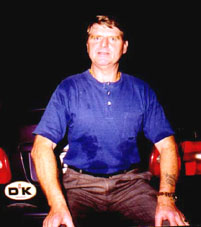 Jorgen Lundbaek. Jorgen Lundbaek.
Jorgen, although not of Viking stature, followed his family tradition
of all becoming seamen. At fifteen, an age he exaggerated, he joined the Danish ship the
Maerskline as a deckhand which took him to Asia. This was at the beginning of the Vietnam
War and in 65 to 66 Jorgen had a job working with the U.S. Marines in Da Nang transporting
ammunition. After that year he went to Bangkok and got a job with a civilian company,
Conam, supervising tugboat and barge transport from Sattahip to Bangkok Port, as well as
working in the maintenance and radio repair at Sattahip until his contract expired in
’68.
Jorgen’s next endeavour was to team up with an Englishman, Captain
Bent, to form a company "Maritime Survey". By 1982 he was working as a surveyor
and joined with another Danish seaman to form the company now named "Mermaid
Maritime". Jorgen speaks with rapid-fire bursts of enthusiasm about his company and
claims that work is all there is for him. "If you retire and do nothing you get bored
and fed up I love to work."
The work his company does is varied. "A marine survey business
does all kinds. We do servicing and survey, which is testing and repairing to
international standard and certification, and we also send trained people out to the
oilrigs to do the same. We handle safety equipment, life rafts, fire fighting, commercial
diving, civil engineering projects, marine electronics, and ships chandelling."
Jorgen’s business is no small affair, employing nine expats and
fifty Thais and even boasts two, four men decompression chambers. He enthuses about the
new services Maritime Marine are providing in training for underwater welding, cutting,
ultrasonic thickness gauging (no they don’t use dolphins), as well as dry land,
marine and oil rig welding. They have set up a joint venture to run internationally
recognised, certificate training here in Pattaya. "I believe training here in
Thailand will be a big business in the future. It is the first of its kind in Asia."
Jorgen is happy here. He speaks Thai fairly well and even reads it. He
was married twice, though his Thai daughter and son prefer living here despite being taken
to visit Denmark five years ago. He does not forget his origins, however, despite the
length of time he has been here. Even his company logo has a ship’s buoy encircling
the famous mermaid of Copenhagen sitting on a rock, perhaps just to remind him.
Scratch the surface and you find Jorgen does have other strings to his
bow besides work. He admits to exercising in the gym, lifting weights and running. He
casually mentions a hotel-restaurant and a nightclub he is a shareholder of in Bangkok.
The forty-room hotel-restaurant the "Stable Lodge" came about by chance. He was
dining there about eight years ago when he discovered they would take only cash, not
credit cards. His response was, "If you guys are that hard up, I’ll buy the
place." By the end of lunch he had!
The most important values to Jorgen are: "Health, money enough to
have a beer or two when you want it and to have a good time." So would he do it all
over again? "Yes, but I would make ten times the money if I had the time back."
Jorgen Lundbaek, the dynamic Dane, certainly gives the impression he would know how!
Snap Shots: Off the wall!
by Harry Flashman
Have your photographs become boring? Do they all look
the same? Predictable pictures that no longer excite you or any of your family either for
that matter? So dull that you have almost given up taking photographs?
OK, for you this weekend, we will take some of the wildest shots you
have ever done and the end result will be such that people will say for years "How in
heck did you take that?"
 The first step
is to pop down to the photoshop and buy some slide film. Yes, slide film! Don’t worry
if you haven’t got a projector, never used slide film before or any other of the
excuses I hear people say when Harry here mentions slide film. If you normally use 100 ASA
print film then get some 100 ASA slide film. Simple, so far! Do not get the Kodachrome
that you have to send away for processing, just get ordinary slide film that can be
processed here in Pattaya. Look for the cheapest - it will be perfect for what we want. The first step
is to pop down to the photoshop and buy some slide film. Yes, slide film! Don’t worry
if you haven’t got a projector, never used slide film before or any other of the
excuses I hear people say when Harry here mentions slide film. If you normally use 100 ASA
print film then get some 100 ASA slide film. Simple, so far! Do not get the Kodachrome
that you have to send away for processing, just get ordinary slide film that can be
processed here in Pattaya. Look for the cheapest - it will be perfect for what we want.
The next fact is that you do not need to know anything about f stops,
shutter speeds, zoom lenses or the like. The special photographs we will end with can be
taken by anybody with a fully automatic point and shoot compact camera.
OK, load the camera with the slide film (it’s just the same to
load as print film - for most cameras, put in the cassette, pull the tail across and shut
the back of the camera. Hey Presto!)
Now let’s go and shoot. For the effect you are going to get, some
good landscapes or seascapes are excellent here. Pop down to Jomtien and take some shots
of boats on the water and then some of the beach scenes. Now get in the car and go up to
Buddha Mountain and take some shots there. Finally, go across the road and up to the radio
station lookout and finish the roll of film.
Now take the film for processing, and here is an important part. You
ask for E6 slide processing, but DO NOT MOUNT THE SLIDES! Leave the slides either as a
roll or cut into strips of 6 and put in sleeves like your usual print film negatives.
Impress this on the girl behind the counter. You do not want them mounted.
When you get the film back, just hold them up to the light and select
any one shot that you like the look of (or even only half like, it doesn’t matter!).
Go back to the photo processing shop with the following instructions ... "I want you
to print number X as if this is a negative. I know it is a slide, but I want you to print
a picture, using this slide as the negative." It will probably take quite some
repeating before the technician will reluctantly take the job on, with much warnings about
it will not look right, etc. Ignore all warnings, just have faith in Harry Flashman. While
you are at it, tell them that you do not want the usual size, but get an enlargement done
straight off. 10 x 8 is sufficient and costs around 80 Baht. Repeat your instructions,
tell them you know the colour will be wrong and leave them to it.
You see, what happens with colour prints is that the processing machine
recognizes certain colours in the negative and converts that to green for grass, blue for
skies, etc., in a photochemical way. By giving the autoprocessor grass that is already
green and skies already blue totally confuses its auto brain (and the girl in the shop
usually) and it will produce a print with the wildest psychedelic colours you will ever
see. Expect orange trees and yellow skies - you can get anything! It is almost impossible
to predict, but the end result will be wild. Try it this weekend. You will not be
disappointed.
Modern Medicine: A bloody mess!
by Dr Iain Corness
People do faint at the sight of blood. In fact, in my class in medical
school we had such a fellow. The poor chap managed to last till third year but kept on
fainting, even when we were being shown slides of anything a little gory. Needless to say,
he did not make it through the compulsory six years!
However, "blood" is not a "magic" fluid. It is
mainly a water solution with oxygen bearing red and white blood cells floating in it.
Unfortunately, we do need blood to circulate or otherwise the tissues starve of oxygen and
we die. That simple.
Our blood circulation system is also very simple. It is truly a closed
circuit pumping system - the heart pumps the blood through the arteries till eventually
they get smaller and smaller. They then hook up with tiny veins that get larger and larger
and return the blood to the pump (the heart).
Because it is a closed system, we do not get to see this blood rushing
around - until we somehow open up an artery or a vein. It is then the red stuff falls on
the floor! The common way this occurs is when we cut ourselves, which we medical folk call
"lacerations". No matter how it happened, if you split open a vein or artery,
the pump keeps on pumping and the blood pumps out.
Now if it is a vein that has been opened, the blood is moving along at
a fairly low pressure, so you get a nice steady ooze at the site of the cut. But if it is
an artery that has been cut, then these are high pressure blood carriers and the blood
will tend to spurt in rhythmic pulses, in time with your heart beat.
>From the point of view of stopping the blood loss (which we call
haemorrhage), it does not really matter whether the blood loss is venous or arterial. Even
arterial blood is only at 3 p.s.i. pressure and you can stop the flow with your thumb.
While blood loss may look gory and horrible, you can stop 99% of all
haemorrhages by putting a piece of cloth (a handkerchief, rag, torn piece of shirt, etc.)
over the site of the wound and applying firm pressure with your hand.
Now some parts of the body are better supplied with blood vessels than
others, so these are the areas that really bleed. The scalp, the ear lobe and around the
mouth are classic sites for lots of gore. Fortunately the treatment is just the same.
Cloth and direct pressure and the flow will cease. Of course, you will still need to see
the doctor for the closing of the laceration - but you will not bleed to death in the
meantime!
Don’t be like my unfortunate classmate in medical school. Keep
your head and apply direct pressure over the wound. See you in the Casualty Department!
 Dear Hillary, Dear Hillary,
When my husband of 5 months and I make love, he calls me
his "little girl." The problem is, I’ve caught him a few times winking at
actual little girls. Sometimes he plays with our neighbors two little daughters, 3 &
5, and I do not like the way how he’s touching them. He also told me many times that
if we have children he wants only girls, no boys. And he once mentioned that when he was
younger, he babysat for a couple who had a 2-year-old girl, and he had to get into bed
with her to make her fall asleep. Telling me so, I could see how much he enjoyed it
thinking back of it. Maybe I’m being silly and overreacting, but sometimes I get the
feeling that he’s a sick pervert. I’ve never talked to him about it. How could
I? What can I do?
Confused wife
Dear Confused Wife,
Child molestation is such an ugly crime that even the faintest
suspicion is worth checking out. And in this case, that means talking to your husband.
There’s no need to be confrontational. On the contrary, if you share your sexual
fantasies with him, especially the depraved ones, and then explain why his calling you
"little girl" gives you the creeps, he’ll understand right away what
you’re getting at. If he says anything to confirm your suspicions about him,
you’re in a position to urge him into therapy right away. Whether or not you stay
with him is another question entirely. But don’t be surprised if he’s startled
by your suggestion. If he called you "kitten" in bed, would you assume he was
sexually interested in cats? See what I mean? Lots of people of both sexes wink at little
girls because they’re adorable. And plenty of men want daughters because they think
they’re easier to raise and present no threat to their male dominance of the family.
Furthermore, had there been anything weird or perverted about his babysitting experience,
he wouldn’t have told you about it. The thing is, once you suspect something is
amiss, everything he says or does, no matter how innocent, is going to reinforce your
fears. So, it’s not a question of how you talk to him, but whether you can afford not
to.
GRAPEVINE
Killer sponges
Alarm bells were ringing at Jomtien Beach this week after the
foreign newspaper La Stampa reported that flesh eating sponges of the genus Asbestopluma
had been sighted off the coast near Rayong. In breathtaking scenes reminiscent of the
movie Jaws, whole families (mostly Italian) moved their deck chairs back another ten
meters from the sea and shouted warnings to various nationalities and a topless bather,
"Water No Good Today, Will Eat You." Luckily Rochdale tourist Albert Titmarsh,
who had been imprisoned for a fortnight by the Italians in North Africa during World War
Two, was able to translate the alarming article. The beach became calmer after Albert
explained that the tiny evil sponges were interested only in plankton and decaying
crustaceans.Anzac Day
Poteen Still in Soi Yamoto, the street next to Soi Post Office,
is arranging transport for anyone wishing to attend the memorial service at Kanchanaburi
on Sunday April 25. The itinerary involves leaving the soi at 5.30 a.m. and includes lunch
at the Bridge on the River Kwai. Expect to be back in Pattaya by 8.00 p.m. The price will
be 400-500 baht depending on numbers and must be paid at the Poteen Still by Saturday
evening April 10. All are welcome, but remember that T shirts and shorts are not
appropriate for the memorial service.
Amazing Thailand
Keen eyed Grapevine reporters have spotted the following notices
in the Pattaya area. From a blackboard outside a South Pattaya restaurant, "Special
Today - Ice Cream Is Off." From a travel agent’s ad, "Three day temple tour
and visa run to Ankor Wat 17,000 baht. Note - you can’t obtain a Thai visa in Ankor
Wat." From the rules listed in a one star hotel, "If water not coming in
bathroom please make a small bang, but do not disturb others." From a restaurant new
to farang food, "Our pepper steak is served with the Unknown Sauce." A Pattaya
pizza restaurant is offering fast food "for you to enjoy at home or in the comfort of
our convenience."
Wasted journey
Russian pop idol Stanislaus Beria was delighted to get a fax
invitation to sing his latest numbers at a Pattaya wedding party for two Muscovites who
had managed to save up for the fare. In his haste to get here, Stan forgot the piece of
paper with the name of the Russian restaurant on Second Road and spent three hours roaming
around Pattaya with a baht bus driver who misunderstood that he wanted to visit a
transvestite cabaret. He arrived at the restaurant shortly after the guests had left. His
intended new hits included, "I Know How To Get Here" and "You’re
Can’t Be Happy When I’m Away." |
Travel in style
Prize winning Emirates Airline is offering business class return
trips from Bangkok to Europe for 55,000 baht. All journeys involve a change of plane in
Dubai with a wait from two to three hours as a rule. As Emirates does not have a first
class on these routes, business class is excellent with a 40 inch pitch seat, the latest
in-flight entertainment video systems and delicious food and wines. Emirates dedicated
lounges are available in all airports and, if you request the service, you can be
transported in a limousine for free to any home destination in Europe not more than 30
miles from the airport. Some flight restrictions apply, so see your travel agent.Exterminate! Annihilate!
A greenhorn tourist, said to be from Ireland, explained to the
junior keeper that he was nervous of taking an elephant ride as he had heard it could be
dangerous. He had read in a book that the mighty beasts sometimes stampede or crush you to
death if they can’t find any bananas. The keeper said not to worry and pointed out
that Pattaya also has mechanical elephants which operate on electric batteries by remote
control. They are designed specially for tourists who are reluctant to try the real thing.
Having handed over 1000 baht, the tourist waited for two hours for the keeper to reappear
with the large metallic Frankenstein. Surprisingly, it was in vain.
Cooking Phuket’s goose
Word is finally getting round: not all Thailand’s resorts
are the same. Some tour agents in Europe are already deleting Phuket from their brochures
because of skyrocketing prices in the southern resort. Customers are complaining about 200
US dollars nightly room rates, double or triple charging on public transport and
outrageous fees for using deckchairs and ordering a snack. One London based operator, who
sends thousands of tourists to the kingdom every year, said Pattaya was the cheapest and
best value resort in Asia. "What holds it back," he suggested, "is the lack
of zoning for night time entertainment venues which are spreading every month." What
he meant was that Pattaya’s public sleaze makes it difficult to encourage mixed
groups and families to stay here. |
Dining Out: Savour the flavour
by Miss Terry Diner
With so many different cuisines available in Pattaya, the Dining Out
Team has to admit that Indian cuisine has not been one of its more favoured varieties.
Perhaps the introduction to Indian food many years ago - an incandescent Chicken Vindaloo
that burned on its way in (and out) - left me with a permanent distrust and a long lasting
impression that all Indian food was too hot and too harsh. It is with pleasure that I
report that all that has changed after a visit to the Sher-E-Punjab on Soi Pattaya Park
off Thappraya Road.
We were also very fortunate to have two "Indian foodies" with
us on that Dining Out evening, Graham Macdonald and Kim (Delaney’s) Fletcher. With
the multitude of dishes on offer it certainly made more sense for your reviewers to be
able to sample much on the menu and this required numbers of diners!
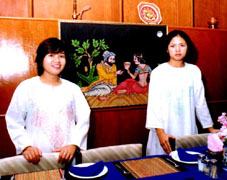 Sher-E-Punjab. Sher-E-Punjab.
The menu is indeed comprehensive, covering soups, starters, Tandoori
Khajana, Murg "E" Bahar, mutton specialities, seafood specials, vegetarian
cuisine, rice and breads.
We were advised to order several dishes from the starters menu.
Particularly the Samosa’s. These are like large curry puffs with a crispy pastry.
Coming in several varieties (vegetable, chicken and mutton) they were flavoursome and
light with no greasiness. We also tried the Shami Kabab which is similar to a rissole, but
loaded with aromatic spices and herbs.
By this stage we were starting to appreciate the subtleties in this
restaurant’s cuisine. While there was "spiciness" there was also an
aromatic flavour that would come through and tickle the taste buds.
With much ceremony, Garry the Maitre d’ (a handsome Omar Shariff
type) brought in the mains. Many of these came in individual copper plated pots with
matching serving spoons. These included Tandoori Prawn, Fish Tikka, Tandoori Chicken and
Paneer Shashlik. Many of these were cooked in the Tandoori oven, that special oven used by
the Punjabi for their cooking. We ate the mains with an assortment of breads including a
Keema Parantha and (my favourite) Garlic Naan.
Every dish had its own distinctive flavour, and again I must thank
Graham who so patiently took me on the discovery trip through Indian cuisine. It was an
eye opener and a taste experience that will be repeated.
We washed the multitude of dishes down with some nice red wine and
Carlsberg. (No Singha Gold - an oversight that many restaurants share in Pattaya. Are you
listening to me, restaurateurs?)
It really was a most pleasant culinary evening. We ate Indian food we
would never have had the courage to try before - and what is more, we enjoyed it! If you
are, as we were, afraid of the Indian dishes you can discuss choices with Garry and order
without fear. The Dining Out Team can recommend the Sher-E-Punjab without hesitation.
As a final suggestion, Sher-E-Punjab should perhaps consider printing a set menu to
cover the most common items for those diners not as fortunate as we were to have Graham
and Kim as dinner companions. It certainly would take some of the hesitancy out of
ordering Indian food for the novice.
Animal Crackers: African Grey
Parrots
by Mirin MacCarthy
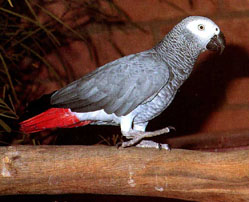 African Grey Parrots are the best known pet parrot in Europe and highly sought
after. Due to distance and import restrictions they are expensive in America and
Australia. Widely renowned as the best talkers, they are affectionate, highly intelligent
and long lived birds. African Grey Parrots are the best known pet parrot in Europe and highly sought
after. Due to distance and import restrictions they are expensive in America and
Australia. Widely renowned as the best talkers, they are affectionate, highly intelligent
and long lived birds.
Where did I come from, Mummy?
The African Grey hails from equatorial Africa and
is usually imported in a somewhat traumatized condition. Recently I was fortunate to
purchase a two month old chick from the Chatuchak Market, still being hand fed. It was
bred here in Thailand thus making it easier to rear and tame. We just had to name it
Nelson after Nelson Mandela, the grey African.
Red tails in the sunset
The bird is shades of pastel greys, with a black
beak, a squat bright red tail and a large bare facial area around the eyes like macaws.
They grow up to be about thirteen inches long as adults.
Grey matter
African Greys are unusually intelligent and
perceptive. These parrots have shown the ability to understand tasks and concepts such as
same or different, absence, quantity and size.
Although they talk superbly and readily mimic the human voice they do
not screech noisily like cockatoos. They usually begin talking at six months of age but
some can take up to two years before they are saying words and sentences.
Mother’s tucker
As chicks up to four months, old they are hand
fed with a spoon on Kaytee bird rearing formula if you can obtain it, alternatively hot
baby cereal ‘Nestle’s Cerelac’ mixed in with small amounts of bottled baby
fruit or vegetables. Adults eat sunflower and safflower seed, boiled corn, green
vegetables, fruit and dried dog biscuits.
Disposition or dat position?
They are strong, active birds with powerful beaks
and a fairly large sturdy cage or aviary with heavy gauge wire is essential for them to
swing and play. They love to hang upside down and attack their toys! They are very
affectionate birds and crave attention and physical contact, i.e. hugs and pats. African
Greys are alert, curious and responsive pets.
Snail tale
One day a tortoise was ambling down the road, as
tortoises do, when he was unexpectedly leapt upon by a gang of Snails from Hell. They
thoroughly beat him up, robbed him and then scampered. The tortoise then inched his way
down to the police station to make a report. The nice policeman asked him if he could
identify any of the snails in a line-up. "No I’m sorry, I can’t," he
said, "It all happened too fast!"
Auto Mania: The good times have
gone!
By Dr. Iain Corness
The visit to the 20th International Motor Show in
Bangkok confirmed my suspicions that the world is starting to stagnate. Motoring trends
that are "new" are a joke and the much publicised crowd pleasers are revamps of
old classics. Let me expand further.
Take, for example, the "new" Beetle. This car looks like the
pictures your six year old son drew of the venerable Beetle of yesterday. Honestly,
it’s a caricature! The much vaunted Audi TT coupe looks like a scaled down Chrysler
Airflow and you can add in the new Veedub Passat, obviously from the same design studio.
Move through to Jaguar and the new S type with the re-created old S type grille had people
panting excitedly, with clever graphics comparing the old and the new. The Jaguar XKR is
pure reminiscence of D type and E type. Chrysler even had a road going production
"hot rod" from the 50’s on display.
The technology of today is much better than that of the 50’s and
60’s - so why is this retro car styling so popular? A visiting auto designer from the
UK, Fran Cush of Cush Design Studios, suggested that for many people the future does not
look inviting. For the world at large, the good times are not coming - they have already
gone! So for these folk, the retro look recalls the good times they had and which they
cannot see coming again. If he is correct, this is very depressing. Is the new millennium
going to bring us such beauties as the 1940’s Ford Anglia, the ‘50’s Nash
Metropolitan, or even the Bat-wing Chevrolet? The mind boggles at the thought!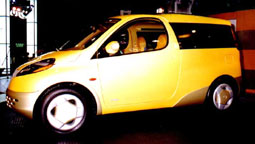
So was there anything new at the show? There was, and it was
sensational. It was the new VW W12. In brilliant yellow and did 300 kph standing still. It
reiterated my statement of a couple of weeks ago when I said that Veedub under MD Pietsch
has the design team and the financial clout to produce anything. It was simply gorgeous.
Other exciting and interesting vehicles included the Honda S2000 sports
- a brutish sports car reminiscent of a smaller Dodge Viper in some ways.
The latest Nissan GTR was also on display - another brute. Called
"Godzilla" in Oz, these twin turbo 4WD machines are sheer excitement to drive.
They have an electronic brain that tells the centre differential what the split should be
to the wheels. In ordinary driving it is 100% rear, but turn on the tap and it
progressively feeds in more power to the front wheels. At full noise can get the 50/50
split and you know you’re there, I can tell you. Performance figures in the mid four
second range for 0 - 100 KPH is real grunt.
Electric shocks
Probably one of the more interesting stands at
the show was put up by Electric Vehicles Thailand. They had some nice little scooters and
mopeds, all electric with around 6 hours between recharging for the scooters and 3 hours
for the ‘peds. With a good tail wind the scooters claim 50 KPH and cost 42,500 Baht
(including VAT). The little ‘uns do 30 KPH and retail around 20,000 Baht. Certainly a
nice quiet pollution free alternative to the noisy little smoking two strokes we have at
present.
Pug lion shows its claws
Peugeot in this country are really trying hard at
present. Their CKD 306 and 406 models are being very well promoted and are competitive
price-wise with the more usual Japanese offerings. In addition, I would consider the
Peugeot range to be more "sporting motorist" oriented. Pug has been the leading
European over here for the past 3 months and this has been the result of the keen pricing
and promotion. On their stand at the show was their WRC 206 screamer. I want one!
Definitely a Pug with claws.
More show bits
The motor show was much better than last
year’s effort. More cars, more accessories and generally a much better feeling than
the despondency of 1998. Motor vehicle sales may still be very depressed, but the mood
this year was not.
One of the biggest problems on press day at the show is the razzamatazz
and hype that seems absolutely mandatory. Some exhibitors definitely confusing the
ceremony with the substance.
What happens is, that following a strict timetable, the camera crews
and the newspaper paparazzi line up at the manufacturer’s stand. At the cue, out come
the promo girls, usually dressed in some totally outlandish costume (Ford had girls in
silver jodhpurs would you believe) all with radio mikes and then they parrot off their
rehearsed and memorised spiel about the new cars. The local MD’s then have a little
say and then the finger food and booze gets attacked by the frenzied horde who rip off any
free goodies and anything else they can get their sticky little paws on. The freebies run
out and it’s on to the next stand for a repeat. Judging by the number of
"Press" badges, Thailand must have 397 newspapers with a dedicated motoring
column. After the Pattaya Mail and the half a dozen rags in Bangers, I’d love to know
who the other 390 publications are!
Toyota, as usual, were the last of the big spenders. They had smoke,
they had dancers, they had promo girls, they had concept cars. They also had a less than
exciting stand with a Camry (yawn), Soluna (double yawn) and Corolla (yawn again). No
English language press kits either (so much for it being an "international"
show). Mind you, the three concept cars were interesting in a weird sort of way. The
"Fun Carry" obviously styled by Walt Disney! Look at the pix if you doubt me.
The accessories exhibitors were out in full force this year. Lots of
imported go-faster goodies, including steering wheels with imitation F1 type gear shift
buttons (blows the horn instead of electro-shifting) and some interesting extractors. Wild
lines in air dams, spoilers and wings - but none for the family Mira. Ah well, it helped
save me money, I suppose.
More on the show next week, if we both can stand it.
Fitness Tips: Fit Facts
G’day Pattaya.
This week in Fitness tips I am going to pass on 3 bits of information,
the first 2 are great news for us on the Eastern Seaboard and the third is an explanation
for a problem that some of us suffer.
A Spicy entrée can work wonders
In direct contrast to the effects of a pre-dinned
drink with a high fat snack, a spicy appetiser appears to reduce the amount of food eaten
at a main meal. Canadian researchers have found that snacks made from red peppers, which
include the spice Capsaicin, can lead to reduced food intake of around 200 calories at a
main meal. Spicy foods are also known to have an impact, albeit slight, on metabolic rate.
The current research suggests a positive benefit of low fat spicy foods as an entrée. It
is not known whether other foods high in Capsaicin (peppers, chillies, curries, etc.)
would have the same effect.
Implication: Suggest spicy, low fat foods as snacks or entrees in order
to reduce the total amount of energy consumed.
Coastal dwellers are more active
Australians who have a postcode (zipcode) which
indicates they live on the coast are 23% less likely to be sedentary than those who live
off the coast. This is a finding from a survey by the New South Wales Health Department
with over 16,000 people. Coastal dwellers are also 27% more likely to have an activity
level defined as ‘adequate’ for good health and a healthy body weight, and over
38% are more likely to be regularly vigorously active. Whether living on the coast causes
this effect or those who are more active tend to choose the coast to live is not clear.
However, it does seem that being more active is more possible and more likely given a
congenial environment. Moving to a coastal address might at least be a better solution for
weight loss than the "diet of the week". At least the percentage chance of you
achieving your goal is by far in favour of the move to the coast.
Implication: People living on the coast in Australia may find weight
maintenance easier than people living inland.
The price of development
Living standards in the US, based on per capita
income, are undoubtably amongst the highest in the world. Obesity rates are also amongst
the highest, and this is often put down to over-eating in the U.S. A comparison of daily
energy expenditures between U.S. women and Gambian women, however, show that this is not
the whole story. According to a Laval University scientist Dr. Angelo Tremblay, average
energy expenditure among women in the US is 1.4 - 1.7 times basal metabolic rate.
Metabolic rate is the amount of energy required to keep a body alive at rest, and is
generally considered to be around 70% of total daily energy expenditure. An energy
expenditure of 1.5 would mean that all of the day’s physical activities (including
exercise and non-exercise related daily movement) is only 50% greater than basal metabolic
rate. Comparative measures of native women in Gambia (where machines are not as available
to carry out daily work) are 2.35 times BMR. "This could amount to an 800 - 1000
calories difference per day between women in developed and non-developed countries,"
Dr Tremblay says. The answer for women concerned about their weight, it seems, is not
diet, but to pack up and move to a less developed part of the world, leaving modern
conveniences behind.
Implication: Concentrate on total daily physical activity at a level
more than 50% of basal metabolic rate. For those of you who can’t readily measure
their metabolic rate, try walking instead of using the car, the stairs instead of the
elevator all the way up - I’m sure you get the concept.
Carpe’ diem
Copyright 1998 Pattaya Mail Publishing Co.Ltd.
370/7-8 Pattaya Second Road, Pattaya City, Chonburi 20260, Thailand
Tel.66-38 411 240-1, 413 240-1, Fax:66-38 427 596; e-mail: [email protected]
Created by Andy Gombaz, assisted by Chinnaporn Sangwanlek. |
|