

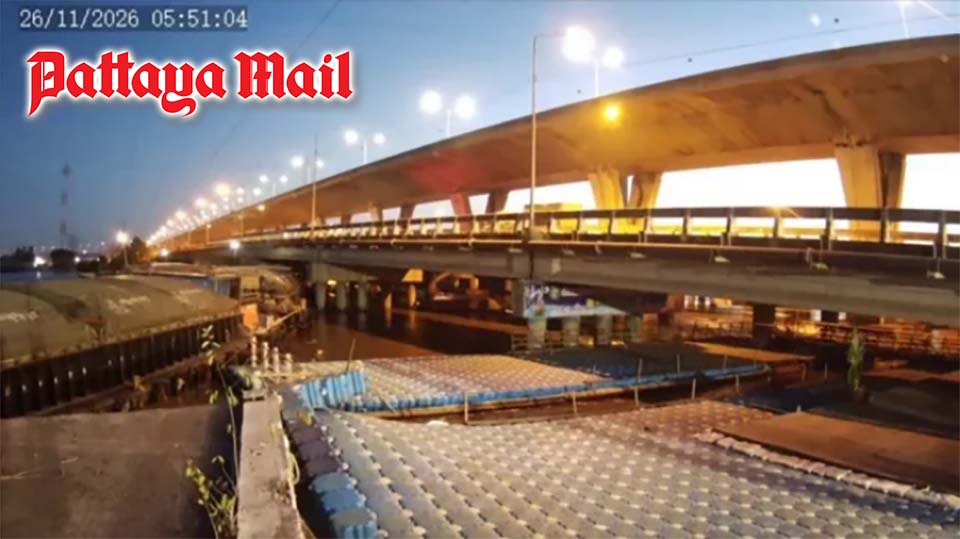
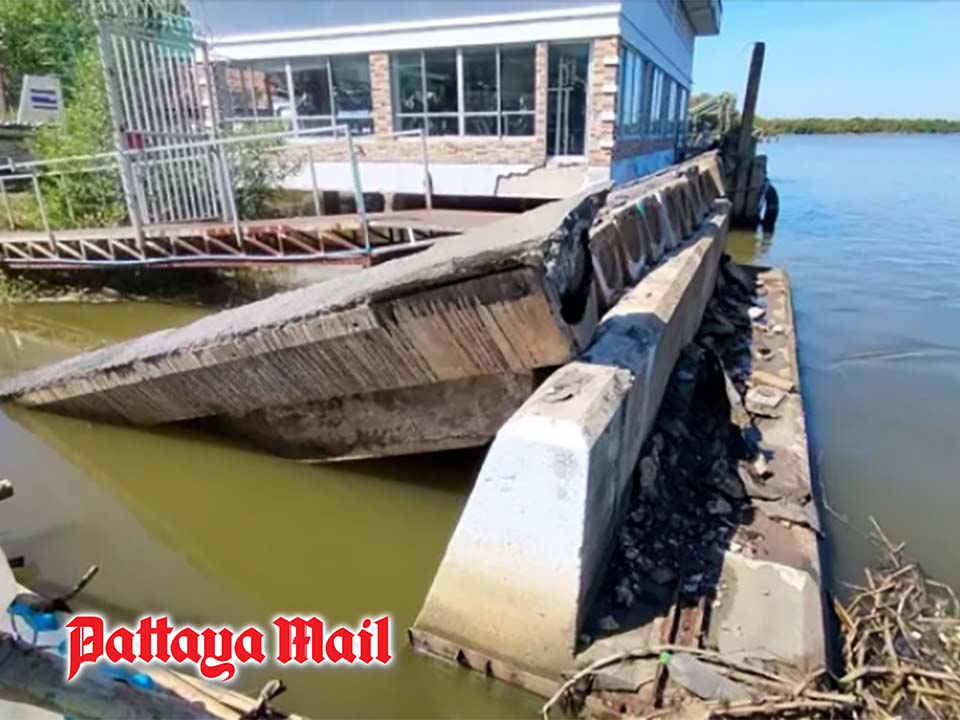
CHACHOENGSAO, Thailand – Four rice-carrying barges tied together broke free from their moorings during a strong incoming tide early on November 26 and crashed into the remains of a historic bridge over the Bang Pakong River in Chachoengsao, causing part of the old structure to collapse into the water. The incident occurred near Thep Hatsadin Bridge in Tha Kham subdistrict, Bang Pakong district. The barges, including the Phutthanu Phap 39 and Phutthanu Phap 22, were travelling with tugboats and another motorboat. Their impact also damaged CCTV cameras, water-monitoring equipment and a municipal floating platform, while the main bridge remains open to traffic.
According to Walapa Singha, deputy permanent secretary of Tha Kham Subdistrict Municipality, the vessels had been carrying rice from Asia Golden Rice in Tha Sa-an subdistrict. They passed beneath the bridge at around 3am, heading towards the river mouth, but encountered a strong incoming tide while fully loaded. Unable to continue, the convoy moored at the pier of Saengthai Bang Pakong Co., Ltd.

At around 5.50am, the vessels are believed to have broken loose after their anchors failed to hold against the strong current. The linked barges were swept into the remains of the old bridge, bringing down the surviving section, while the opposite end of the convoy struck a pier of the newer bridge, which is still in use.
An initial inspection found damage to two municipal CCTV cameras and additional cameras belonging to the Marine Department. A sonar system operated by the Department of Marine and Coastal Resources was also damaged. The equipment is used to detect dolphins entering the river and help prevent them from becoming stranded or dying in freshwater. Its control cabinet sank with the collapsed bridge section.
The municipality’s floating platform, recently used for Loy Krathong activities and scheduled for a December 17 ceremony, also sustained damage to its supporting base. More than 40 floats were affected. Authorities are assessing the total cost of the damage. Initial checks found no serious damage to the main bridge piers, allowing the bridge to remain open to the public. The municipality is compiling an inventory of damaged property before filing a police report with Bang Pakong Police Station. It will also contact the vessel operator to seek compensation and coordinate inspections with the relevant government agencies.
The collapsed structure was part of the original Thep Hatsadin Bridge, built in 1949 and no longer in use. The municipality had sought to preserve around 10 meters of the remaining structure as a memorial to the first bridge crossing the Bang Pakong River. It also served as protection against riverbank erosion near the municipality’s fitness center.
The area has experienced several previous incidents involving tugboats striking bridges. The relatively low clearance and numerous supporting piers create a narrow passage for vessels. Plans are also being prepared to demolish two parallel bridges along Highway 34, the Theparat Road, built in 1969 and 1996, and replace them with a new structure featuring wider openings between piers and greater clearance for cargo vessels. Demolition had been scheduled to begin in November 2026 but was postponed at the municipality’s request to avoid disrupting important festivals and local events. The contractor is expected to proceed at a later date.