
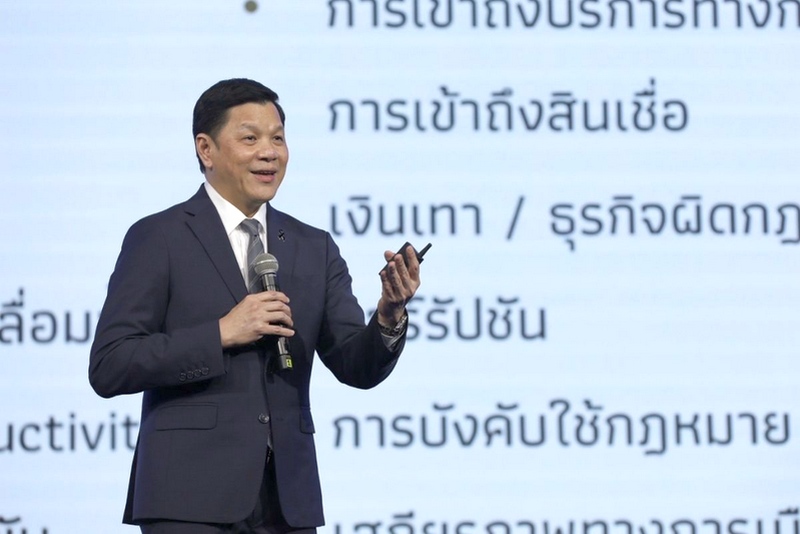
BANGKOK, Thailand – Thailand’s informal economy accounts for an estimated 48% of gross domestic product (GDP), ranking the country 14th among 158 nations assessed, according to the Bank of Thailand (BOT), which is calling for structural reforms to bring legitimate businesses into the formal system and make illicit financial activities more difficult. BOT Governor Vitai Ratanakorn presented the findings at the BOT Symposium 2026, organized by the Puey Ungphakorn Institute for Economic Research (PIER) under the theme “From Informality to Opportunity: Unlocking Thailand’s Informal Economy”.
According to World Bank estimates cited by the BOT, Thailand’s informal economy represents 48% of GDP. Vitai stressed that the informal economy is not solely associated with corruption, illegal gambling, scammers or money laundering, but also includes legitimate small businesses, market vendors, freelancers and farmers who operate outside formal registration and tax systems.

PIER estimates that the legitimate informal economy accounts for approximately 21%–35% of GDP. An estimated 2.5 million small businesses, vendors and independent operators remain outside formal registration and the tax system, representing around 70%–80% of Thailand’s approximately 3.2 million businesses.
Thailand also has an estimated 26 million informal workers, accounting for around 65% of the total workforce. Many face difficulties accessing formal loans because they lack standardized accounting records and tax histories, making it difficult for financial institutions to assess their income and creditworthiness.
As a result, some are forced to rely on informal lenders, costly non-bank financing or borrowing from acquaintances, often through short-term loans that do not support long-term investment or productivity improvements. Informal workers also lack adequate access to social security and retirement savings schemes, leaving them financially vulnerable in old age. Meanwhile, businesses and workers operating outside the tax system limit government revenue and fiscal flexibility, particularly amid concerns that public debt could approach 70% of GDP.
Vitai also highlighted the darker side of the informal economy, including corruption, online gambling, scam networks and mule accounts. A 2012 study estimated this segment at around 13% of GDP, although he said it is believed to have expanded substantially since then. He said illicit money is often hidden, laundered or kept outside normal financial channels, preventing productive circulation within the economy.
Although the BOT does not directly have law enforcement authority, Vitai said it could make illicit financial activity more difficult through tighter financial controls, including scrutinizing large cash withdrawals, stricter account-opening procedures, monitoring payment service providers and tracking money laundering through financial instruments, foreign exchange transactions and digital assets such as USDT.
The BOT’s strategy is to encourage legitimate informal businesses to enter the formal economy through incentives that improve access to financing, with interest rates reflecting actual credit risks, support productivity improvements and broaden the tax base. At the same time, financial institutions would be expected to play a stronger role in obstructing illegal transactions and reducing opportunities for money laundering.
Vitai said the central bank is expanding its role beyond maintaining financial stability to include addressing long-standing structural economic challenges. He stressed that the informal economy cannot be transformed within eight to 10 months, but requires sustained efforts over several years, involving the government, financial institutions, private sector and academics. (Story & Photo: Prachachat Business)