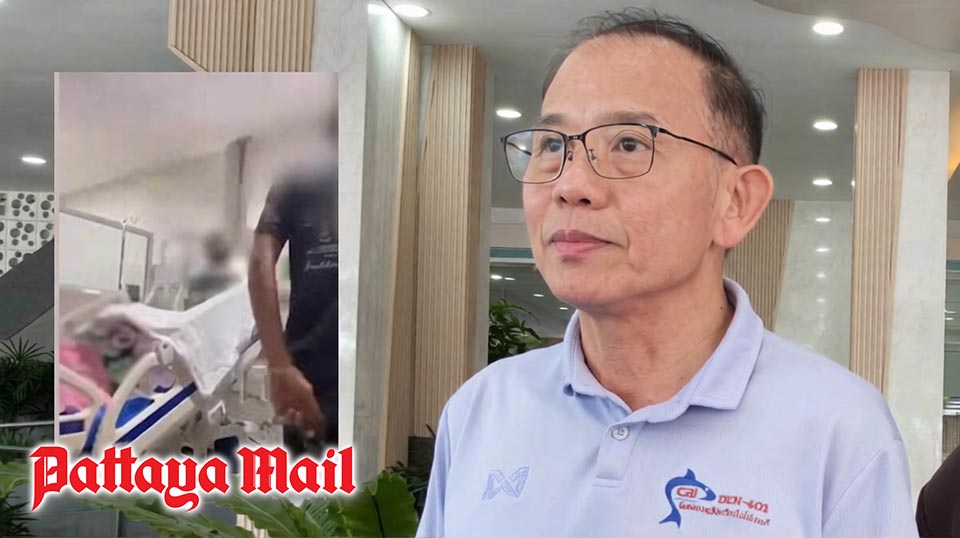
PATTAYA, Thailand – Pattaya Bhattmakhun Hospital has released a detailed timeline of treatment for a 17-year-old student who died on November 11, following concerns raised by her family over wall drilling carried out in her hospital room while she was receiving treatment. At a press briefing on November 14, hospital director Dr Wichai Thanasophon and attending physician Dr Thanakorn Jaturasuwan, known as Dr Benz, explained the teenager’s medical condition, the hospital renovation work and the sequence of events leading to her deterioration.
The hospital also allowed reporters to inspect the shared special-care ward on the third floor of Building 5, which accommodates up to 11 patients requiring close monitoring. The disputed work involved drilling parts of the wall to install equipment and wiring for a central monitoring system, allowing nurses to observe patients’ vital signs from a single station.
Dr Wichai said the project was intended to improve patient care. He acknowledged that images of the contractors at work may have given an inappropriate impression and showed that precautions had not been sufficient. The hospital would review and improve its procedures for carrying out work in patient areas. He said drilling was limited to small points for mounting equipment and routing cables.
Contractors used a vacuum cleaner to collect dust, and each drilling operation took only a short time. The hospital faced difficulties relocating patients because of high occupancy and the need for close medical supervision. The director said the hospital had assessed the risks and, based on its retrospective review, had found no evidence that the work adversely affected other patients in the ward. He acknowledged that he had not personally been present when the contractors carried out the work.
Dr Thanakorn provided the treatment timeline for the student, identified as Nattathida, known as Nong Tonkhao, a Mathayom 5 student at Sattahip Wittayakhom School. She was first admitted on August 28, 2026, with neck pain, followed by rapidly worsening weakness in her arms and legs. Her condition progressed to the point where she could no longer breathe independently and required a breathing tube. CT and MRI scans revealed a suspected tumour in the cervical spinal cord, compressing the nerves responsible for movement and breathing. She was transferred to Rajavithi Hospital in Bangkok on September 1 and underwent several operations.
After her condition stabilised, she was transferred back to Pattaya Patmakhun Hospital on October 6 for continued care. She still had an infection requiring antibiotics, medication to reduce swelling and respiratory support, and remained unable to move her limbs. At her family’s request, she was moved from the female surgical ward to the shared special-care room on October 8. Her antibiotic treatment was completed on October 10.
Dr Thanakorn emphasised that the patient began developing a fever around October 10–11. By 6am on October 12, she already had a high fever, several hours before contractors arrived to drill the wall at approximately 9–10am that morning. Doctors subsequently conducted blood tests to investigate the infection and restarted antibiotics. Treatment continued until October 20, when her condition deteriorated and she became drowsy and unresponsive. A further brain scan revealed hydrocephalus, or a build-up of fluid in the brain, requiring surgery to drain the fluid.
Following discussions with her family, the hospital arranged for her return to Rajavithi Hospital, where specialists had performed her earlier tumour operations and were better equipped to manage the complication. She died on November 11.
Dr Thanakorn explained that a tumour in the cervical spinal cord is a serious condition because it can affect the nerves controlling movement and breathing. Even after surgery, patients may remain bedridden and require long-term rehabilitation. He said discussions about preparing equipment for home care had been part of planning for the possibility that her condition might stabilise sufficiently for her to return home. She would still have needed respiratory training and continued care for possible complications.
Regarding concerns that dust from the drilling might have contributed to her deterioration, the attending physician said the small drilling points were unlikely to have generated a large amount of dust. He added that hydrocephalus could develop because of the underlying disease or complications associated with surgery in the affected area.
Dr Wichai added that patients breathing through a tracheostomy tube receive air through a closed ventilator system, which he said made the risk of external dust entering the respiratory tract relatively low. The hospital stressed that its explanation was based on its medical information and assessment. No formal investigation findings had been disclosed establishing whether the construction work was connected to, or unrelated to, the teenager’s death.
A woman whose husband was being treated in a nearby bed also described what she witnessed during the installation. She said contractors drilled for approximately one to two minutes at each point, while another worker held a vacuum cleaner nearby. Beds were moved away from the work area, and the contractors cleaned up after completing each section.
She said she had not seen large amounts of dust spreading through the room, although the drilling and movement of equipment caused noise. She clarified that her observations were limited to the area around her husband’s bed and that she could not confirm exactly what precautions were taken near the teenager’s bed. The woman praised the nursing staff for their close attention to patients but suggested that the hospital better regulate the number of visitors entering at one time to reduce congestion and avoid disrupting staff.
Dr Wichai expressed his condolences to the family again and said the hospital was willing to meet them to answer further questions. He said he had not yet spoken directly with the family after learning of their concerns through social media. The hospital said patients and members of the public could submit complaints and suggestions through QR codes displayed around the facility and its online channels.