

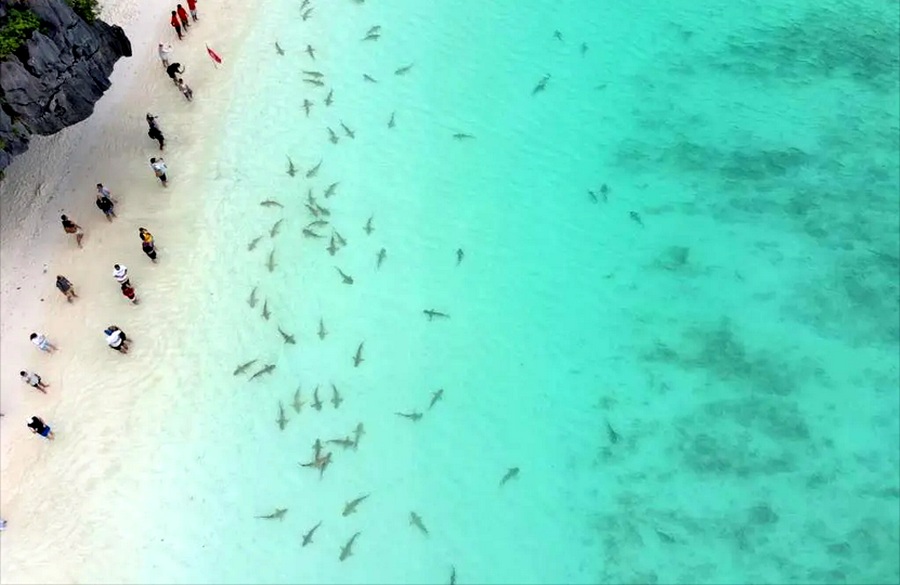
KRABI, Thailand – Maya Bay in Krabi has recorded its highest-ever number of blacktip reef sharks, with researchers counting 451 individuals during a morning survey on November 3, the largest total since monitoring began in 2023.
The Marine National Park Operations Centre 3 in Trang announced the findings on November 11, following a seven-day research programme conducted in November by the Marine National Park Research and Development Centre 3, with students from Prince of Songkla University.
The team carried out 15 drone surveys to count sharks, 22 underwater behavioral observations using Baited Remote Underwater Video Stations (BRUVS), and 22 seawater quality assessments.
Drone monitoring showed that early morning was the most productive period for spotting the sharks, with an average of 328.83 individuals, compared with 277.40 around midday. The highest single count was recorded shortly after dawn on November 3, when 451 sharks were observed.
Most of the larger sharks, classified as subadult to adult and measuring more than one metre, gathered near the right-hand side of the bay, particularly close to the beach and beneath the cliffs. Researchers said this clustering could be linked to reproductive behavior, although further study is needed to confirm the theory.
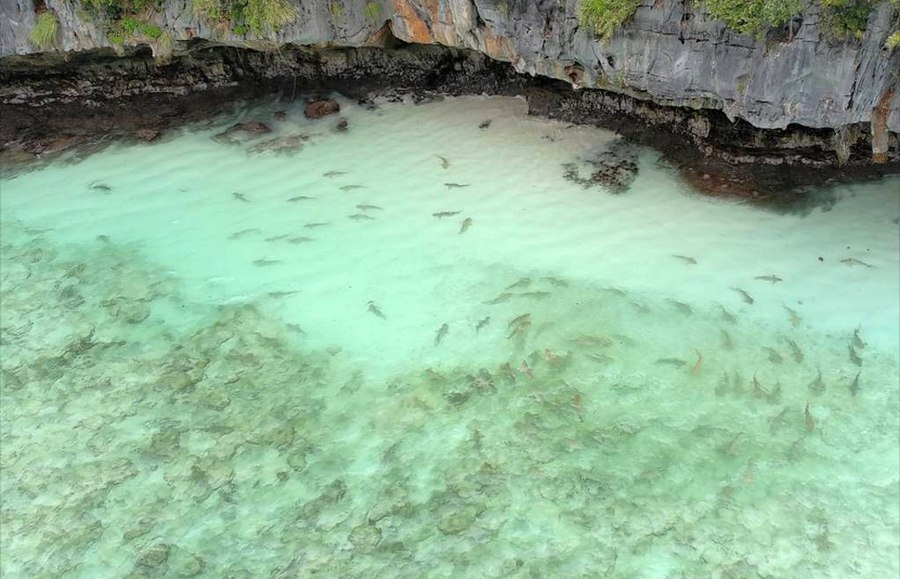
The survey also identified around three to five newborn and juvenile sharks measuring less than one metre in shallow water near the beach on the opposite side of the bay. The findings indicate that Maya Bay remains an important habitat for blacktip reef sharks at different stages of life. Underwater camera observations found that most sharks responding to bait were subadults. Some displayed clear attacking and biting behaviour, with stronger responses recorded during the evening and night. The maximum number recorded in a single video frame was nine.
Water quality measurements showed an average sea temperature of 30.87 degrees Celsius, salinity of 31.16 parts per thousand and pH of 8.62, all within ranges considered suitable for marine life.
Researchers said the survey was about more than counting sharks. The findings provide scientific information to support national park management, marine biodiversity protection and sustainable tourism, helping maintain the ecological health of Maya Bay.