

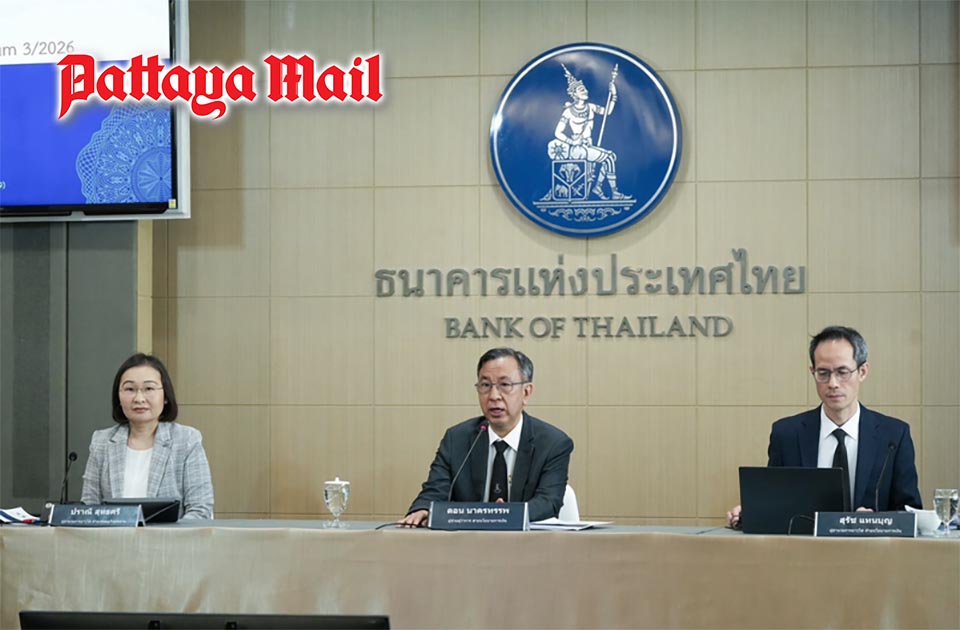
BANGKOK, Thailand – The Bank of Thailand (BOT) says its current policy interest rate of 1% remains appropriate to support the country’s economic recovery, but further increases could be considered if growth becomes more stable or risks to economic and financial stability emerge. Don Nakornthab, Assistant Governor for Monetary Policy at the BOT, made the remarks during the third Monetary Policy Forum of 2026. He said policymakers were looking ahead and would not necessarily wait for economic growth to reach Thailand’s estimated potential growth rate of 2.7% before considering an interest rate increase.
If the economy shows a stable recovery over the next two years, the Monetary Policy Committee (MPC) could begin gradually normalising monetary policy at an appropriate pace, even if growth remains below the 2.7% benchmark. The BOT is also reviewing whether the country’s potential growth estimate of 2.7% remains realistic, given rapid structural changes in the Thai economy over the past two to three years. The figure has been used for several years, although the bank is studying whether it needs revision.
For comparison, the International Monetary Fund estimates Thailand’s potential growth at around 2.5%, while the ASEAN+3 Macroeconomic Research Office puts it at 2.9%. The BOT currently considers 2.7% a reasonable reference point while its review continues. Don said the MPC was also considering a pre-emptive approach to managing risks. If inflationary pressures or threats to economic and financial stability emerge, policymakers could consider raising rates before the recovery reaches full strength.
Meanwhile, Surach Tanboon, Senior Director of the BOT’s Monetary Policy Department, outlined three risks associated with keeping interest rates low for too long. The first is excessive borrowing. Prolonged low rates can encourage households and businesses to underestimate financial risks and take on more debt than they can comfortably repay. If interest rates subsequently rise without a corresponding recovery in income, defaults could increase. Investors may also take on excessive risks, potentially creating instability if asset bubbles burst or lower-quality corporate bonds default.
The second risk concerns external financial stability. Persistently low interest rates can influence capital flows and exchange rates, particularly if Thailand’s interest-rate differential with neighboring economies becomes less attractive. An external shock, such as a renewed spike in global energy prices that pushes the current account into deficit, could increase pressure on capital movements and the currency.
The third risk is inefficient allocation of resources, including the continued operation of so-called zombie firms. These are businesses with weak prospects that remain afloat through borrowing and refinancing because financing costs are unusually low. Cheap credit can also encourage investment in projects that offer inadequate returns or are less productive. Surach said monetary policy remains accommodative and continues to support the recovery, while the BOT closely monitors inflation expectations, cost pressures and the possibility of renewed energy price increases.
He stressed the need to balance short-term economic support with long-term financial stability, alongside appropriate fiscal and financial measures. Although the bank has not yet seen significant signs of risk accumulation, it remains cautious about the potential consequences of keeping interest rates low for an extended period.