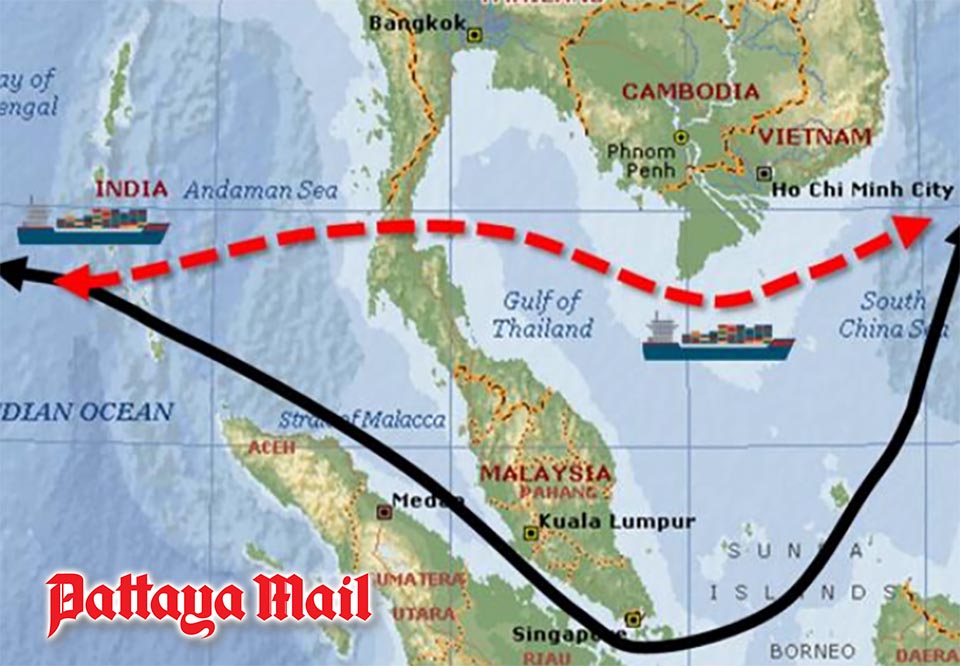
BANGKOK, Thailand – Thailand is shifting away from its controversial 1 trillion baht Land Bridge megaproject, with the government concluding that the original plan is commercially unviable and could expose the country to significant financial risks. Instead, the focus will turn to upgrading Ranong Port and developing rail connections to improve freight transport between the Andaman Sea and the Gulf of Thailand.
Deputy Prime Minister and Transport Minister Phiphat Ratchakitprakarn said the Cabinet had acknowledged the findings of a study committee chaired by Deputy Prime Minister and Finance Minister Ekniti Nitithanprapas. The report, approved at the Cabinet meeting on October 27, concluded that the proposed Land Bridge project was not worth pursuing in its original form.
“The Land Bridge project, under that name, no longer exists,” Phiphat said, describing the Cabinet’s acceptance of the findings as the end of the original proposal. He argued that the name itself had become a source of conflict and that the priority should be developing effective infrastructure capable of supporting regional economic growth.
Phiphat said deep-sea ports remained necessary on both Thailand’s Andaman and Gulf coasts. Ranong and Chumphon were still considered suitable locations for port development, but the scale, investment model and transport links would need to be reconsidered. The Office of Transport and Traffic Policy and Planning (OTP) has been instructed to study the options and recommend infrastructure suited to current economic conditions. He added that the original Land Bridge proposal relied entirely on private investment, while a smaller revised development could involve government investment.
The original Land Bridge concept was designed to connect two new deep-sea ports in Chumphon on the Gulf of Thailand and Ranong on the Andaman coast through road and rail infrastructure. The proposed 1 trillion baht corridor was intended to provide an alternative to shipping routes through the Strait of Malacca, potentially reducing transport times and costs while positioning Thailand as a regional logistics hub.
However, the committee found that international trade and investment conditions had changed significantly since the original feasibility studies. The global economic slowdown following tensions in the Middle East, together with uncertainty over shipping demand and competition from established ports, had weakened the project’s commercial prospects.
The committee also identified limitations in the assumptions and data used in the earlier studies, particularly in comparing freight costs and estimating the origins and destinations of cargo. These weaknesses made it difficult to establish whether sufficient shipping companies would use the proposed route.
Thailand’s southern economy remains heavily dependent on agriculture and tourism, while the volume of locally generated freight is relatively limited. More than 34% of goods from the South are currently exported through ports in neighbouring countries because of limitations in existing facilities. Nevertheless, trade between Thailand and markets to the west, particularly India, the Middle East and Europe, is expected to expand. The development of rail connections between Thailand, Laos and China could also create additional opportunities to transport goods through Thailand to western markets.
Environmental and community concerns
Environmental impacts were another major reason for the committee’s conclusion. It found that several Environmental Impact Assessment (EIA) and Environmental and Health Impact Assessment (EHIA) reports lacked sufficient information about construction methods and affected communities. As a result, the proposed prevention and mitigation measures were considered incomplete.
The committee recommended reviewing the Strategic Environmental Assessment (SEA) for the Chumphon-Ranong corridor. The existing assessment, prepared in 2016, does not cover the current proposed route. It also raised concerns that environmental assessments had been divided into seven separate reports overseen by three different agencies, making it difficult to assess the combined impacts and coordinate overall project management.
The proposed port development could significantly affect marine ecosystems, particularly Ranong’s mangrove forests, which form part of an internationally important biosphere reserve and wetland area. Other potential consequences include damage to rare marine species, fisheries, conservation tourism and the livelihoods of coastal communities.
On land, the proposed infrastructure could fragment protected forest areas, require substantial agricultural land expropriation and affect food security and residents’ quality of life. The committee also questioned whether local public utilities and healthcare services would have sufficient capacity to support the development. It recommended that future route selection consider environmental, engineering, economic and geopolitical factors rather than focusing primarily on the shortest distance.
Public consultation was also found to need improvement. The committee identified four broad stakeholder groups: supporters, including parts of the logistics and manufacturing industries and investors; people who remained concerned but undecided; opponents, including marine conservation networks, academics and local fishing communities; and residents who had not yet participated in public hearings. It said future major infrastructure projects should place greater emphasis on transparent communication, meaningful public participation and the concerns of vulnerable groups and local communities.
Government shifts focus to existing infrastructure
Despite shelving the original megaproject, the committee concluded that Thailand still needed better transport connections between its two coastlines to support growing trade.
It recommended three main measures:
- Upgrade Ranong Port: Improve the existing port and make full use of its current capacity before considering a much larger development.
- Develop rail connections: Study the feasibility of connecting Ranong Port to Thailand’s main railway network, allowing freight to move more efficiently through the country’s existing rail infrastructure and increasing container volumes handled by the port.
- Consider a new Andaman port only if necessary: If cargo volumes eventually exceed Ranong Port’s capacity, the Transport Ministry should study a suitable location for a new port on the Andaman coast, with an appropriate scale and investment budget and the least possible environmental and community impact.
The committee also concluded that there was currently no need to build an additional port on the Gulf of Thailand to handle transshipment cargo. Existing facilities could already serve the region, while the operational complexity and transport costs involved in transferring cargo between ships and land transport made it unlikely that shipping lines would use the proposed arrangement in sufficient numbers to justify the investment.
Phiphat said the government would ask the OTP to examine the most appropriate infrastructure options, including how ports on the two coasts could be connected. He reiterated that Ranong still needed a deep-sea port capable of handling additional cargo, but the development should reflect actual demand and economic conditions. He also noted that the revised approach could have a different investment structure from the original proposal, which relied entirely on private-sector funding. With a smaller project, government investment could become an option.
The committee concluded that future major infrastructure investments must be aligned with national development strategies and undergo thorough assessments of commercial viability, financial returns and potential risks. They should also make better use of existing infrastructure and consider local workforce capacity and regional development plans. The decision marks a major change in Thailand’s approach to the proposed Andaman-Gulf transport corridor, moving away from a single large-scale megaproject towards a more gradual development based on existing ports, rail links and demonstrable freight demand.