

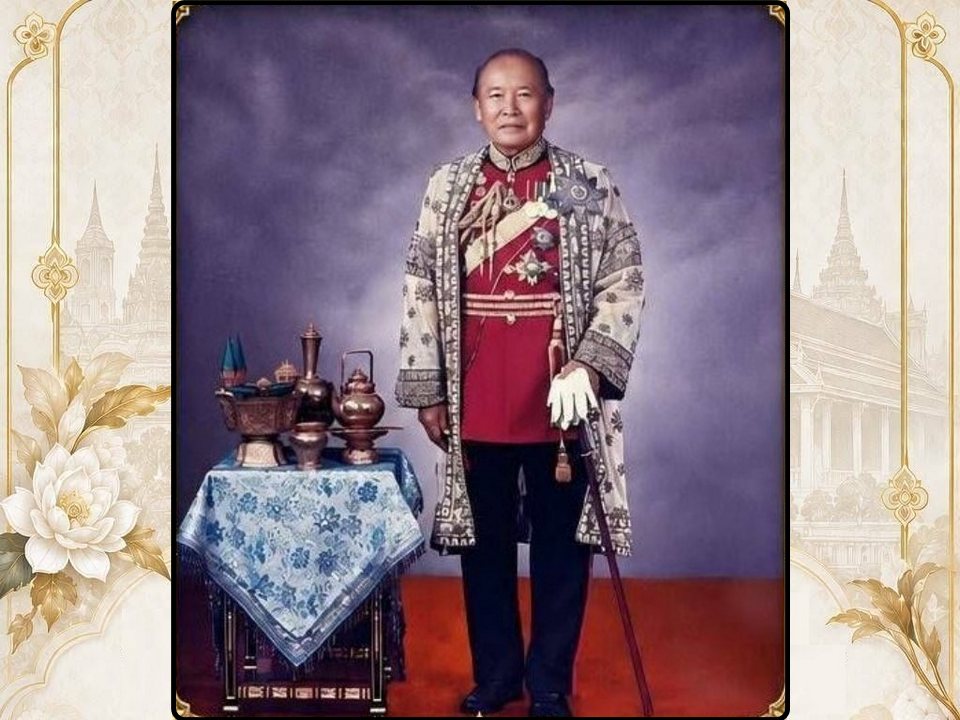
BANGKOK, Thailand – General Saiyudh Kerdphol, former Supreme Commander of the Royal Thai Armed Forces whose life encompassed wartime service, efforts to strengthen democratic participation and more than half a century in Rotary, died on October 30, 2026, aged 104. His passing has brought tributes from organisations that knew him as a military strategist, an advocate for credible elections and a dedicated humanitarian.
Born in 1922 in Sukhothai province, Gen. Saiyudh rose from a farming family to the highest levels of Thailand’s armed forces. His early military career included service in the Indochina conflict and with the Phayap Army during the Second World War. As a captain, he oversaw the surrender of Japanese forces in Nakhon Pathom in 1945. He later served in the Korean War, developing a career in military intelligence, operations and strategic planning that culminated in his appointment as Supreme Commander before his retirement in 1983.
His military career unfolded during some of Southeast Asia’s most turbulent decades. He helped establish Headquarters 333 in 1960, supporting Thailand’s covert operations in Laos, and became closely involved in the country’s response to the communist insurgency.
One of his most significant contributions was his advocacy of an approach that placed political understanding, rural development and reconciliation alongside security operations. His thinking helped lay the foundations for the policy associated with Prime Minister’s Office Order 66/2523, which encouraged insurgents to abandon armed struggle and return to civilian life. He also helped open a path home for students who had entered the jungle following the violence of October 6, 1976.
After retirement, Gen. Saiyudh remained active in public affairs. In 1986, he initiated a nonpartisan civic group to encourage public participation and scrutiny of political conduct. He subsequently served as deputy chairman of an election-monitoring committee established in 1992 and of the Democracy Development Committee in 1994.
His commitment to electoral oversight extended beyond Thailand. As longtime chairman of the People’s Network for Free Elections, vice chairman of the Poll Watch Foundation, and a founding member and president of the ANFREL Foundation, he supported election observation across Asia. His missions included Cambodia, Indonesia, Bangladesh, Pakistan and Sri Lanka. In 2008, he led a 100-member international observation mission for Nepal’s Constituent Assembly elections.
His later political interventions sometimes drew disagreement. During Thailand’s 2014 political crisis, he led a group of former senior officials proposing mediated talks and a framework for resolving the impasse. Supporters viewed the initiative as a route to reconciliation, while Pheu Thai Party representatives criticised it as a potential means of bypassing the elected government.
Rotary provided another enduring avenue for service. Gen. Saiyudh joined the Rotary Club of Bangkok in 1969, became club president in 1984-85 and served as District Governor in 1991-92. He was the last governor of District 335 before Thailand introduced its present four-district structure-Districts 3330, 3340, 3350 and 3360 in the 1992-93 Rotary year.
His humanitarian work brought practical assistance to communities recovering from conflict. He encouraged the Bangkok club’s support for northern hill tribe communities and later initiated its Khao Kho peacebuilding project. Under his leadership, a fundraising dinner in January 1982 raised 850,000 baht. Between 1981 and 1984, the club invested 780,000 baht in vocational training, farming and livelihoods at Khao Kho, helping villagers rebuild their futures through greater economic self-reliance.
As district governor, he helped establish the Rotary Centre in Thailand and prepare the transition to four districts—achievements he regarded with particular pride. He continued serving as an adviser to the Bangkok club’s board and chairman of its foundation.
Together with his wife, Rotarian Eva Maria Degli Albizi, he maintained a devoted presence at club meetings, achieving perfect attendance over many years. Fellow members remembered his warmth, generosity and intellectual curiosity, which remained evident beyond his hundredth birthday.
For Pattaya’s Rotarians, his message of understanding across cultures was particularly memorable. Reporting on his address to the Rotary Club of Pattaya in 2004, Pattaya Mail recorded his belief that cooperation among people of different backgrounds was essential to peace. He praised the club’s bilingual fellowship and urged members to “learn to love each other and work together as a team.”
That appeal reflected his conviction that Rotary could build friendships across differences of nationality, language and belief, turning tolerance and mutual respect into practical service.
Even his hundredth-birthday celebration became an occasion for giving. At a Rotary gathering in Bangkok on March 3, 2022, he presented scholarships to military nursing students, continuing his support for the next generation.
Away from public duties, he promoted vegetarian living, founding the Thai Vegetarian Union and serving as president of the Bangkok Vegetarian Society.
Funeral rites are being held at Sala 5, Wat Sommanat Ratchaworawihan in Bangkok. The royal cremation ceremony is scheduled for Saturday, November 7, 2026, at 3.30 p.m.
Across a life spanning more than a century, Gen. Saiyudh’s service reached from the battlefield to the ballot box and the Rotary meeting room. For those who shared his work and friendship, his legacy lives on in the communities he helped, the young people he encouraged and his enduring belief that understanding one another was the beginning of peace.