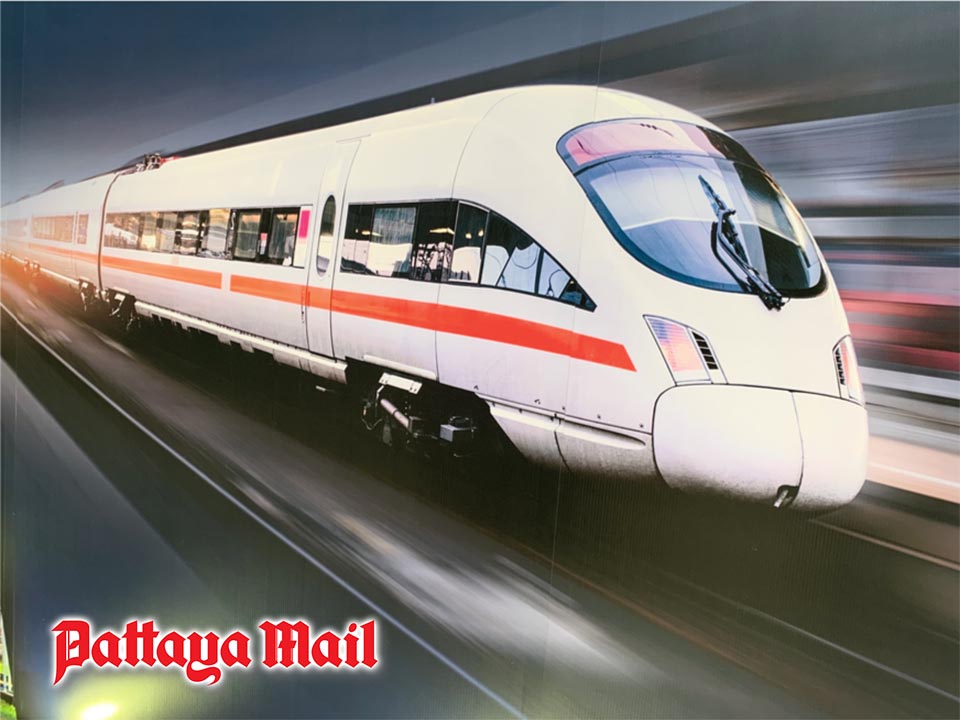
BANGKOK, Thailand – Thailand’s high-speed rail project linking Don Mueang, Suvarnabhumi and U-Tapao airports remains stalled nearly seven years after its concession agreement was signed on October 24, 2019. The 220-kilometre project, valued at 224.544 billion baht, was awarded to Asia Era One Co., a consortium led by the Charoen Pokphand Group (CP), under a 50-year concession.
The project’s future has become increasingly uncertain following a dispute over proposed changes to the joint investment contract and the State Railway of Thailand’s (SRT) latest legal action against the private concessionaire and related parties.
Dispute over construction payments
The central issue is CP’s request to change the construction payment arrangement to a “build-and-pay-as-you-go” model. Under the original agreement, the private sector was expected to finance construction during the first five years, with the government reimbursing the investment from the sixth to the fifteenth year.
The COVID-19 pandemic disrupted travel patterns and financing plans, prompting the concessionaire to seek a revised arrangement. The proposal received consideration from the Eastern Economic Corridor (EEC) Policy Committee and the Office of the Attorney General in 2024, but final approval remains outstanding.
Prime Minister and Interior Minister Anutin Charnvirakul and Transport Minister Phiphat Ratchakitprakarn have indicated that amending the contract will not be straightforward. The proposal must again pass through the EEC Policy Committee and Cabinet before it can proceed.
CP seeks to end the agreement
On July 6, 2026, Asia Era One wrote to the SRT exercising its contractual rights to seek termination of the joint investment agreement, with September 30 specified as the proposed termination date. The request also covered the Airport Rail Link operation.
The SRT subsequently asked the company to withdraw its termination notice to allow negotiations to continue. CP did not withdraw the letter but agreed to continue operating the Airport Rail Link for a further four months, until January 2027, while arrangements are made for an SRT subsidiary to take over. The extension is subject to separating the Airport Rail Link arrangement from the high-speed rail concession.
SRT Governor Anan Phonimdaeng said the two sides had held one round of talks but had not reached agreement. The railway had asked the private company to confirm its position on termination, but had not yet received a response.
The SRT board is due to meet on October 30, when the issue may become clearer before being referred to the EEC Policy Committee.
SRT files 13.34-billion-baht lawsuit
On October 21, the SRT filed a lawsuit with the Central Administrative Court seeking payment of Airport Rail Link concession fees and default interest totaling 13.33593 billion baht.
The principal claim against Asia Era One amounts to 10.67109 billion baht, with a further 2.66484 billion baht in default interest calculated up to the filing date.
The railway also named Bangkok Bank and Siam Commercial Bank as guarantors, each with a guarantee limit of 1 billion baht. Five companies were named in connection with letters of guarantee covering potential damages arising from contractual non-performance: Charoen Pokphand Holding, with a 70% investment share; China Railway Construction Corporation, with 10%; Bangkok Expressway and Metro, with 10%; CH. Karnchang, with 5%; and Italian-Thai Development, with 5%.
The SRT said the legal action was intended to protect the state’s rights and would not affect public services. Airport Rail Link trains continue to operate normally.
Contract dispute could take years
The Airport Rail Link payment issue is closely connected to the wider dispute over the high-speed rail contract. According to a report citing a Transport Ministry source, the concession fee had originally been due from October 24, 2021. Following the pandemic, a memorandum of understanding and Cabinet approval allowed the payment issue to be incorporated into the proposed contract-revision package.
However, the revised agreement had not received the necessary EEC committee and Cabinet approvals before the September 30 deadline. As a result, neither the revised payment arrangement nor the wider contract changes had been finalised.
The SRT maintains that the private partner cannot terminate the agreement unilaterally and considers the signed contract valid. The parties are expected to face a further dispute over the termination request, with the possibility of court proceedings if negotiations fail.
A lengthy legal process could take three to five years or more, depending on whether the case proceeds to the Supreme Administrative Court. Any termination could also lead to separate disputes over damages, which both parties would need to establish.
Alternative rail plans under consideration
If the original high-speed rail project cannot proceed, the government may need to consider alternative rail development plans. The SRT has previously discussed services operating at up to 160 kilometres per hour, alongside other infrastructure projects.
Options include the 25.9-kilometre Red Line Missing Link connecting Bang Sue, Phaya Thai, Makkasan and Hua Mak, together with a section between Bang Sue and Hua Lamphong, estimated to cost 44.573 billion baht.
Another proposal would extend the Airport Rail Link from Phaya Thai to Krung Thep Aphiwat Central Terminal, covering 7.8 kilometres at an estimated cost of 14.984 billion baht. Plans have also included electrifying and developing double-track rail infrastructure along the 187-kilometre Hua Mak–Chachoengsao–U-Tapao corridor.
Extending the Thailand–China railway towards Laem Chabang and Rayong has also been raised as a possible option.
With the seventh anniversary of the concession agreement approaching on October 24, the project remains at a crossroads. Its next phase will depend on whether the government and private partner can resolve the payment and contract disputes, or whether Thailand must pursue a different rail development model. (Story, Photo: Prachachat Business)