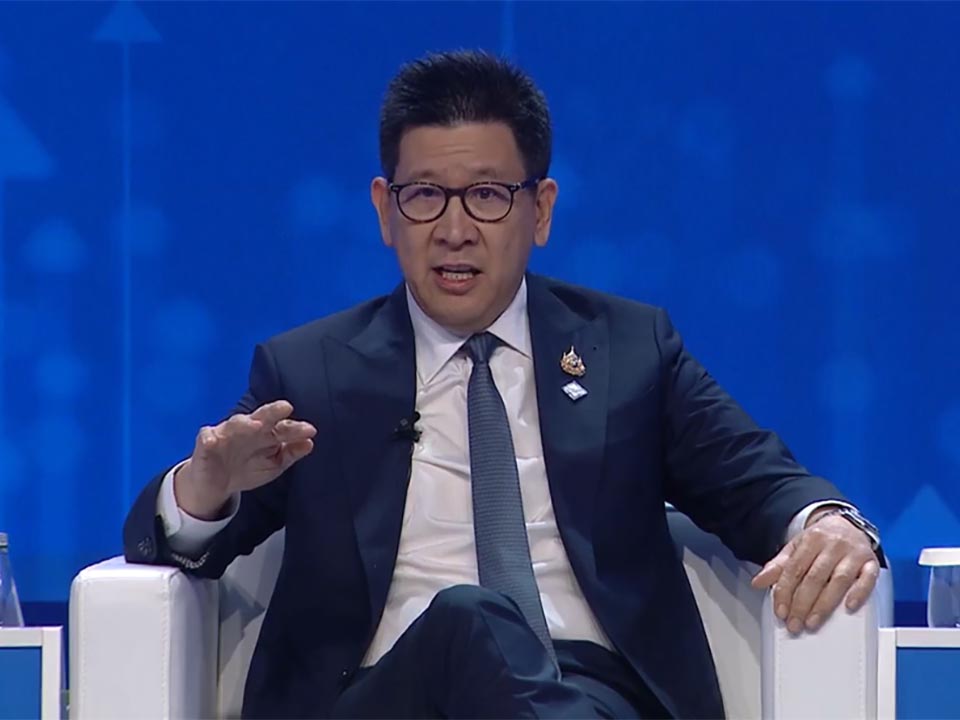
BANGKOK, Thailand – Deputy Prime Minister and Finance Minister Ekniti Nitithanprapas has detailed Thailand’s plans to bridge the gap between major and smaller economies by promoting international cooperation, attracting foreign investment, and developing domestic capabilities amid an uneven global recovery. Speaking at the Building Resilience in a Fragmented World flagship event during the 2026 IMF–World Bank Group Annual Meetings in Bangkok, Ekniti described a K-shaped recovery in which major economies and large corporations advance while smaller economies and businesses face greater economic pressures.
Ekniti explained that Thailand is well-positioned to serve as a trusted connector between large and small economies through international cooperation and support for a rules-based global system. He cited cross-border renewable energy trade from Laos to Singapore as an example of Thailand’s role in facilitating regional economic connectivity within ASEAN.
The finance minister also underscored the importance of maintaining trust through domestic reforms and international engagement. He described Thailand’s hosting of the 2026 IMF–World Bank Group Annual Meetings, often referred to as the Olympics of Finance, as an opportunity to reinforce international confidence in the country. Thailand is hosting the meetings for the second time, following its first in 1991.
To improve long-term economic resilience, the government is working to connect domestic supply chains with global markets. Foreign direct investment incentives are being used to encourage technology transfer and partnerships with universities, helping Thai workers acquire skills needed in a changing economy.
Ekniti stressed that foreign investment should deliver benefits beyond immediate capital inflows. By converting investment into technological expertise, workforce development, and lasting domestic capabilities, the Thai government is now working to expand economic opportunities and establish itself as a reliable link between economies in an increasingly fragmented world. (NNT)