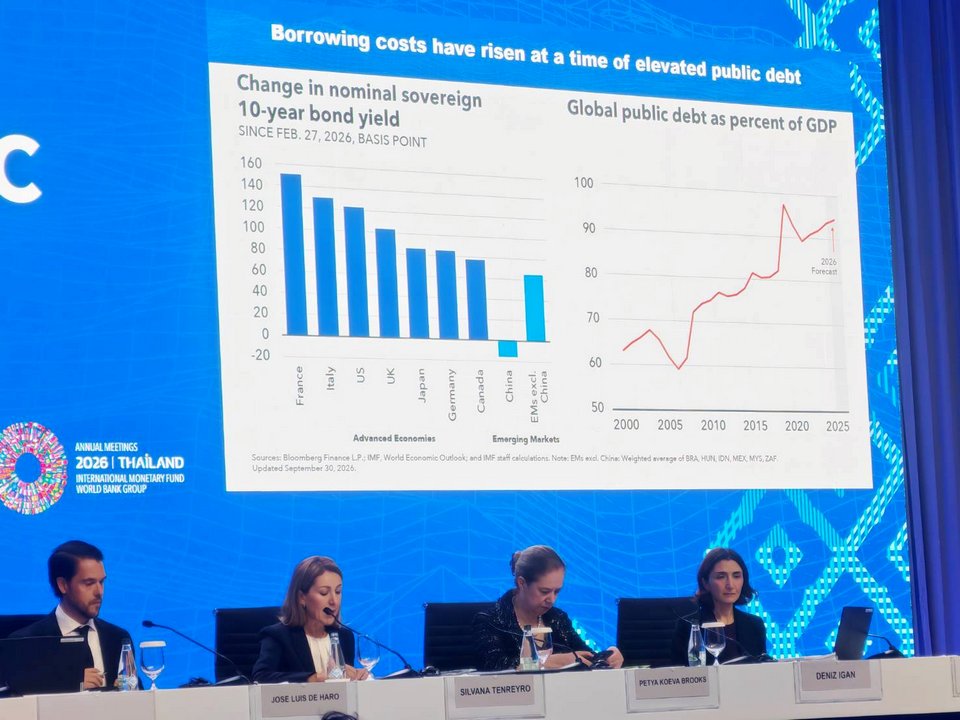
BANGKOK, Thailand – Global economic resilience is reaching its limits and faces significant downside risks from war, high debt, and potential bottlenecks in artificial intelligence, the International Monetary Fund (IMF) warned. Speaking at the 2026 IMF- World Bank Group Annual Meetings in Bangkok, Silvana Tenreyro, Economic Counsellor and Director of Research at the IMF, unveiled the latest World Economic Outlook report, noting that while the global economy has shown resilience to past shocks, that buffer is now wearing thin.
GROWTH FORECAST CUT
The IMF projects global economic growth at 3.1% this year, down 0.4 percentage points from last year, before ticking up slightly to 3.4% in 2027. Global headline inflation is expected to remain elevated at 4.7% this year before easing to 4.1% in 2027.
The research director highlighted two opposing forces driving current global economic trends:
Negative supply shock: Geopolitical conflicts and war, particularly in the Middle East, have driven up prices for crude oil, natural gas, and refined petroleum products (diesel and jet fuel), weighing on economic activity and accelerating inflation.
Positive demand shock: Surging interest and investment in artificial intelligence (AI) have provided a counterweight, boosting global trade and investment.
THREE KEY RISKS WEIGHING ON RESILIENCE
The latest report outlines three critical risk factors dampening global recovery:
1. Energy and commodity buffers strain: Mitigation mechanisms in energy markets, such as tapping oil reserves or enhancing energy efficiency, are stretching tight. Without these buffers, global growth could slide to 2.5% this year.
2. AI supply chain concentration: Although AI adoption supports growth, its supply chain remains heavily concentrated in a few countries and leading firms, posing bottleneck risks alongside potential tech stock corrections and cybersecurity threats.
3. Fiscal burdens and higher borrowing costs: Elevated public debt combined with high interest rates and borrowing costs continues to squeeze fiscal space in many nations.
POLICY RECOMMENDATIONS: FROM “COPING” TO “RESTORING”
To counter these mounting risks, Tenreyro urged member countries to adopt firm policy measures:
Fiscal policy: Governments must maintain strict fiscal discipline and accelerate deficit reduction to steer public debt ratios onto a sustainable path.
Monetary policy: Central banks must maintain a sufficiently tight stance to keep inflation within target ranges while safeguarding central bank independence. “The most important task ahead for all countries is to transition from merely ‘coping’ to ‘restoring’ fiscal space and supply-side resilience to build a truly sustainable foundation for growth,” Tenreyro concluded. (TNA)