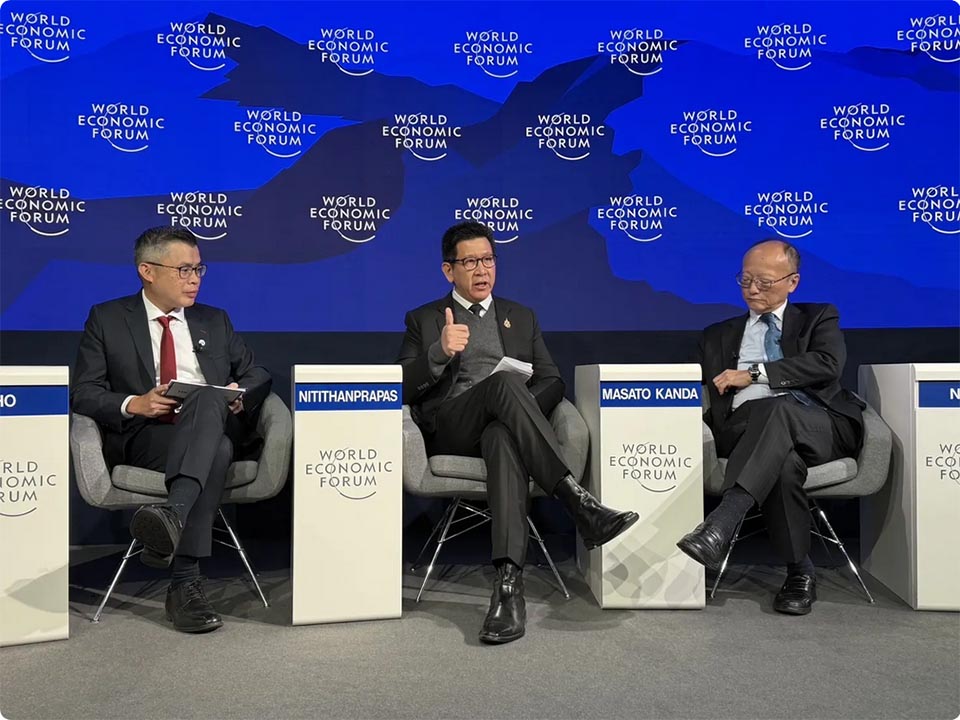
BANGKOK, Thailand – Deputy Prime Minister and Minister of Finance Ekniti Nitithanprapas participated in the World Economic Forum (WEF) 2026 in Davos on January 22 as a principal panelist in the session “Is ASEAN Moving Fast Enough?”, where he discussed ASEAN’s strategic path forward amid growing global geo-economic volatility.
Ekniti observed that ASEAN is being tested by three major megashifts. The first is the convergence of geopolitics and geoeconomics, which is influencing global trade patterns and disrupting supply chains. The second is the rapid advance of artificial intelligence, fundamentally transforming productivity and economic structures. The third is climate change, which is accelerating the global transition toward green growth and sustainable economic models.
The deputy prime minister stressed that ASEAN still holds key structural advantages, particularly its openness, strategic neutrality, and adherence to a rules-based international system, at a time when global economic power is increasingly fragmented. These strengths, he noted, can serve as a stabilizing force—if ASEAN moves decisively from dialogue to implementation.
Ekniti also underscored the urgency of accelerating action through targeted investment in infrastructure, energy, transport, and digital connectivity, alongside workforce reskilling and upskilling, and the effective integration of small and medium-sized enterprises into regional and global value chains.
Ekniti added that such progress would deliver clear benefits for Thailand, including attracting high-quality foreign direct investment and advancing economic transformation toward future industries and high-value services. At the regional level, he called for stronger cooperation on digital governance, cybersecurity, and the green economy, to ensure that ASEAN’s growth is inclusive, sustainable, and resilient over the long term. (NNT)