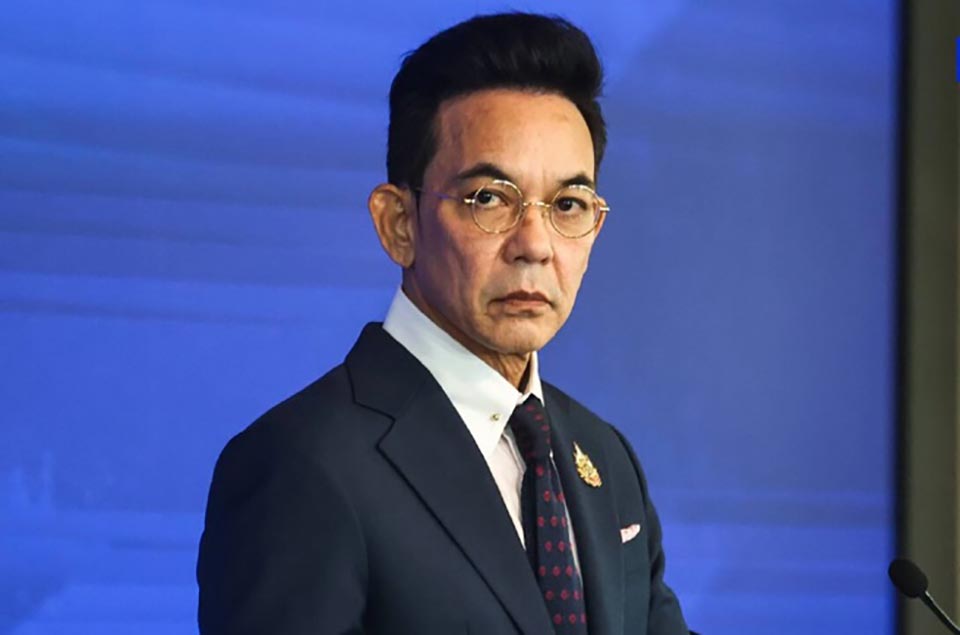
BANGKOK, Thailand – Nikorndej Balankura, Director-General of the Department of Information and Spokesman for the Thai Ministry of Foreign Affairs, held a press briefing today at around 1:00 PM to address the Thai-Cambodian border situation and responded strongly to Cambodian Senate President Hun Sen’s ultimatum, calling it inappropriate and damaging to bilateral trust.
Hun Sen had issued an ultimatum demanding Thailand restore normal checkpoint operating hours by tomorrow or face a full border closure and import ban. Nikorndej stated that such threats are not in line with international principles and do not reflect the behavior of a good neighbor.
“Being a good neighbor does not involve issuing ultimatums without constructive dialogue,” he said. “Such actions risk harming the people on both sides the most.”
Thailand, he added, has always prioritized the interests of its people and responded at the government level without targeting civilians. He emphasized that social media communication and unofficial channels often cause misunderstandings and reflect Cambodia’s lack of sincerity in using existing bilateral mechanisms.
“The Thai government exercises restraint and careful judgment in responding to these matters. We will not allow foreign relations to become politicized or handled emotionally,” he said.
On the issue of foreign workers, Nikorndej clarified that Prime Minister Paetongtarn Shinawatra had already stated that Thailand has never intended to expel foreign laborers. Any decision to leave the country rests solely with the workers.
JBC Meeting: Progress Despite Tensions
Addressing the outcomes of the 6th Thai-Cambodian Joint Boundary Commission (JBC) meeting held in Phnom Penh, the spokesman reiterated Thailand’s firm commitment to bilateral mechanisms and good-faith negotiations. He noted that Thailand had entered the JBC meeting sincerely and in good faith to achieve outcomes beneficial to both nations.
“Unfortunately, Cambodia chose not to engage constructively, and instead decided to pursue four disputed border areas through the International Court of Justice (ICJ),” Nikorndej said.
The four areas are Chong Bok, Ta Muen Thom Temple, Ta Muen Tot Temple, and Ta Kwai Temple. Cambodia declined to include these areas in the JBC agenda, despite the fact that boundary issues fall squarely within the JBC’s technical mandate.
“Thailand expressed deep disappointment that Cambodia refused to discuss these technical matters within the proper framework,” he said.
Thailand Reaffirms Use of JBC Mechanism
Despite tensions, Nikorndej stressed that the JBC remains a viable and effective bilateral mechanism, having functioned for over 25 years. He confirmed that Thailand will host a special session of the JBC in Bangkok this September.
Regarding the ICJ, he reaffirmed that Thailand does not recognize the court’s jurisdiction over the matter, a position held consistently since 1960. The Cambodian side has been made aware of this during the JBC session, and the Thai Ministry of Foreign Affairs is already preparing strategies to respond.
Briefing for Foreign Diplomats
Finally, Nikorndej announced that the Ministry would hold a briefing for the diplomatic corps at 3:30 PM to present the facts and reaffirm Thailand’s longstanding peaceful policy and its commitment to continued diplomacy and mutual understanding.
“We have never been complacent,” he concluded. “This government is committed to informing the international community with transparency and in the spirit of peace.”