FEATURES

HEADLINES [click on headline to view story]:
 
Dolf Riks: Travelling in Thailand in the early sixties
 
Thailand’s elephant population victims of modernization
 
Exhibition City
 
Successfully Yours: Kim Fletcher
 
Automania
 

Dolf Riks: Travelling in Thailand in the early sixties

In 1961 I came to this country and rented a bungalow type house off Sukhumvit Road in Bangkok. I was going to be an artist and to get some inspiration, I decided to see more of the country. Travel in those days was different from now. The roads were generally in poor shape, full of potholes, dusty in the dry season while many were flooded during the west monsoon, which often made them impassable. American friends who owned a car once invited me to visit Ayuthaya, but we had to turn back only a short while after we passed the airport, as the countryside was one big lake - including the highway. Most of my travel I did by train and bus but I preferred the former, as the colourful busses in those days were not only unreliable but most uncomfortable and although they could not achieve the speed of the present day monsters, they were just as perilous.

I visited Goh Samui when hardly anybody went there and most people had never heard of the place. I embarked on a coaster from the Thai Navigation Company called the Bandon and made a voyage to Songklah and Narathivas. I also went up north to Chiang Rai, Mae Sarieng, Chiang Mai, Lampang and so forth.

Usually I made these expeditions on my own, until I became friends with an American free lance teacher who lived in the Saladaeng area. He was called Vance and a bit of a character. Vance was a good and straightforward man but he had quite a temper and a low flash point. The doctors in New York had told him in the late fifties that he had not long to live, but he was stubborn and died about twenty five years later. Travel with Vance could be quite difficult as he was rather picky about what he ate and he also suffered from diabetes mellitus.

At one time I proposed to make a trip to Rathburi, a town in the west of the country where I had never been. Early in the morning we took the train to the south from Bangkok Noi railway station and on arrival in Rathburi we left it and rented rooms in a small Chinese hotel over an open restaurant. After we did some sightseeing we had dinner in the market place on the banks of the Menam Maeklong River and the following day we were going to rent Samlors (Trishaws) to see more of the temples and the surrounding countryside.

In the morning Vance stated that he would have a western style breakfast and since my Thai was slightly better than his, I was supposed to order it. What he wanted was two soft boiled eggs, black coffee without sugar and two pieces of toast with butter. In those days there were no western style coffee shops in the country towns so we sat down in the restaurant on the ground floor. The Chinese woman who operated the place with her husband came over and I ordered in my best Thai, Vance’s breakfast and for myself a plate of rice with Moo Deang (red pork).

First the eggs, which were brown and greasy, were brought to the table. They had - as I later found out - been dumped in a big pot with simmering pork stew for a while. Vance looked at it with suspicion and carefully proceeded to break the top of one, discovering that what was inside was hardly cooked at all. It is called "Gy Luak", or eggs briefly put in hot liquid. Usually they are broken into a cup, some soup sauce or soy is added and the whole unappetising mixture is spooned up. I immediately noticed Vance’s horror and displeasure so I hastened to tell the lady to cook the eggs a little more. Off she went slightly irritated about the fuss.

The Thai coffee, old style, mixed with roasted tamarind seeds, was served in a glass, with a thick layer of condensed sweetened milk on the bottom. She, apparently, had never heard of people who drank unsweetened coffee and as I had said, "no sugar" she had substituted the sweet creamy milk. My friend’s face showed his anger at this point and I felt very guilty indeed. After explaining what the gentleman wanted, the proprietress took the coffee away and came back with two pieces of thick Chinese bread, generously spread with orange coloured margarine and sprinkled with a thick layer of sugar. This was it. Vance was livid. Albeit the eggs came back overcooked of course, the black coffee came without a sweetener and the toast without sugar or grease, he did not recover from this disastrous meal until the next morning, when we had fried rice before we boarded the train back to Bangkok.

When Vance became a more seasoned traveller, we ventured a trip to Phuket. By train we went to Chumpon where we stayed the night in a Chinese hotel. The next day we took a bus to Ranong where we slept in a most peculiar flophouse where gambling and other nocturnal activities went on until the crack of dawn. We paid the bill and bleary eyed, boarded the bus to Phuket.

It was in those days that the road was widened and the bridges across the small streams to the Andaman Sea were also being enlarged. The colorfully decorated buses were made of wood, including the seats, and we were given a place of honour next to the driver. This was a harrowing experience being directly faced with the dangerous practices of Thai bus drivers. Only later we found out that the bus people thought we were missionaries, that’s why we had the seats usually reserved for monks. We did not enlighten them. Every now and then the bus was let through a stream, as the bridges were in disrepair and sometimes we even had to walk over one or along the road because it was too dangerous to stay in the bus when navigating a particular weak structure or a bad stretch. I recall that it took us until late in the afternoon to reach the ferry to the island, as the Sarasin Bridge from the mainland to the island had not been build yet.

The tourist resorts and the developments in Phuket had not been built. Accommodations were simple and cheap. We stayed in - I recall the name - Senthavee Hotel in downtown Phuket, which was full with travelling salesmen. We toured the island for a couple of days and went to several, still deserted beaches like Rawai, Surin and Patong Beach, the latter is now a second Pattaya. After a couple of days we took the bus back to Chumpon and were treated again with the utmost courtesy by the staff. A drawback was that in the back of the bus a few crates with fish in brine were stowed, which seeped, and every time the bus driver stepped on his brakes, a thick smelly liquid flowed over the floor to the front. The result was that, unless we raised our feet, we, on the front bench, were sitting with our shoes in this pungent ooze.
Back to Features Headline Index

Thailand’s elephant population victims of modernization

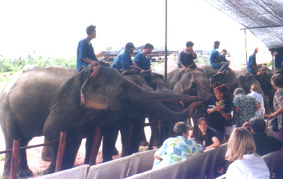
Most of the Elephants in the various entertainment venues of Pattaya are from Surin Province. This province is the home of the rapidly disappearing Suay people. The Suay are a tribal people whose language, of mysterious origin, resembles a combination of Vietnamese and Cambodian. This group has been famous for centuries as the ‘elephant people’. The Suay are masters at domesticating wild elephants. This is their whole culture and a complex and revered ritual is connected to every aspect of ‘elephant wrangling.’ With consummate respect for these majestic beasts, the Suay capture the elephants and offer the souls of the animals respect and care for work done in kind.

f2.JPG (44541 bytes)Elephant shows are a big attraction for tourists. But are they actually helping or hurting the massive creatures?
Due to the modernization of Thailand, the elephant’s natural habitat and the forests on which they feed is quickly disappearing. The old medicines used for treating the animals when ill have disappeared, along with the forests, and there is a need for new techniques to care for the animals.

Dr. Suvit Yordboonmee has had audiences with His Majesty the King on various ways to keep the elephants healthy in the modern world. From statistics, there are now 83 domestic elephants who are seriously ill.

Dr. Suvit said that various entertainment venues in Pattaya are contributing to the problem by keeping elephants for shows and entertainment without the slightest idea of how to take care of them.

At this point, Thailand is in a bit of a ‘double bind’ situation. The wild habitat for the elephants is disappearing. This makes the need for ‘elephant’ reserves even greater. The elephants are at a disadvantage in captivity as there are not enough experts to care for them. Elephants can watch over themselves in the wild. But in captivity, they must depend on human beings who often do not know their needs.

Back to Features Headline Index

Exhibiton City

The Mini Siam Exhibition City is located diagonally across from the Bangkok-Pattaya Hospital on the edge of Sukhumvit Road. It was built as an exhibition city of arts from around the world, and is the only place in Thailand which has gathered together the artistic treasures of the world and from Thailand on a 1:25 scale.

There are only two other places in the world like it, at Modurodom in Holland and Window on China in Taiwan.

The building began in 1986 by artisans who are mostly graduates of the Poh Chang Academy in Bangkok.

During the first stage in 1986, the exhibitions were laid out using cement for the ancient Thai structures. This was opened to the public in 1987. In 1988, the mini-Europe section was added in front of mini-Siam. These days, it has the slogan ‘Visit all of Thailand by going to the exhibition city.’

The open-air site is situated on more than 10 square rai. Visitors may walk around as they wish at about 1:45 p.m. They may take pictures as souvenirs, but video camera owners must pay 100 baht per machine.

The area is divided into two sections; the front is ‘mini-Europe’ and the ‘mini-world’ with such attractions as the Eiffel Tower of France, the Statue of Liberty of the United States, the ‘Atonium’ of Belgium, and St. Basil’s of Russia. The back is ‘mini-Siam’, where there are exhibitions of Thai artistic cultural places of the past, such as the Temple of the Emerald Buddha, Bangkok Airport (Don Muang), the Golden Mountain, the Phnom Rung Castle and the Victory Monument.

Aside from this there is a ‘show corner’ with Thai dance and a restaurant which has Chinese food as the main attraction. This is because most of the tourists are Chinese and Taiwanese and Hong Kong people. Other tourists usually come in small groups.

Unfortunately, Exhibition City practices a "double-pricing" policy. The entrance fee for Thai people is 80 baht for adults and 40 baht for children. For foreigners the entrance fee is 200 baht for adults and 100 baht for children. Those interested in booking group tours may receive a discount by calling the public relations department at (038) 421-628, or 424-232 every day.

Back to Features Headline Index

Successfully Yours: Kim Fletcher

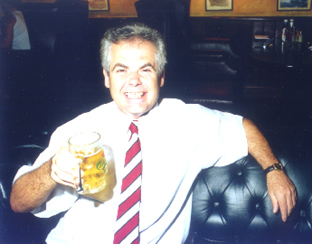
The new manager of Delaney’s, Kim Fletcher, is a publican through and through. He was born in a pub, has a publican’s "hail-fellow-well-met" personality, and will probably die in a pub. It just could be that he keels over on the Hash House Harriers fun runs he indulges in. Not that I am pointing the bone.

f4.JPG (50322 bytes)Photo: Kim Fletcher

Kim really was born in a pub, "The Market House" in Maidstone, Kent. Kim says, "Not many people can accurately say they were born in a pub. What they usually mean is their parents owned one at the time. Well I was born on the spot. My Mum just opened up and then had me behind the bar."

Kim was seven years old when his parents packed him off to boarding school, where he stayed until age seventeen. This probably taught him how to be a survivor. It then took Kim a year of doing his worst behind the bar and chatting up the older patrons before he was able to persuade his parents to send him off to catering college.

After learning his trade there he returned home absolutely sure that he knew everything. "I was a right cheeky chap then. After a big blow up, my Dad took me out and bought me a beer. Then he gave me the best advice about this business I’ve ever had. ‘There are only three important things to do, son. As soon as a person comes through the door, say Hello. If you remember their name, even better. Have their drink on the bar before they ask for it. Work very hard behind the scenes, but never appear to be busy in front of your customers.’ My Dad had it all worked out".

Kim chose the hospitality industry because, "I was born to it, but it gave me a great chance to mix with the older lads and find out about rock and roll." Beatles to the music of the early eighties are his passion. Ask Kim any question on rock and roll in these eras and he is sure he can answer it.

After a three-year stint as head chef of the Brunswick Restaurant in London, and losing all his hard earned savings on the stock market in thirty-six hours, Kim tried his luck in Saudi Arabia.

About fourteen years ago he discovered that Thailand was more to his liking and relocated to Bangkok to spend eighteen months working at the Copper Pan Restaurant there. Next, together with a partner he opened his own restaurant "Jools". Perhaps not surprisingly, Jools has the atmosphere of a British country pub as well. After ten years there, he left the restaurant in the charge of his partner and moved to Pattaya. "It’s much better here for the kids than Bangkok."

Kim says the most important values for him are his children, and being happy. In addition, "I don’t have to leave here to see my friends. They all come to Delaney’s to find me. They even phone, fax and email me to make sure I’ll be in!"

Mine host at Delaney’s has advice for prospective publicans in Pattaya. "In a word: Don’t," he says. "Not unless you have previous experience and can fill a gap in the market. There are just too many bars here and not enough customers."

Kim’s goals and future plans are to stay at Delaney’s playing ‘Lord of the Manor’ so that he can make it the number one five star pub in Pattaya.

His last words were, (This is no lie. Would I put words in a man’s mouth?), "I can tell you how to make a small fortune in Pattaya, just start out with a big one." Thanks Kim.

Back to Features Headline Index

Automania: Driving by the Book

by Dr. Iain Corness

I don’t know about you, but books on all things motoring have always been an important part of my library. Thailand, however, is not the world’s best English language bookstore. In fact, the general Thai bookshops are very light on when it comes to motoring books. Lots of shelves full of the life and times of Buddhism, but precious little on the life and times of Bugatti or Bentley.

My wife, who is a card carrying bookaholic, took me into "Bookazine" in the Royal Garden Shopping Mall the other day and, wonder of wonders, a very reasonable motoring section! It’s in the central area down the far end and there are two shelves full of a sizeable number of different book titles. Well done, Bookazine!

Autotrivia Quiz

While I was away overseas, the Automania columns were pre-written to keep the continuity going. Of course, this meant that when I came back there was this mountain of faxes and emails with answers to all of the questions posed over the past four weeks. There were lots of "good" answers, but not so many correct ones!

Winner of the Rolls-Royce question was regular Automania reader Bruno Buergi from Switzerland who was first in with his email. R-R rejected the name "Mist" for one of their models, because it does indeed mean "manure" (or an even more graphic and earthy 4 letter word, Bruno informs me) in German!

The 1953 car still in production today (and looking the same) was the Morris Oxford, now masquerading as the Hindustan Ambassador. This brought a very interesting crop of replies, all the way from Morgans and VW (built before 1953, I’m sorry, Martyn Callow in California!), to Sir Alec Issigonis’ Mini (after 1953) and London Taxicabs (no longer built in the 1950’s design).

So to this week’s question - "British Racing Green" (BRG) is the accepted colour for cars racing under the UK flag. Which British car company was the first to use it in competition? And when? The first correct answer wins the usual Automania FREE BEER of the week. Fax or email the editorial office. (Overseas entrants have to present themselves in person in Pattaya to get their beer - Bruno’s already let me know he’ll be over in November to claim his!)

Fiat Unplugs!

As reported in Bangkok’s English language newspaper, the deal between Fiat in Italy and the local assembler, the PNA Group, has fallen over. PNA wanted Fiat to put up the cash, but the Italians felt that by bringing over the technology that was enough. A Mexican stand-off eventually resulted in Fiat’s fingers to Thailand and loss of revenue for the Eastern Seaboard. Shame really, as the Laem Chabang assembly factory would have been the biggest winner.

When I was over in the UK last month I had the opportunity to test a few of the new offerings from Fiat. The Marea was one of the most impressive small cars I have driven in a long time. This is a four door of around the Toyota Corolla size and felt much roomier inside than the Japanese car. It was truly an easy 5 seater. The boot space was gargantuan, helped by the high tailed styling. The "bubble" shaped tail lights looked strangely out of place, however!

An interesting three valve engine of 1400 cc is available, which was very fuel efficient, if perhaps somewhat low on horsepower. I think the term "gutless" sprang to mind at the time, as I struggled to pass a fully laden semi-trailer! The 1600 cc 4 valve engine delivered a much more acceptable road performance.

Good range of options, but the most impressive feature was the road-holding which was simply breathtaking. It cornered very flat, with no evidence of complaint from the suspension and the 4 wheel disc brakes (with ABS) were sensational. Variable ratio power steering completed what is an exceptionally good package (and one you’re not going to get here, more’s the pity!).

Mind you, after the larger Fiats I then had a little one for four days. The Punto is not one you are going to grieve over, let me tell you. An underpowered, noisy, uncomfortable disappointment. Where the Marea had zero wind noise, the Punto defied all efforts of trying to get any ventilation into the car without "drumming". Even the old tricks of just cracking open the sunroof and a 1/4 inch gap in the rear windows failed to stop it. The driving seat was abysmally designed being hard and lumpy, while the driving compartment was obviously built for a person with two foot legs and five foot arms! It was difficult to conceive that the Marea and the Punto had come from the same manufacturer.

A Small Fortune!

It has often been said that to make a small fortune out of motor racing, it’s best to start with a large one! For the average Joe this may be so, but for those few who do make it to the top there are obviously some very worthwhile rewards.

Hidden away in the woodlands of Devon is a very exclusive golf club, owned by ex-world F1 champion Nigel Mansell. "Our Nige", as he was christened by his army of British fans, came across the run-down golf course and snapped it up for a mere one and a half million pounds (or one hundred and two million Baht if you prefer the local currency - you silly twisted boy!).

Getting his mate Greg Norman to pop over, they enlarged the course, adding another 9 holes, built a huge clubhouse (inside which Nige has an F1 Ferrari and an F1 Williams), produced a Sports Club building and then built a house for Nige with a four hole (private) course around it. The plumbing alone in Nige’s cottage was over 1 million quid!

The complex is called Woodbury Park, his helmet is carved into the wooden gates and the final hole has a chequered flag, naturally. No, our Nige isn’t short of a bob, believe me!

Back to Features Headline Index

Copyright 1998 Pattaya Mail Publishing Co.Ltd.
370/7-8 Pattaya Second Road, Pattaya City, Chonburi 20260, Thailand 
Tel.66-38 411 240-1, 413 240-1, Fax:66-38 427 596; e-mail: [email protected]
Created by Andy Gombaz
, assisted by Chinnaporn Sangwanlek.