Family Money: The Cost of Dying
In recent weeks I have had a surprising number of enquiries about wills, probate, inheritance taxes, appointing executors and their functions, funeral costs, and other aspects of departing this mortal coil.
In northern climes, more people die during the winter months than in summer. Perhaps this accounts for the number of enquiries Ive been receiving recently.
But it can happen to any one of us at any time, even if were still young and in good health.
For instance, have you noticed all the chalk marks on the roads around Pattaya lately? One thing that makes Thailand Amazing is that not more people get squashed on the roads each day, given the local driving skills. (Or perhaps we should just drop the first s, as it seems to be some sort of local competition: 1 point for each motorcyclist, with a bonus point for each passenger (up to a maximum of 4), plus an extra 5 points if you get the baby straddling the gas tank...)
Seriously, though, it is truly amazing how few people I meet professionally seem to know how to prepare for their final journey, and potentially would leave all sorts of problems behind them for their grieving loved ones to sort out (and in some cases not-so-loved ones to fight about).
Making proper arrangements in advance of your final departure is a simple kindness to your family and loved ones.
And although such arrangements can be quite simple, they should not be taken lightly or hastily. Otherwise things can end up even more complicated.
A lack of adequate preparation can cause your family and loved ones not only additional grief and suffering when they least need it, but also lead to bickering over your possessions, and in some cases even acrimonious court battles that can drag on for years.
In the latter case, the eventual winners are always the lawyers.
Where theres a will
First and foremost, anyone living abroad should have a Will.
It doesnt matter if youre young and unmarried, or believe youll live forever - you should have a Will.
Let me illustrate this with a true story of a sad personal experience which still haunts me.
Some years ago I was at a party where one of the guests, a friend of mine, had rather too much to drink, and accidentally fell off the balcony.
As this was from the fourth floor, he landed with a nasty thud on the carpark below. At first we imagined he would just get up and wave. Unfortunately he didnt.
Having had an advanced course in first aid, I tried to do what I could to keep him going until the ambulance eventually arrived, but sadly he was already dead by then.
The local police, after conducting a thorough search of the flat and failing to find any illegal substances (there werent any to find), and an even more thorough interrogation of all the guests (imagining perhaps that someone had pushed our friend over the balcony in a jealous rage), deduced from the autopsy report that our friend had committed suicide (which none of the guests believed for an instant).
However, as our young friend had not left a Will, the British Embassy contacted his next of kin - his mother - through her local constabulary, whereby a very junior officer was dispatched to her home and with inimitable tact, blithely announced, "You son S- has committed suicide. What do you want done with the body?"
She, of course, shocked at this bolt from the blue, blurted out the first thing that occurred to her: "Send him home!"
PC Plod calmly reported this instruction back to his superiors, who reported it to the Foreign Office, who reported it to the local British Embassy, who made the arrangements to fly our friends body back to Scotland, after which his poor mother was presented with a total bill of some £5,500!
Had our friend made a Will, his wishes to be cremated (which I knew, but had no authority to carry out in the absence of a Will) would have been followed, and a small urn containing his ashes sent back to Scotland, at considerably less expense to his widowed mother.
Whats in a Will?The person who makes the Will is called the Testator.
A Will should address three areas: 1) your appointment of an Executor; 2) your wishes as to the disposal of your mortal remains; 3) the distribution of your assets. All property can be disposed of by a Will.
Lets look at these in more detail, starting with the second.
Living overseas it is especially important that a Will should include clear instructions regarding what you want done with your body (burial, cremation, funeral or religious ceremony).
Typically your Will will direct your Executor to arrange payment for same as well as your debts as soon as possible after your decease.
So first you need to decide if you wish to be buried or cremated. With or without religious ceremony? Any special requests?
If you wish to be repatriated to your home country for burial, the costs can be very high - at least several thousands of pounds (or dollars).
However, a recent innovation is the pre-paid international funeral plan, whereby all these costs and arrangements may be made during your lifetime, thereby relieving your family of the burden (and costs) of making these arrangements upon your demise.
A cremation in Thailand, on the other hand, can be a bit more complicated than Western-style funeral arrangements, especially if you want the full Buddhist ceremonials, but the "full works" typically costs a total of under Bt50,000 plus whatever you might wish to contribute to the Wat.
Do you need an Executor?
The appointment of an Executor is standard, and your Executor is simply someone entrusted to arrange your affairs and dispose of your estate upon your death.
This can be your spouse, relative, trusted friend, or banker or solicitor.
However, it is generally preferable if your Executor is not a beneficiary of the Will, to avoid accusations of vested interest or bias.
The main function of an Executor is to ensure your wishes are carried out, speedily and efficiently.
This involves arranging for your debts to be cleared, may include taking care of the funeral arrangements, and always involves the processing of your estate through probate, and subsequent distribution of your assets to your heirs.
Depending on the complexity and location of your assets, this whole process may take a considerable amount of time and effort - and in some cases considerable expertise as well.
In the case of an international estate where assets are located in several different countries, a Grant of Administration has to be obtained from the courts of each regime where assets are held before these can be distributed to the heirs.
This is the process popularly known as probate.
Your appointed Executor therefore has to know in advance what assets you have, and where. Otherwise assets may be lost to the heirs forever (such as offshore bank accounts you never told them or anyone else about).
Additionally, most countries have inheritance laws which determine the amount of assets that can be inherited free of tax, and what estate tax is payable on the rest.
These taxes have to be paid (or at least, arrangements have to be agreed with the tax authorities to pay them) before they can be passed to the heirs - who in some regimes may then find they owe inheritance tax themselves.
It can be a minefield and a nightmare being an Executor of a substantial international estate!
Professional Executors
Many people appoint professional executors with the laudable aim of saving their heirs hassle.
But there is a high price to pay for this service, particularly if you choose to use a bank as your Executor.
The London Financial Times recently examined the hidden costs of nominating a professional UK executor to wind up an estate: "Think twice before you appoint a bank or solicitor as an executor in your will, particularly if your estate is straightforward or relatively small. Your beneficiaries could be hit by huge charges - and find there is nothing they can do about it."
Banks base their charges on the value of the estate, rather than the time spent. For a simple estate there may be relatively little work involved, yet the fees can easily run into thousands of pounds.
Also, these charges are on a sliding scale - the bigger the estate, the smaller the fee as a proportion of the estate value.
For people with estates of less than £100,000 the service provided by most banks is not really cost-effective - for either the customer or the banks.
One bank representative defends the high charges on the grounds that banks offer an efficient service: "The average time we take to settle an estate is about a year." (Fast, eh?) He adds that, "the charges are reasonable for the responsibility we are taking on - why should we do it for peanuts?"
Indeed. For peanuts you get monkeys.
Solicitors/Attorneys fees
While solicitors generally charge quite a lot less than the banks, particularly for small estates, their fees do not exactly fall into the "peanuts" category either.
Most solicitors charge for their time (including a profit element) and a set percentage of the value of the estate.
As an indication only, charges comprise:
The solicitors time, which is charged at their expense rate (a typical rate would be £90 an hour in U.K.); plus a 25% profit mark-up; plus 0.5% of the value of a home (0.25% if it is owned jointly with someone else); plus 1% of the value of the rest of the estate.
To make matters worse, the executorship charges will not necessarily be fully disclosed by the solicitor when the will is drawn up.
"Its a fuzzy area," a representative of the Law Society was quoted as saying. "There is no explicit duty to disclose - the person could die in 30 years time and the whole charging basis be different by then - but it is sensible [for the solicitor to do this]."
Sensible, maybe. Always disclosed? Unfortunately not.
(To be continued next week)
If you have any comments or queries on this article, or about other topics concerning investment matters, write to Leslie Wright, c/o Family Money, Pattaya Mail, or fax him directly on (038) 232522 or e-mail him at [email protected]. Further details and back articles can be accessed on his firms website on www.westminsterthailand.com.
Leslie Wright is Managing Director of Westminster Portfolio Services (Thailand) Ltd., a firm of independent financial advisors providing advice to expatriate residents of the Eastern Seaboard on personal financial planning and international investments.
| Back to Columns Headline Index |
Successfully Yours: Jan Olav Aamlid
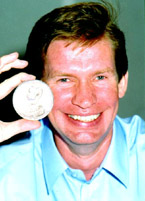
Jan Olav Aamlid would smile at the old saying, "Money is the root of all evil". Jan is the man with the Midas touch who has made money, or more particularly coins his love, his life and his livelihood.
Jan, a Norwegian in his forties, is a Numismatist, that odd breed of person who is a collector of rare coins. Just as a doting parent talks enthusiastically about his children, he talks excitedly of his coins and their history. They are all his children and he knows every one in all their detail.
Jan Olav Aamild.
It is a long way from Norway to Thailand and Jan had never really thought much about this country till a chance stopover in 1980. As with so many ex-pats now living here, that initial visit was enough to change his life forever. "I was going to a meeting of National Coin Dealers in Singapore and was told if I stayed in Asia for ten days it was cheaper, so I came here and found Paradise."
His passion for coin collecting began as a boy when his grandmother gave him his great grandfathers collection of old Viking coins. The interest never deviated from there. He sold newspapers after school to buy more coins to make his collections complete, and in high school took summertime jobs in the bank (closer to coins, perhaps?). At age fourteen, Jan invested his entire savings of 250 Kroner (a large amount of about U.S. $35 then) in his first big purchase of a Swedish gold coin minted at the turn of the century.
He started work as a trainee banker at age nineteen, but after six months, resigned and opened his own coin shop. "You always think you are the greatest expert in the world, but if I understood how little I knew I never would have started."
His big chance came five years later when he bought the salvaged bullion of about 5,000 gold coins and 50,000 silver Ducats of a 1725 shipwreck, with a value of 3.8 million Kroner. "I went to the bank where I used to work and asked for a loan. They asked what I would use as guarantee, so I put a bag of gold coins on his desk and got away with it."
Jan had to have the coins professionally cleaned and made up small boxes with one gold and eleven silver Ducats. The coin sets were popular and their sale was a success.
Another notable record in his career was the sale of a gold coin Olav the Holy. It was sold in 1988 to a collector for 540,000 Kroner, over $U.S. 100,000 then.
Jan still has the partner he met in the early days who manages their Oslo business in Jans absence. "Knowledge is important but that comes after experience. One of the most important aspects is honesty and trust. I have seen colleagues coming and going because they got too greedy. You have to be able to meet people and deal with them next week, next year and in ten years time."
Jans knowledge of coins has opened up the world for him. "The most exciting event in my career was being honoured with a private audience with our King Bhumibol Adulyadej last year. I had helped design a commemorative medal for the 90th anniversary of King Chulalongkorns historic visit to Norway in 1907. It features a portrait of the Thai and Norwegian Kings together. We were finally given permission to make the commemoratives by both Royal families and 500 gold, 3,000 silver and 6,000 copper nickel medallions were struck with the proceeds to go to cultural projects in both countries."
Success means, "The freedom to do what I enjoy instead of a job I dont like." And so for Jan, life has always been a never ending collection of quality and history from coins, medallions and tokens to even accumulating orchids in his garden. That fourteen year old boy who looked so excitedly at his first purchase of a gold coin is just the same today - he is just a little older!
| Back to Columns Headline Index |
The other day Harry Flashman here suffered from every photojournalists nightmare. Taking two rolls of film in for processing and getting not one image back. Not one! The images "supposed" to be there included three portraits, a photo essay on a band, a dinner for visiting dignitaries and a restaurant. The reason? An internal camera malfunction. Never mind camera breakdowns - this was nervous breakdowns material!
The next night it was on again, another band, more dignitaries plus some candids. The Harry Flashman camera bag has more than one camera in it, so camera number 2 was brought out. It failed after six shots! By this stage Harry was sure he was the victim of a vendetta and was ready to catch the next speedboat out from South Pattaya Pier.
Take shots in both formats.
Settling down mentally and physically and looking at camera 2, and then doing some elementary diagnostics showed that the battery had failed. Simple! The camera used can be run in a full manual mode (no electronics at all), but the shutter speed then becomes fixed at 1/250th of a second. This was not going to work for the night situation where the shots would be taken. Was it back to square one? Not quite.
The cameras in the bag are identical models to make sure there is interchangability of lenses and parts. Its called "thinking ahead". Taking the battery out of the disabled first camera, it was possible to get the second one going again. All this was being done while bands were playing and people parading, waiting to be shot for posterity! It was not a fun evening.
Why had this happened and what had gone wrong? Well, the first camera had shattered its shutter, and in the second camera, batteries are just batteries and so must eventually fail. But this was not really the full story. Harry here has to take some blame as well. Every photographer should carry spare batteries as well as another roll of film. Every photographer should also sit down every year and clean and service his or her camera(s). Harry stands guilty as charged!
Now if you do not feel confident enough to do this basic maintenance, then you should get it done for you. It will certainly reduce the chances of camera breakdowns, which at best are frustrating and at worst diabolical in their consequences. (We just had a relative over on holiday whose camera also failed to deliver, and all her holiday memories are just that - memories. There are no photographic prints to take back.)
The biggest problem in Pattaya, of course, is just where do you take your camera to get maintenance work done? I have had some reasonable work done at Central Colour Lab on Pattaya 2, just past the Isuzu showrooms before Pattaya Klang, where they replaced the shutter on the Nikon that failed. There is a guy in there who is a Nikon enthusiast, so that always helps. However, how they go with other brands I am not sure. Perhaps now is the time you should contact the local agents for your brand before it is too late.
Quick Tip! Never just take one shot of any subject you are interested in. You might have just taken the shot of the century and the negative might have a scratch on it! Its always good insurance to take a couple of pictures in the usual horizontal format, then turn the camera into the portrait format and take another couple of shots. You have just increased your chances of success by 400%. Not a bad sort of average!
| Back to Columns Headline Index |
Modern Medicine: Sticks and stones may break my bones!
by Dr Iain Corness
Many people think it is easy to diagnose a broken bone - but its not. If it were that easy we wouldnt have invented X-Rays!
Just to complicate things even further, there are many different types of breaks (fractures), some of which will not show up with ordinary X-Rays. So you can see there are lots of good reasons why the medical course takes so long to complete and why work in medicine is called "Medical Practice" (you keep learning all your life)!
As a very young doctor, I worked for a while in Gibraltar, that small (once British) peninsula off Spain. At the time it was blockaded off from Spain so we had to be totally self-sufficient. We had a total breakdown in the X-Ray department and we had to guess at "Fracture or Bruise" for 6 weeks. It was interesting when we X-Rayed everyone after the machine was fixed to see how correct we were (or otherwise).
So what tips can I give you to save unnecessary trips to the doctors with little Johnny whos just fallen out of a tree?
With any bruise, contusion or fracture there is swelling and pain at the site of the injury, so acute tenderness will not give you the diagnosis. Whats more, little Johnny will resist all your prying fingers if you try and push at the point of pain. Expect tears and yells at best, a well aimed kick at worst.
The trick is to gently push and pull the bone in its long axis. In this way you can hold the ends of the bone, far away from the site of swelling and pain. You gradually gain the confidence of little Johnny and can then progress further with the diagnosis.
If there is a fracture, pulling or compressing the bone in the long axis will produce pain, but a bruise or contusion will not be affected. Try it next time your young man falls out of a tree. Mind you, if there is obvious deformity in the bone, then do not hang about - its straight to hospital!
Here are some other hard won pointers towards correct diagnosis. Hammer on to thumb invariably produces a fracture. Brick dropped on toe - likewise. Stubbing the toe while running through the house - fracture for sure. A great deal of bruising at the painful region appearing within 24 hours - at least a 75% chance of fracture.
The simple rule of thumb is then, pain on compression or extension - probably a fracture, take him to the doctor. No pain on compression or extension, probably safe to wait 24 hours. If at all in doubt, splint and see your friendly hospital.
| Back to Columns Headline Index |
I have a problem. Well, actually, everyone else has a problem. If I wanted to dress like an Inuit, I would go to Alaska!
What is this problem Thai people have with the human body? Its one of Gods most beautiful creations.
When I come to Pattaya, I dont want to wear anything on the beach. I want to get a complete tan. Cant a guy sunbathe without being accosted by the local police?
Why are local law enforcement officials always telling me to put my swimming suit back on?
Theyre men too, so its not something theyve never seen before.
Everyone is so out of touch with their physical side here!
Im a,
Sun Worshipper
Dear Sun,
Traditional Thai culture dictates that people not take off their clothing in public places. It is actually illegal for men to be shirtless, unless on the beach.
It is illegal for women to be topless in any city. Older ladies may go topless far upcountry but this is a different situation and you are not Thai nor an old lady.
It may seem a bit hypocritical but thats the way the culture is.
I have been to Phuket and seen people walking totally naked on the beaches. The local people are very embarrassed by this. Of course, human nature being what it is, it also depends on who is doing it. Ive often seen young naked European Venuses and Adoniss on the beach. The police and residents dont seem to mind this as much.
In fact, I have seen some of the residents peeking from behind trees.
This may tell you something about human nature. That the police tell you to put your clothes on may also tell you that you need to join an exercise program or lose some weight.
Remember, nude sunbathing is ILLEGAL anywhere in Thailand and I suggest you not do it.
| Back to Columns Headline Index |
by Richard Bunch
It would appear from my postbag that my comments regarding computer virus have stirred some interest and caused alarm in some readers. It was not my intention to cause alarm, merely to bring attention to the problems that can arise as a result of virus invasion. These unwanted intrusions are almost invariably avoidable, provided there is no lack of good housekeeping practice and complacency. Remember a good anti-virus program is an essential piece of kit and should be installed on all PCs, once installed then ensure the virus definitions regularly updated.
For those of you worried by possible intrusion to your network, this week British company Gen Technology launched a network security device that prevents hackers from completing a modem "handshake". It stops them entering the network by the back door (by briefly connecting to a modem and collecting other peoples passwords or other information). Access Denied can be used alone or with a firewall as an additional security fence.
Have you ever been frustrated trying to track down the manufacturer of a hardware device? For many of us the answer is invariably yes but the solution comes from an interesting source, none other than the FCC (Federal Communications Commission).
All electrical equipment sold in the USA requires an FCC ID to be issued, ensuring compliance with their equipment standards. So, in theory at least, it should be possible to track that illusive manufacturer using a search engine, e.g. Yahoo. Just enter the FCC ID as it appears on the piece of equipment and follow the link. Another useful site is www.sbsdirect.com/fccenter.HTML which allows the ID to be entered directly.
Remember that this is your column and the PC Doctor welcomes you questions.
The comments contained within this column are not necessarily the views of the author or Pattaya Mail Publishing Co., Ltd.
Send your questions or comments to the Pattaya Mail at 370/7-8 Pattaya Second Road, Pattaya City, 20260 or Fax to 038 427 596 or E-mail to [email protected].
Richard Bunch is Managing Director of Action Computer Technologies, the One Stop Shop for all your computer and Information Technology needs.
| Back to Columns Headline Index |
Crime
crackers Turned ashen UBC again Mystic Martha Insurance scam |
Viva
farangs Kinky tours Crumbs Philosophers advice |
| Back to Columns Headline Index |
Animal Crackers: Give a dog a bad name?
by Mirin MacCarthy
I have always been envious of people who not only give their pets outrageous names, but are also happy to stand in a public place calling them loudly. Though yelling, "Here Beethoven" would be less conspicuous than screaming, "Come here Hot Lips"?
Generally it seems that the more "way out" the owner, the more imaginative the pets name. One lovely lady friend, for example, had two geese she called Abelhard and Eloise.
Axolotis.
My in-laws had one of the worlds more ugly dogs, a bulldog, with the name of Brummel, which was short for Beau Brummel, the Victorian dandy. Anyone who has ever seen a bulldog and the way its coat seems several sizes too large will understand the sarcasm poor Brummel had to endure.
As a child I was very impressed with the name "Marmalade" my mother gave to our strikingly orange striped cat, though I think the cat was more exotic than its name. So, too, are our two Thai cats, called Roi and Pun because of the small fortune they have cost.
All of which brings me to the point of this article - what interestingly named pets do you have, or had? Send in the name you used, and why the animal got that name. I am looking for something really imaginative here to share with the readers, not "Spot" the pet Dalmatian dog! Fax or email the Editorial Office. Fax 427596 or email <[email protected]>
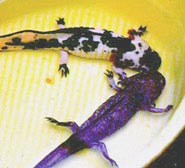
A Fish By Any Other Name Did you know that Axolotls are also called Mexican Water Fish or Water Dogs and are a popular aquarium pet? Axolotls originally came from two shallow mountain lake systems in Mexico, where the floating weed, minute fish, worms and insect larvae afford the perfect environment.However, in Mexico today, they are sold in the markets for food cooked up with tomatoes and chili. Poor Axolotl!
These curious amphibian creatures have the appearance of a lizard with an eels tail. Like frogs and newts they are amphibian and are able to walk on land but need to remain moist so they can breathe.
They are the juvenile form of salamander and have large feathery gills so they can absorb oxygen from slow moving water. They metamorphose like tadpoles and have gills for breathing in the larval aquatic stage and develop lungs to breathe air when they change into the earthbound salamander stage.
What a wonderful creature.
| Back to Columns Headline Index |
Auto Mania: Pattaya Mail scoops Time Magazine!
By Dr. Iain Corness
Autotrivia Quiz A couple of weeks back I asked what the name of the Stewart-Ford F1 Grand Prix Team will be in 2001. At the time I mentioned that it was an animal of a question. That was the clue! With FoMoCo buying Jaguar and FoMoCo poised to buy Stewart-Ford (if they havent already) the smart money is on the Team being re-named as a Jaguar F1 Team. Makes sound marketing sense to me. Mind you, Ford have always been good at marketing, which was why Henry I managed to do so well with the Model Ts for so long, well after they had ceased to be leaders in the engineering stakes. Pattaya Mail scoops Time Magazine! Regular reader, and Autotrivia quizzer, Peter Cabrey from Hawaii faxed us over an interesting item the other day. This was three pages from Time Magazine dated January 18th with a leader article on the forthcoming retro Ford Thunderbird for 2001. This was, as Peter no doubt realised, two days after the Pattaya Mails Automania column had hit the streets with a leader article on the same car. Its nice to know that Pattaya Mail is more than abreast of the times. Thanks, Peter, and a high Hawaii Five-O to you!
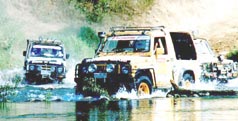
4x4 competitors on the Silverstone Trans Asia Rally.
Chatting with an American ex-pat at the weekend too, who agreed with my sentiments on this retro car. He said that the only people who bought the T-Bird in the mid 50s were newly qualified doctors as a sort of "Look at me, Ive made it" statement. He went on to say that if Ford were to produce a retro 1964 Mustang then they really would have a fireball in their showrooms. I agree completely. The Mustang was a big seller with loads of charisma (I suppose I should set a trend by spelling that as "car-isma"!) and they sold plenty of them. Thats enough to give them a large enough customer base for a retro. Think about it, FoMoCo. Youve still got time to change your mind!
Dirty Dealings There are a lot of 4x4 enthusiasts out there, and the recent Silverstone Trans Asia Rally seems to have whipped up even more. This week, a new publication came across the Editorial desk, called "4x4 Magazine". A very glossy item with 162 pages of road tests (sorry, dirt tests), tips and info. The mag comes in English and Chinese so if your names Yo Pin Ho you get to read it twice! It caters for the Off-Road driver, with particular emphasis on the Asian scene. The Editorial office is in Japan and the printing and photographic content is first class.One excellent item for the Thailand 4x4 folk is the list of major Off-Road shops in Asia. Theres six here, plus all the listings from Malaysia.
Now more good news, there is a special introductory subscription offer of 2,750 Baht for the twelve issue year, a reasonable saving from the news stand price.
If you are interested in taking up this offer contact Khun Supanee Yupool at the Subscription Department of Inter-Media (the local agents). Fax K. Supanee at (02) 641 8480 for further details.
The Greatest Racing Driver? The above topic will always produce a heated discussion. Senna? Clark? Fangio? Moss? Schumacher? I believe that the greatest driver was none of these. My vote goes to Rudolf Caracciola, a German of Italian extraction.Born in 1901, he won his first race at age 22. He secured a job with Daimler-Benz and conned his employer into "lending" him a factory race car to enter the German G.P. at the Avus in 1926, though he had to enter under his own name.
He stalled the car at the start and finally got going stone motherless last in the 44 car race. However, it began to rain, and like Germanys current top driver he very quickly showed his skill and carved through the field in the atrocious conditions.
His lead was only short lived as the Mercedes began to misfire. He called into the pits and by the time he had changed the offending plug he was again nowhere and was advised to retire.
This was never Caracciolas style and he rejoined the race, driving at ten tenths for three hours (and more than 200 miles). It was only after the flag fell that he found out he had again come right through the field and had won the first Grand Prix of Germany. (It was after this that the legendary Team Manager Alfred Neubauer devised the pit signalling system to advise his drivers of their positions in a race.)
Caracciola was brilliant in the wet and even managed to overcome a five lap handicap in a thirty lap race, driving in a deluge in the Irish Tourist Trophy. He won many European Championships, the fore-runner of todays World Championship, and even set the World Land Speed Record before WWII. He was one of the very few non-Italians to win the Mille Miglia (it was 20 years before this record was broken by Stirling Moss).
The cars he drove were not easy vehicles to drive either. The SSKs and SSKLs were big heavy brutes, and the later W159s and W163s were enormously powerful race cars putting the power down through bicycle tyres compared to the tyres of today. To drive those cars needed extra large cojones. Safety was not a word used much in those days.
He was the ultimate racer. Despite ill health and personal tragedies, he continued winning - always a consummate professional. His career was interrupted by Adolfs bun fight, but he returned to racing after the war, although his health went against him. His death was premature and he died in 1959.
There were many great drivers pre and immediately post-war, and the one man who had knowledge of them all was Neubauer himself. In his words, "... of all the great drivers I have known - Nuvolari, Rosemeyer, Lang, Moss or Fangio - Caracciola was the greatest of them all."
Who of us mere mortals would dispute those facts?
Ive ever raced on!
| Back to Columns Headline Index |
Fitness Tips: Putting more muscle into weight control, continued...
by David Garred
Club Manager Dusit Resort Sports ClubGday Pattaya. The week before last I borrowed some research from the U.S. Surgeon Generals Report on Health & Physical activity regarding the benefits of weight lifting (specifically for women) when the desired training effect is weight (fat) loss.
In summary, all the women in the study were on a tailor-made eating plan. None of the women participated in any cardiovascular exercise and half the group did no extra activity. The other women, who lifted weights as part of a structured program twice a week, lost 44% more fat than the inactive women.
These women gained muscle mass (useful weight) and reduced their measurements as well as their overall body weight more so than the diet only group.
On the other hand, the diet only group lost some weight yes, but they also lost muscle and bone mass.
This is a stereotypical response in both cases.
Let me pose a question:
Dont you think that it is healthier to do a little weight lifting in the interest of losing a greater amount of overall weight while keeping your bone mass and density up in the interests of feeling healthier and stronger?
Lets not forget that the only way to get rid of fat is intensity correct cardiovascular training. Imagine how much better off someone is that eats well, does some sort of regular cardiovascular activity and lifts weights a couple of times a week.
As promised last week here are the further benefits of a balanced approach:
* Revs up the metabolism: A strengthening workout burns calories at the club and it also builds muscle that burns calories all day long. Documented proof shows an increase in metabolism of, on average, 15% (burning 15% more fat per day).
Strength training can also help active individuals break through weight/size plateaus.
Ill use a testimonial to illustrate this point. Susan told me, "When I was in my 20s, I managed to lose weight through Aerobic exercise - Id do a step class and the spend 45 minutes on a stair climber. When I reached my 30s that stopped working." After Susan started strength training she was able again to reach the weight/shape she wanted.
Susans case is no miracle nor even slightly special, she only made a conscious decision to help herself.
* Facilitates a more physically active lifestyle: Stronger muscles make it easier to move and perform aerobic activities, which burns even more calories.
3 different studies conducted at Tufts University have found that, once people become strong from strength training, they naturally, automatically, adopt a more active lifestyle. In one of these strength training studies the control group (no extra activity other than their training program) was not even aware they had made changes when they began walking more, using stairs instead of elevators. When it all was added up they had become 25% more active.
* Firms and Tightens.
A pound of fat is 2.5 times more bulky than a pound of muscle. With almost monotonous regularity women will come to me and say that, after a few months of regular strength training, they have dropped one or two dress sizes even though they had not lost any great deal of weight.
* Helps people feel good about themselves.
We have known for years that regular aerobic exercise counters depression and anxiety, alleviates sleep problems and improves overall health. Now research is demonstrating that strength training confers similar benefits.
Do something for yourself, re-read last weeks fitness tips article before going over this one again, then ask yourself what is more important to you.
Carpe diem
| Back to Columns Headline Index |
Copyright 1998 Pattaya Mail Publishing Co.Ltd.
370/7-8 Pattaya Second Road, Pattaya City, Chonburi 20260, Thailand
Tel.66-38 411 240-1, 413 240-1, Fax:66-38 427 596; e-mail: [email protected]
Created by Andy Gombaz, assisted by Chinnaporn Sangwanlek.