Asian men receive much opprobrium for being
irresponsible Don Juans. A lot of this comes from their having Mia Noi or
‘Minor Wives’.
This phenomenon is spread throughout all levels of all Asian society.
Stories of important men in society having ‘kept’ wives can be seen in both
local and English language newspapers. Members of the military have been discovered to
have more than one ‘household’. This is usually done ‘on the sneak’,
although the Thai grapevine usually knows about these affairs long before the press.
This ‘institution’ draws a lot of righteous criticism from moral
luminaries of the Western world. Institution is the correct word, as Thailand wisely
changed her laws (not wanting to give Western Powers reason for invading, colonising and
‘civilising’ Siam) and made having more than one wife illegal.
Viet-Nam, having fallen to the French in the last century, need not worry
about escaping, having been already colonised.
Until very recently, all Viet-Namese birth certificates had spaces for the
name of the father and mother of the child. One of the columns under the mother’s
name had the words Vo Chanh hay Vo Thu. In Vietnamese this translates as
"Major Wife or Minor Wife".
Before feminists start painting banners and organising protest marches,
remember that women in Tibetan and Polynesian societies were allowed more than one husband
at a time. One needn’t worry about most of the Polynesian societies anymore, as pious
missionaries brought Christianity and diseases such as measles, which killed most of the
people as well as their customs.
In the past, having more than one wife was due to various reasons. This
was not always a cause of pain to the concerned parties. This is not an excuse or an
opinion but rather a story that I heard as a boy.
While young I learned about the Chinese community’s thoughts on this.
Not from a man but from our Chinese landlady.
When I was age 14 and living in Bangkok, we discovered that our landlady
was the ‘minor wife’ of our landlord.
How did we know? She told us. At that time she was forty-five and her
husband was fifty. They had been together for 21 years. It didn’t seem to be a case
of our landlord being bored with his first wife, deciding to have a ‘lollipop’
on the side. As our very beautiful landlady was so candid, my mother confessed that she
did not understand the situation.
Laughing, Madame Chao told us that her husband, being a good Chinese son,
was compelled by tradition to go along with his parent’s choice of a wife. His first
wife’s father and his father were old friends. They had agreed if one had a son and
the other a daughter, they would have them marry each other for the purpose of binding
their families and respective businesses together.
In such cases, the young man and women are not consulted about this matter
and Confucian ethics give the children no right to refuse. Our landlady told this story
with very good humour as she knew it was out of our cultural realm.
"So, my husband knew from the age of 8 that he was to marry the
daughter of the pearl-merchant down the street. His father was a diamond dealer. So you
see it was a good match for the families."
"But did they love each other?" my mother asked.
"Mary, Chinese society is different. This is not the most important
thing between husband and wife. My husband’s first duty was to his father and mother.
They gave him life. They gave him food and education. It was his duty to go along with
their wishes for the good of the family."
"But what about his own happiness?"
"Why shouldn’t he have been happy? He had everything he needed
and a lot more than many other people. Sometimes I wonder about cultures who think that
‘romantic’ love is the only true happiness. If my husband had not had good food
and a good education, would romantic love have made him happy?"
"All right," my mother said, still locked in to her own values.
"What about your life?"
"My family had just enough money to educate us. We were tailors.
Nowhere as rich or as important as my husband’s family."
"I was sent to Chinese school for eight years and was very lucky to
have that much education. My father was rather enlightened. He believed that educated
daughters were much more valuable than merely decorative women."
"When my husband finished Chinese university, he and his major
wife’s marriage contract was negotiated and they were married."
"What was his first wife like?" Mom asked.
"His major wife. He is still married to her. I would call her
typically ‘Chinese’. She never went to school. She likes to sew and keep
house."
"But if she came from a rich family, why wasn’t she given an
education?"
Madame Chao explained patiently, "Her family was rich. She
didn’t need an education."
"It sounds like you know her," my poor mother rejoined.
"I do! I go to Malaysia to see her almost every year."
"What?"
"Are we supposed to hate each other? She and my husband have four
boys. My husband and I have two children. He has responsibilities to both families. We
like each other. She is a good woman."
"Doesn’t she feel resentful that you took her husband from
her?"
"How could I have done that? After she and my husband were married,
they had children and he began to travel to do business. If Chinese couples are lucky,
arranged marriages often turn into love. In their case, this didn’t happen. They
didn’t have anything in common personally. But they respected and liked each
other."
"How did he meet you?"
"I’m from Hong Kong. My husband was on a business trip. He had
started a banking business with colleagues in Malaysia. He had his clothes made in my
father’s shop and we met there. He came in regularly and I could tell that he liked
me. I found him to be an attractive and dynamic man."
"Did you know he was married, with children?"
"Of course! He told me. He was not ashamed of having a family. He
told my father that he liked me."
"I’m totally confused. If your families would have not allowed
you to marry in the first place, didn’t they object to you."
"You must understand. My husband had already fulfilled his
parent’s wishes. He had married the woman they had chosen for him. He had
grandchildren to continue the family line. He has been and is a responsible father to all
his children. If he now wished to find personal happiness with a woman he loved, it was
his right."
"What about his first, uh, major wife’s personal
happiness?"
"Ah," Madame Chow said with a naughty smile. "The Chinese
are very discreet. Some things are better not talked about. I don’t think my
husband’s major wife is personally desolate!"
"Why did your husband become attracted to you, do you think?"
"Mary! I’m insulted! Look at me! I’m not so ugly. The other
reason is that I have a good business sense like my husband and enjoy commerce. We find
each other very stimulating. His major wife is more of a homebody and doesn’t like to
travel." Another naughty smile. "And I think she also has ‘interests’
in Malaysia."
My mother’s Western ethnocentrism was a bit disappointing to me.
Madame Chao continued. "My husband’s major wife and children are
coming to spend Chinese New Year with us. I hope your family will join us for this most
important of celebrations. Seeing us all together will show you that we are not so
unhappy."
"Oh! Now I understand."
I didn’t belive her.
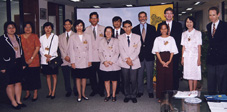 Mr. William Fisher, the Australian Ambassador to
Thailand (5th from right), and Mr. Michael Pilbrow, First Secretary AusAID (4th from
right) presented a cheque to the Dhamrongrajanuparb Institute of Research and Development
to enable the institute to deliver comprehensive training on environmental management to
provincial planners.
Mr. William Fisher, the Australian Ambassador to
Thailand (5th from right), and Mr. Michael Pilbrow, First Secretary AusAID (4th from
right) presented a cheque to the Dhamrongrajanuparb Institute of Research and Development
to enable the institute to deliver comprehensive training on environmental management to
provincial planners.