If you read that a portfolio manager is "overweight in
Europe", you may well think this means he’s been eating too many Christmas
puddings over the holiday and needs to diet.
Although that may well be true in some cases (myself included), when
referring to an investment portfolio, the term "weighting" simply refers to what
proportion of the portfolio would be placed in any one market sector, as determined by its
relative size and importance in global terms.
If an investor or portfolio manager believes a particular market sector
will outperform other sectors, he increases the relative proportion of his portfolio
invested in that market. He goes "overweight", in other words.
So being "overweight in Europe" simply means that the portfolio
manager has taken on a larger proportion of European investments than would be regarded as
‘standard’.
A balancing act
Imagine you were investing a lump-sum of capital and wanted to construct a
"balanced" portfolio. What weighting would you give to each asset class? That is
to say, what proportion of your money would you keep in cash, in currencies, in bonds, in
equities, in commodities futures & options?
As it is generally recognised that over the long term, equities outperform
bonds which outperform cash - you’d tend to put more of your money into equities than
into bonds or cash, all things being equal.
A typical diversified, balanced portfolio would probably comprise about
59% in global equities, 29% in bonds, 9% in cash & currencies, and 3% in commodities,
futures & options.
This would be a typical portfolio for someone holding a medium-risk basket
of unit trusts or a ‘Managed Fund’.
But these proportions will also be affected by your aversion to risk,
which differs markedly from one investor to another.
Thus these "standard" apportionments would be adjusted according
to your individual risk profile, moving the overall weighting to a more conservative or a
more aggressive stance.
Then, what proportion of each of these asset classes would typically be
placed in any one market sector?
Here two factors come into play, and they’re very important ones.
First, the relative size of that market and its importance to the
world’s economy.
Secondly, and perhaps even more importantly, current and projected market
conditions.
In what direction do your favoured markets seem to be headed? In addition,
what impact (if any) will movements in one market have on your other investment sectors?
You’d adjust the proportions invested in individual markets to
reflect your beliefs of which will do well in the coming period, and conversely those you
think will perform poorly.
Thus you’d end up "overweight" in some sectors, and
"underweight" in others.
Adjusting the balance
For example, in terms of the amount of money invested in stock markets
around the world, the United States has the most, holding about 44% of the world’s
total capitalisation in equities.
So, if you were to spread your investments based solely on the relative
capitalisation of stock markets, 44% of the money you’d earmarked for global equities
would go to buying US stocks.
Of course, no portfolio manager actually does invest money proportionate
to the size of each market. That’s why we read all the time about portfolios being
"overweight" in this and "underweight" in that.
But if you believe that the US will outperform other markets in the next
few weeks or months, you’d go "overweight" in this market, which simply
means you’d tend to allocate more than 44% of your total equity portfolio to US
stocks.
Conversely, being "underweight" in a market means having less
than the proportion indicated by its relative capitalisation and importance in global
terms.
For example, a portfolio manager who feels the US market is poised for a
correction may divest himself completely of any exposure to US equities. He will then be
very ‘underweight’ in that market!
Similarly, if he feels ‘bullish’ for Europe, his equity
portfolio may hold significantly more than the 31% indicated by relative capitalisation
value.
If he feels ‘bearish’ about equities in one or another market -
either because they’ve risen too high too fast or he believes the economy is weak and
will perform poorly - he may reduce his equity holdings and go ‘overweight’ in
bonds (i.e., have more than the ‘standard’ proportion in his portfolio), or
increase his cash element ready to return to the stock markets once the drop has taken
place and good fundamental value is seen again.
Specialist sectors
More and more nowadays, portfolio managers are moving away from the
traditional geographical allocation model based on these relative capitalisation figures.
Recognising that the world has become a global marketplace, portfolio
managers are tending nowadays to look more at sectoral allocation rather than geographical
allocation.
For example, the telecommunications industry may be moving ahead rapidly
even though the rest of a market’s ‘blue chips’ are stagnating.
This applies also to the technology sector, healthcare, and even leisure
& tourism. These industries have become globally spread, with very considerable
amounts of money invested in them over the past two decades.
Another sector which some investors neglect is the worldwide move to
privatisation of state-run entities such as railways, airlines, telecommunications,
utilities, and so on.
Once returned to the competitive private sector, these enterprises often
gain in value out of all proportion to the rest of the market, even rising against the
general downtrend in some instances.
The significance of the opportunities that can be lost if one doesn’t
look for potential growth in specialised sectors is amply demonstrated by past history.
For instance, who back in the early 80s would have guessed that an obscure
little computer software firm called Microsoft would prove to be such a hugely successful
growth investment?
If you have any comments or queries on this article, or about other
topics concerning investment matters, write to Leslie Wright, c/o Family Money, Pattaya
Mail, or fax him directly on (038) 232522 or e-mail him at [email protected]. Further details and back
articles can be accessed on his firm’s website on www.westminsterthailand.com.
Leslie Wright is Managing Director of Westminster Portfolio Services
(Thailand) Ltd., a firm of independent financial advisors providing advice to expatriate
residents of the Eastern Seaboard on personal financial planning and international
investments.
David Shrubsole, Managing Director and co-owner of the Icon
Hotel in Pattaya, has made a perfect foil for his creative flair and love of company with
this hotel.
David has traveled far since leaving school in Australia at age fifteen.
"My parents weren’t very keen on my finishing school early but I found study
boring. I knew I wanted something artistic and creative that involved talking to people
and I had been offered an apprenticeship in hairdressing."
 David Shrubsole, creative interior designer.
His mastery and brilliance with interior decorating makes people suppose a
background of extensive training in design, theatre or architecture, but no, David is one
of those fortunates whose creative genius flows from the fingertips. He gained his
inspiration solely from his artistic hairstyling and accompanying theatrical fashion
shows. "Then I got excited by collecting and by being able to make something old look
good with just a spray of paint or a stencil."
He has been in Thailand for seven years. "I knew I loved Thailand the
moment I stepped off the plane in Bangkok. It is peculiar but it felt right to be here, it
felt like home."
The best aspect of living here to David is, "The people absolutely
without question, their genuine hospitality and openness to help. It really fascinates me
to hear why people do the things they do. I am just in awe of the Buddhist religion, it is
so deep rooted and there are such strong family ties."
David ventured to Thailand initially to set up the first internationally
accredited Hair and Beauty Academy in Bangkok. Then after two and a half years, he was
approached by the Westin Banyan Tree Group to develop their spa resort projects. David,
however, dismisses the quantum change in direction. "I didn’t hesitate. It
seemed totally appropriate. My career was always about making people look good on the
outside. After a while you realize they never will unless they feel good on the inside. I
studied massage and other healing methods. That was what it was all about, helping people
to feel healthy and relaxed. It really took off in Phuket and we opened other spa resorts
in Bali and the Maldives." Although it was idyllic, every Friday evening saw him on a
plane and back to the noise and the traffic and friends in Bangkok.
"No matter how luxurious hotel rooms are, they become very lonely
when you are on your own. This is what inspired the Icon concept. I love having people in
my home and it is an extension of having the same type of people as guests and inviting
them for dinner."
David and his partner William bought the Icon site property in May last
year. It was a run down back-packer hotel, which he found through the Pattaya Mail.
"We totally rebuilt it. I knew as soon as I saw it what it would look like, even to
the colour. I love a challenge and I believe in change. I think Pattaya has lots of
potential and is ready for change. If you present something new that is good and working
then people will go with this new direction." David plans to open three more Icons,
Chiang Mai, Phuket and then Bangkok.
"I want the Thais to know that Farangs do care and are not just there
to exploit them. I want to be able to make a difference to people. If someone says thank
you for a good day then I am happy. That’s what it is all about, enjoying good
company."
David describes himself as "I think I have been lucky. I feel
content, I have a wonderful family and a great relationship. I know exactly who I am and
how and why I handle things." David Shrubsole certainly has the aura of a happy,
creative, complete person.
 Dear Hilary,
I don’t know what to do. I’m 16 and am depressed
a lot of the time. I don’t know why but I just feel that life is boring.
I don’t do anything but go to school, come home, do my homework,
watch TV and go to bed.
I do OK in school but I actually have to force myself to do my homework. I
feel all right when I get together with my friends. Whenever they come to my house, we
have fun and talk about dumb things. My mom and dad often complain about this and tell me
I shouldn’t act so silly.
I told them that it was better than being depressed. They don’t
understand at all.
They always say, ‘What do YOU have to be depressed about. You should
be grateful for what you have.’
Hillary, I am grateful but that doesn’t make me feel any better.
Doesn’t anyone understand?
Depressed
Dear Depressed,
I think I do understand. Feelings are feelings and no matter what
others say, we do feel them.
It is doubtful that your parents mean any harm. They are, just
like everyone else, looking at things from their point of view. Acting ‘silly’
with your friends is just a natural part of growing up which helps us cope with day to day
life.
We older people often forget what being a teenager is like.
It’s not necessarily a totally ‘fun’ period of life.
So, parents often wish they were teenagers again, forgetting the
emotional turmoil that 16 year olds often experience.
I would suggest you talk to your school counselor. It is often
helpful to talk to an ‘objective’ and trained individual whose job is to help
young people.
Whenever you feel depressed at home, you could try calling the
Community Services ‘Help Line’ (in Bangkok) at (02) 662 0979. They are people
who truly care. If they didn’t, they wouldn’t be there.
In two years you’ll be 18 and have more say in your own life.
The first two things to do are talk to your school counselor and
give the ‘Help Line’ a call.
Dear Hillary,
I’ve always heard that the Thai people were kind. After being here a
few months, it seems they’re more callused than a chess player’s behind.
It’s really nasty how they laugh at other people. Yesterday, while
walking down the street, I collided with a telephone pole. (I was busy looking at this
woman with the most fantastic body and didn’t see the pole.)
I bumped my nose really hard and all the people around laughed! This
doesn’t seem very kind to me.
They even laugh at each other. Our housekeeper’s father, who is
staying with us, accidentally stepped on a piece of charcoal, which had fallen out of the
stove. He was only slightly burned, but jumped with the sudden pain. Our maid actually ran
into the house and was laughing into her apron.
What goes here? Don’t people have any feelings?
I’m really disillusioned...
Dear Disillusioned,
Different cultures deal with situations in different ways. In Thai (and
many other Asian) cultures, small mishaps which befall people are usually greeted with
laughter. Believe it or not it’s a way of diffusing tension and relieving any
embarrassment the victim might feel. It is not a sign of callousness.
Of course, bumping into that pole served you right (he!he!). You should
have been watching where you were going.
Your housekeeper’s father was not hurt, so laughter was a natural
‘tension reliever’.
I assure you when people are badly hurt, Thai people are just as quick to
offer help as any other nationality.
I hope your nose feels better soon. (BWAHAHAHAHA!). Oh, sorry.
By Dr. Iain Corness
The forward thinking folk at Thai Rung V.P. supplied a
Wanderer last week for evaluation. I must congratulate their management on taking the
"brave" move in making a vehicle available for test. The motoring industry in
Thailand is well aware by now that Automania speaks its mind and has even been known to
call a spade an effing great shovel! We also do not use yards of column inches reprinting
guff of questionable quality from other magazines!
 Thai Rung Wanderer.
So let’s look at the offering from Thai Rung. Walk up to the Wanderer
and wonder at the size of it. It aint small! But then it carries a large number of
passengers. How about this - two large armchairs in the front, a very wide three seater in
the second row and another two seater in the third row. That’s 7 full size expat
adults or just short of half a score of the smaller brands of people! The leg room is
enormous, even behind the driver with a six footer at the wheel. The furthest rear
passengers even get their own air-con outlets as well.
From the point of view of carrying 2 children, this seat is perfect. They
don’t get a door or wind down windows, won’t fall out and are far enough away
that you won’t hear the whinges or the "I want to go to Maccas" every 500
metres.
The seats are excellent with good lateral support in the front and a
fold-down arm rest in the middle bench. Every passenger remarked on the comfort. Well
done, Thai Rung.
The other feature most commented on was the lack of noise. Whilst this was
a diesel version (2.8 Turbo), the sound proofing was such that you weren’t cringing
at the traffic lights listening to pre-ignition!
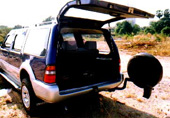 Interior shot of the Wanderer.
The test vehicle had an auto box in behind the diesel, and while some may
say that it robs the car of some power, I personally found it nippy enough in the Pattaya
traffic. It must be remembered that this is a large people mover, not a sports car or an
SUV. It bowled along Sukhumvit at 100 kph without a murmur, drove over some of our
"outback" roads without a rattle and tooled around Pattaya 2 with ease.
The Wanderer had loads of extras, from the again fashionable running
boards, "Roo" bars at the front that would protect you at speeds up to 3 kph (!)
and dinky little air deflectors across the nose of the bonnet which do little other than
make it difficult to wash. However, these are popular options!
Despite the fripperies, practicality is really the name of the game with
this Thai Rung Wanderer. Based on the Isuzu mechanicals that can be serviced anywhere
between Botswanaland and Beijing, it can be a truly international form of transport. World
servicing possibilities and a good solid sensible multi-person mover.
Thai Rung are already involved in, and currently looking at, the
possibilities of further export and even have a "Disassembly Line" in the
factory to be able to send CKD (Completely knocked down) and SKD (Semi knocked down)
Wanderers overseas.
The vehicle would be great for the Aussie outback or the South African
Veldt, and if they can get them in at a competitive pricing structure they have an
immediate overseas market winner. Whether they can "hook in" to the Isuzu dealer
network overseas would certainly assist them in the cause of export sales. Thai
Rung’s relationship with the Japanese giant is one that could obviously be mutually
beneficial to both partners if handled correctly. The fact that Isuzu make their own
people mover based on the same mechanicals is obviously a small problem, but really, the
Isuzu (Holden) Rodeo is in another bracket from the Wanderer. I believe they could
peacefully co-exist!
Enough of the politics. The model, as tested, sells over here for around
700,000 Baht making it a relatively inexpensive vehicle in Thailand. That’s not much
more than many of the top of the line pick-ups, and well below most of the other
MPV’s.
The Thai Rung Wanderer impressed me, and all the other seven people who
traveled in it. If you are in the market for a large transporter, and particularly if your
driver is ferrying your kids around, then it’s worth having a look at one of these.
It feels solid, it feels safe, it is comfortable. It should be reliable. Just tell
‘em the Doc sent you!
Autotrivia Quiz
There were no correct answers to last week’s quiz, simply because I
ran out of room and didn’t put one in! (Forgot, actually!) However, this being the
New Year and all, I really must thank all those readers, both local and from all over the
world, who entered the quizzes during 1998. Some of you have become regulars and I and my
Editor (suck, suck) really do appreciate your interest and patronage. As I said when we
initially kicked off this segment, it is amazing just how much background knowledge on all
things motoring there is out there - someone should put it all together one day. It will
sell a million copies (well, I’d buy one at least)!
So this week, I would be interested to know what you folk consider to be
the WORST vehicle in the world. Let’s narrow it down to the last thirty years, so
we’ll cut out the Hindustan Ambassador Mk I. I’ll put my money on a Trabant as
I’ve never actually seen one that could move under its own power! So what is it,
Automaniacs out there? Fax or email me at the Editorial Office and I’ll publish the
best answers and offer a FREE beer to the winner. There’s a few contenders out there
for sure - the XJ6 has to go close, or how about a Nash Metropolitan or a Reliant Robin? I
await your reply with interest (as my friendly Bank manager used to write).
By David Garred,
Club Manager Dusit Resort Sports Club
G’day Pattaya.
Everyone should be well into the first week of getting himself or herself
back into shape.
Last week I gave you an overview on how to start getting yourselves active
again - this can be seen as Energy Output.
This week I am feeling a compulsion to cover the other side of the coin -
the Energy Input.
 K. Ple is looking
good.
K. Ple is looking
good.
If weight loss, or more precisely fat loss, is what you want, the perfect
solution is to get active and follow a low fat eating plan.
Ahhhhh, that is where the problem starts...
What do you actually need to do in order to achieve your aim?
Instead of following the fad diets found in Women’s magazines, try
keeping the following guidelines in mind.
A sound weight loss eating plan should:
1. Be nutritionally sound, providing all the nutrients you need.
2. Never promise fast weight losses.
3. Offer an eating plan based on real foods.
4. Allow you to eat out.
5. Avoid expensive meal plans, products and supplements.
6. Avoid calorie counting.
7. Not avoid carbohydrate foods, e.g., bread, rice, pasta, cereals and potatoes.
8. Make gradual dietary changes.
9. Provide knowledge.
10. Allow you to eat all foods.
11. Offer recommendations of portion sizes.
12. Recommend physical activity.
13. Take into account your personal eating habits. For better success, any changes you
make should be small and gradual.
Fat calories are more fattening than carbohydrate calories. Your body can
easily convert the fat you eat in food into body fat, so to lose weight you need to cut
down on fats and foods that contain it. Consider the following steps to reduce fat in your
diet and make a tick next to it when you have achieved it:
* Use skimmed or semi-skimmed milk in drinks, cooking and on cereals.
* Buy a non-stick frying pan.
* Buy a cheese slicer.
* Cut the visible fat from meat.
* Eat very little pastry, e.g., in quiche, pies, pastries and deserts.
* Learn how to read a food label.
* Substitute low fat yoghurt or fromage frais for cream.
* Remove the skin from chicken or turkey.
* Eat fruit as snacks rather than eating chocolate and biscuits.
* Eat fewer burgers and sausages.
Fact: A realistic weight loss is around 1/2 to 1 Kg per week. Fast
weight losses are not fat loss but glycogen and water - both of which are necessary to
health and well being.
If you lose weight quickly then you will more than likely return back to
the weight at which you started as quickly as it was lost. Also 90% of people put back
more fat than they lost in the first place.
Fiction:
Weight loss is quick and simple.
Exercise is not necessary.
Certain exercise can spot reduce.
Carbohydrates (for example, bread, potatoes, rice and pasta) are
fattening.
Do set yourself up for success,
Carpe’ diem
 Kangaroo.