FEATURES

HEADLINES [click on headline to view story]:
National Day of Romania
 
Thai Song Dam
 
And then there was Santa...
 
Aussies do it in style
 
Thirteen Philosophical Clarifications
 
1973, The Year Of The Political Upheaval
 
The Computer Doctor

Application procedures for Residence Permits

National Day of Romania

The 80th Anniversary of the Great Union

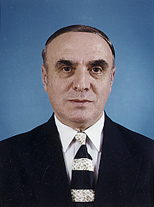
Message from the H.E. Dr. Ioan Voicu
Ambassador of Romania to Thailand

This year, the auspicious celebration of Romania’s National Day, December 1st, bears as enhanced significance as it coincides with the 80th Anniversary of the Great Union, the union of all Romanians into a single State, an outstanding historic event and a century-old dream of our people which came true on 1st December, 1918.
f14.JPG (21074 bytes)On this fortunate occasion it is my privilege and honour to extend my warmest and most respectful greeting to His Majesty King Bhumibol Adulyadej, to Her Majesty Queen Sirikit, to the Royal Family, the Government of Thailand and to the friendly Thai people.

On 1st June 1998, Romania and the Kingdom of Thailand celebrated 25 years since the establishment of diplomatic relations - an important milestone in their history and a testament to the ties of friendship between two peoples which has withstood the test of time and changing circumstances as well as a reminder of the greater tasks ahead as the two countries strive to further build on the achievements of all these years.

The anniversary prompted H.E. Mr. Andrei Gabriel Plesu, Minister of foreign Affairs of Romania, to note that, "during the elapsed period Romanian-Thai friendly relations had continuously enhanced, taking advantage of cultural and socio-economic specific features of the two nations." Summing up his views about the encouraging prospects of bilateral cooperation, H.E. Dr. Supachai Panitchpakdi, Deputy Prime Minister and Minister of Commerce of Thailand, stated: "We can justifiably look back at twenty-five years of accomplishments. Nevertheless, we must recognize that the full potential of our relations has yet to be realized. This should be our agenda in the in the years ahead. I have every confidence that our endeavours will be successful."

In celebration of that momentous event a Symposium was organized by the Embassy of Romania in cooperation with the Ministry of Foreign Affairs of Thailand at the Siam Society Under Royal Patronage.

Considering the fulfillments of 1998, one may say that, while bilateral economic relations were affected by the strong economic crises in Thailand and Asia, a great deal has been done in the social, cultural and academic areas.

In the economic field the entering into force of a new Romanian-Thai Trade Agreement is a significant legal fact. The permanent dialogue between the Business Councils functioning in the two countries continues to energize the bilateral exchanges and the visit paid to Romania by Mr. Uthai Rungrachagarn, Chairman of the Thai-Romania Business Council, was an instrumental initiative to find further ways and means to increase cooperation with Romanian partners. Likewise, the visits to Thailand of the delegations of Chambers of Commerce of Timis, Arad and Targu Mures have had as a basic objective the identification of new opportunities for stimulating bilateral links in a large variety of economic sectors.

In the academic field, a fruitful cooperation has been initiated between "Lucian Blaga" University in Sibiu and Srinakharinwirot University which presently hosts the Exhibition "Glimpses on Romanian Culture" as a prelude to the inauguration of a Romanian Cultural Center in Bangkok and a similar Thai one in Sibiu, which will be a vivid illustration of the lasting value of cultural diplomacy.

Promising relations have also been established between the Assumption University and the Bucharest "Politechnica" University. In this respect, I wish to mention the successful visit to Romania of the President of Assumption University, Dr. P. Martin Komolmas, who has been granted the honorary degree of Doctor Honoris Causa by "Politechnica" University.

In 1998, Silpakorn University continued to render its support in organizing Romanian Language programs for interested members of the Thai academic and business community and hosted an exhibition entitled "Perspective on the Arts and Culture of Romania".

Significant contacts have continued with Chulalongkorn and Chiang Mai Universities, as well as with Bangkok, Mahidol, Siam, Sripatum, Thammasat, Kasetsart, Ramkhamhaeng, the University of Thai Chamber of Commerce and Sukhotaithammathirat, whose President, Dr. Iam Chaya-Ngam, is also Chairman of the Thai Parliamentarian Group of Friendship with Romania.

In the framework of the 1997 Memorandum of Understanding for Cooperation in the Field of Education, signed by the Ministers of Education of Romania and Thailand, for the first time a meaningful sisterhood relationship between a Romanian School and the Bangkok Chutwittaya School has been worked out. The exhibition "Thailand and Romania in Our Children Eyes" sponsored by the Chutwittaya School in cooperation with the Embassy of Romania was but a first propitious step in materializing the new relations.

Encouraging links have been also established with Assumption College in Rayong and Montfort College in Chiang Mai.

With the generous support of the National Library of Thailand a Romanian Book and Photo Exhibition was inaugurated on 18 May 1998. It was dedicated to the 25th Anniversary of the Establishment of Diplomatic Relations between Thailand and Romania and also meant to familiarize thousands of Thai visitors with the literary and scientific universe of Eugen Ionesco, Emil Cioran and Mircea Eliade, whose books were presented both in Romanian and French editions.

A new anthology of poems signed by the well-known Thai poet, Dr. Montri Umavijani, has been translated and published in Romania, thus contributing to a better knowledge of Thai spirituality.

Romanian-Thai relations in the field of tourism have recently been given a new dimension by the successful visit to Romania of Mr. Seree Wangpaichitr, Governor of the Tourism Authority of Thailand. Good links have been cultivated with Dusit Thani College and I-TIM School which are contributing to the development of a professional dialogue in this field with the diplomatic community in Bangkok.

At the United Nations and in its specialized agencies, as well as in other international organizations, Romania and Thailand have continued their fruitful cooperation as both countries are firmly committed to peaceful settlements of disputes among states, to the supremacy of rule of law in safeguarding the world peace and security, as well as in dealing with the great issues of globalization.

Allow me to reiterate my full confidence that Romania and the Kingdom of Thailand have the best perspectives to enlarge and diversify their cooperation at bilateral and multilateral levels.

May I extend my best wishes of continuous progress and prosperity to the friendly people of Thailand.

Finally, I express my thanks to Pattaya Mail weekly for the opportunity to address myself to its distinguished readers.

Dr. Ioan Voicu
Ambassador of Romania to Thailand


Romania in brief

Official Name: Romania

Geographical Position: South of Central Europe, North of the Balkan Peninsula, in the lower Danube Basin, bordering the Black Sea.

Climate: Temperate-continental of transitional type, specific to Central Europe.

Neighbours: Republic of Moldova, Ukraine, Hungary, Federal Republic of Yugoslavia, Bulgaria.

Area: 238,391 sq. km. (92,699 sq. miles). Relief distribution - mountains (31%), hills (33%), plains (36%).

Population: 22,600,000 (January 1, 1997). Urban population (54.3%). Romania is the 12th largest nation in Europe. Another approx. 8 million Romanians live abroad.

Capital: Bucharest -2,037,278 inh. (July 1, 1996).

Main Cities: Constanta - 347,000 inh.; Iasi - 347,000 inh.; Timisoara - 332,000 inh.; Cluj-Napoca - 332,000 inh.; Galati - 328,000 inh.; Brasov - 320,000 inh.; Craiova - 310,000 inh. (July 1, 1996). There are another 4 cities with a population over 200,000 and 25 cities with a population over 100,000.

Official Language: Romanian, the farthest-Eastern member of the family of Romance languages.

Religion: Romania’s religious population pattern is (1992): Orthodox 86.6%; Roman-Catholic 5%; Reformed 3.5%; Greek-Catholic 1%; Pentecostal 1.0%, Baptist 0.5% and other denominations.

Currency: Leu (plural Lei) US$ = 9,800 Lei (November, 1998).

State Organization: Republic, according to the Constitution of Nov. 21, 1991, with a two-chamber Parliament elected for a four-year term, a President elected by universal vote for a maximum of two four-year terms.

President: H.E. Mr. Emil Constantinescu.

Prime Minister: H.E. Mr. Radu Vasile.f1.JPG (20532 bytes)

National Day: December 1st (Anniversary of the 1918 Great Union of all the Romanians into a single State).

National Flag: Three vertical stripes of equal size-from the pole-blue, yellow and red.

National Coat-of Arms: An eagle holding a cross in its beak and a sword and a scepter in its claws. On the eagle’s chest are presented the coat-of-arms of the five major Romanian provinces.

International Relations: Romania has established diplomatic and consular relations with 177 States (with the Kingdom of Thailand since June 1st, 1973) and is a member of UNO and all its specialized agencies, OSCE, IMF, IBRD, IFAD, IFC, MIGA, EBRD, BIS and Council of Europe. On January 26, 1994, Romania was the first European State to sign in Brussels, NATO’s "Partnership for Peace". On February 1, 1995, it became an Associate Member of the EU (official application for full membership on June 22, 1995). In 1996, a full member of Central European Initiative and on April 12, 1997, she joined the Central European Free Trade Association.

Natural Resources: Crude oil, natural gas, coal, iron ore, non-ferrous ores (copper, lead, zinc a.o.), gold and silver ores, salt etc. Of Romania’s total area, arable land covers 39.2%, forests 28.0%, pastures and grassland 20.0%, vineyards and orchards 2.5%, lakes and rivers 3.7%.

Back to Features Headline Index

Thai Song Dam

The word "Thai" means "free". The official government definition of a Thai citizen is "a person who accepts His Majesty Bhoumibol Adulyadej as their sovereign ruler, is a legal resident of Thailand and owes allegiance to only the government of Thailand."

The "Thai" people are part of a larger group of people classified by linguists as speakers of "Tai" languages.

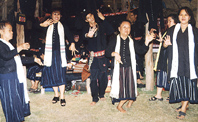
f22.JPG (27932 bytes)“Thai Song Dam” people “Form” (local dance).
Linguists once thought that the "Tai" languages and Thai were related to Chinese. Research has led experts to place Thai into a family of its own, "Thai-Kedai". These languages are spoken in parts of India, Laos, North Vietnam, South China and Burma.

In the northern part of Vietnam, the Vietnamese language could almost be considered a "minority" language if the number of speakers were the criterion. In the hills of north Vietnam, various groups of Thai people make up the majority of the population.

One province in north Vietnam was formerly called "Sip-Song Chau Thai" in the Vietnamese language. Meaning "twelve Thai city states", it reflected the large Thai presence in the hills.

These people are not "Siamese Thai" and most of them never came to Thailand. But during a recent visit to these hill people, Thai anthropologists found that with a bit of effort and dialect mixing, verbal communication was possible. The dress, style of house and various religious festivals pre-dating Buddhism were the same as those of the "Siamese Thai."

Kublai Khan waged war against the powerful Tai Kingdom of Nan Chao in the late 13th century AD. The Tai were known for their unwillingness to submit to Han Chinese rule and the Khan did not wish to have rebellious "splinter groups" on the southern borders of his empire.

His solution was to drive the Tai out of the land completely. Migrating to various areas in the South, the people dispersed and founded what are now Laos, Thailand, the Shan States in Burma and the "Sip-Song Chau Thai" region in north Vietnam.

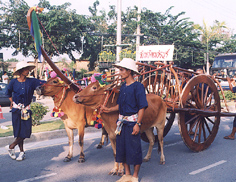
f21.JPG (53645 bytes)An example of a Lao Song oxcart, used to bring rice in from the fields, which are in great demand among Thai art collectors.
There are certain characteristics which all Thai groups have in common. The house built on poles is a characteristic of all Thai peoples, whether they live in Burma, Thailand or Vietnam. Vietnamese, Burmese and others’ houses are on the earth.

Another characteristic is the basic manner of dressing, although there is some variation between groups. This is mainly the color of the costumes. Thus, many Thai peoples came to be known as Thai Khao ("White Thais"), Thai Daeng ("Red Thais") and Thai Dam ("Black Thai").

If one wishes to learn "first hand" about one of these fascinating groups spread over so many countries, it is not necessary to leave Thailand, as some came directly to the area with the "Siamese" Thais while others, wanting to live in a country populated with their ethnic "cousins", came later.

A group of "Black Thais", living in Ðiên-Biên-Phu north Viêt-Nam, heard of the fertile fields and abundance of Siam, or "The Golden Land" of their cousins, the Siamese Thais.

Leaving the relatively Spartan life in the Vietnamese hills, this group made Laos their home for a period of time.

About 200 hundred years ago, hearing of the warmth and plenty of the "Golden Land", the Thai Dam migrated to Petchburi Province.

Welcomed by the Siamese Thai, they keep their characteristic culture, language and dress. As these people came from Laos, the Siamese Thais called them "Lao Song", as they thought they were related to another Tai group, the Thai-Song.

In Lao Song society, the head of the village is traditionally an older woman, which is found in certain minority groups in SE Asia. The Lao Song people are famous for their carpentry, which displays unusual elegance and refinement in the making of everyday implements. Their oxcarts, used to bring rice in from the fields, are in great demand among Thai art collectors. This simple vehicle is totally transformed in the hand of the Lao Song and becomes an elegant piece, with which many Thai people decorate their homes.

The Lao Song or Thai Song Dam, like most rural people, welcome visitors. Hearing that these were years of tourism, they too, are curious to "have a look" at foreigners. They invite people to visit their village in Petchburi.

For those interested, the village is located at, Ban Khao Yoy Village, Moo 5 Khao Yoy, Petchburi Province.

No contrived "tourist attraction", this village is a functioning community of people who keep to the "old ways." Oddly enough, the people live a good life and have not been the least affected by the economic crisis.

Back to Features Headline Index

And then there was Santa...

His real name, however, was neither that, nor Kris Kringle. His roots are from Saint Nicholas, also called Nicholas of Bari or Nicholas of Myra. St. Nicholas feast is celebrated on December 6th. He is the patron of school children, sailors, bakers, weavers, butchers, notaries, advocates and traditionally, pawnbrokers. Prisoners ask for his help and people pray to him for a good marriage, to find stolen goods and for prove against a wrong verdict.

St. Nicholas was born in the ancient Lycian Seaport City of Patara, and when young, he traveled to Palestine and Egypt. He became Bishop of Myra soon after returning to Lycia. Imprisoned during the Roman Emperor Diocletioan’s persecution of Christians, he was released under the rule of Emperor Constantine the Great and attended the first Council of Nicaea. St. Nicholas died at an old age around 350 AD. His shrine was well known at Myra.

In 1087, Italian sailors or merchants brought his body to Bari, Italy. This removal, commemorated on May 8th, greatly increased his popularity, and Bari became one of the most crowded pilgrimage centers, because in Myra, the remains of St. Nicholas secreted a special fluid, the Greeks called it ‘Myron’, which has a strong healing effect. This secretion is still extracted from the Saint’s grave.

Legends of St. Nicholas multiplied rapidly. Numerous miracles on his account were told, of which the best known deal with saving children from tragedy. Thousands of European churches are dedicated to him, one as early as the 6th Century, built by the Roman Emperor Justinian I, at Constantinople, now Istanbul.

Since his removal to Bari, St. Nicholas’s feast has appeared on the Roman Calendar and he became one of the most popular Saints commemorated in the churches of the complete Occident, but is now traditionally associated with Christmas. Every child in Europe knows St. Nicholas, who goes from door to door on the 6th of December to bring presents to the well-behaved children. In some countries, a little ‘devil’, ‘black man’, ‘Knecht Rupprecht’ or ‘Krampuß’, who is armed with a rod and takes good care of the not so well behaved children, accompanies him.

The transformation of St. Nicholas into Father Christmas or Father January occurred first in Germany, then in countries where the Reformed Churches were in the majority, and finally in France, the feast day being celebrated on Christmas or New Year’s Day. Dutch Protestant settlers in New Amsterdam (New York City) replaced St. Nicholas (Sinter Claas) with the benevolent magician who became known as Santa Claus, thus contributing further to his spreading folklore.

The Dutch community in Rayong, as the first to keep this old custom alive, celebrated St. Nicholas Day on November 21st.

The "Seaboard Sound & Friends", in association with "Die Zugvögel" and "Thai Garden Resort" will be organizing a traditional St. Nicholas Day on Sunday, December 6th with a concert and a "Fun Sunday Afternoon" for the whole family. Games are prepared for the children and they will be occupied with constructive hobby work, a picture drawing competition and much more.

Of course St. Nicholas will definitely show up with presents for the children. Everybody of any nationality is welcome to join. There is no entrance fee, yet donations are welcome to cover the expenses. In case more money comes in than needed, the proceeds will go to one of the "forgotten" Thai schools, who are not as fortunate as some others which are being sponsored by many organizations. Please get more information and/or make reservations with Monika Rottmann, tel. 225 903, Marion Vogt, tel. 426 009 or Elfi Seitz, tel. 367 075.

Back to Features Headline Index

Aussies do it in style

Xmas has a special significance for most of the "Farang" countries, and especially so for the Australians. Even in the height of their summer "down under" the Aussies can be seen tucking into traditional Xmas fare with roast dinners, mince pies and Xmas pudding. For most, it is that time when they remember Xmas "back home" in UK or Europe with snow and sledges rather than the searing heat of Australia.

The Aussies over here are no different, with the Australian-Thai Chamber of Commerce Seaboard Sundowners Christmas Cocktails being hosted at BHP boss Hardy Papson’s residence so that they can be of good cheer to welcome in Xmas in Thailand. This function will be held on December 11th right here in Pattaya.

The "good cheer" generally comes in Fosters Lager cans or Aussie wine bottles so there is very little chance of it not being a good evening for the "G’Day Mates" round the place.

To reserve your place, give the ATCC a ring (02 210 0216) or fax (02 210 0218) and get your swaggies hat and laughing side boots out of the cupboard! All your mates will be there!

Back to Features Headline Index

Thirteen Philosophical Clarifications

by Barrie Kenyon

1. Men who have a pierced ear are better prepared for marriage because they have experienced pain and bought jewelry.

2. The best diet involves eating anything you want but only in the company of naked people over 120 kilos.

3. You have to stay in shape. My mother-in-law started walking five miles a day in 1987 and we haven’t seen her since.

4. The reason most people play golf is to wear clothes they would not otherwise be seen dead in.

5. An unsolved mystery of our century is why kamikaze pilots wore helmets.

6. If it weren’t for electricity, we would all be watching television by candlelight.

7. The main difference between animals and humans is that we aren’t afraid of vacuum cleaners.

8. It is troublesome that the man who thought up mobile phones may currently be thinking up something else.

9. Getting the bloodstain out of a T-shirt is a minor problem compared with actually disposing of the body.

10. Where lipstick is concerned, few women accept God’s final word on where the lips end.

11. Chicago got started when a group of New Yorkers moved west arguing that they preferred to enjoy crime and poverty in a warmer climate.

12. No one yet understands why people talking to God is praying, but God talking to people is schizophrenia.

13. Given that fish are known not to be intelligent creatures, it is disturbing to think in a seafood restaurant that you are probably eating a slow learner.

Back to Features Headline Index

1973, The Year Of The Political Upheaval

In 1973 political tension in Thailand had increased significantly. The tyrannical regime from the so-called terrible trio, Thanom Kittikachorn, Prapat Charusathian, his collaborator and Narong Kittikachorn, son of Thanom and son in law of Prapat, had become such a burden for the people that they started to protest openly in the newspaper and in other ways.

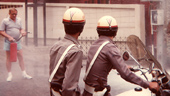
f61.JPG (15742 bytes)No, I did not participate in the ouster of the “Terrible Trio” but tried to extinguish an electrical fire under the watchful eye of our Pattaya Police force.
Sumali the younger sister of Meechai Viravaidya (the famous family planning man whose name is forever synonymous with that useful object the condom), and the older sister of our well-known Pattaya doctor Sunya, was the leader of the campaign against the regime in the English press. I asked Sumali once if she wasn’t afraid she would be arrested and she answered that in this country a woman can get away with a lot and somebody had to do the job, otherwise we would never get rid of them. She was a brave woman.

In May I left for a holiday in Indonesia, a country which I had left in turmoil in 1957. I was apprehensive because of the hatred the Indonesians had felt for the Dutch in those days but to my great relief, when I arrived in Bali all resentment seemed to have been forgotten and forgiven. People were friendly and helpful and I felt at ease. The only frightening incident I experienced was that not knowing how strong the undertow off the beach in Kuta was on the Indian Ocean coast, I almost ended up in Australia and just barely made it back to land.

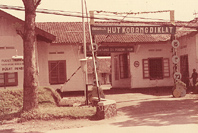
f62.JPG (23576 bytes)The gate to my former prison camp at Chimahi, West Java in 1973.

From Bali I travelled with public busses to Jakarta, all the way through my beloved Java, staying for a few days in several towns like Malang, Jogja, Wonosobo and Bandung. From Bandung I took a side trip to Cimahi where I visited my old prison camp, now, as before the Second World War, a military camp. To my surprise the camp commander let me in to see my old barracks, which had been turned into a school for the soldiers, and the Indonesians were utterly bemused that I took pictures of the latrine. It was a place were I spent much time and of which I had special, unforgettable, but not very pleasant memories. Via the beautiful botanical gardens in Bogor, I left for Jakarta and after a few days for Thailand by plane.

Meanwhile, the atmosphere of discontent in Thailand had become palpable and in the first weeks of October the events came to a climax resulting in a massacre of protesting students in Bangkok on Rajadamnern Avenue and Sanam Luang. It was said that Narong Kittikachorn himself participated by flying over the area in a helicopter while shooting at the youngsters. Finally a delegation of students went to the Chitlada palace to ask His Majesty the King to intervene, which he graciously did and this stopped the blood bath. The terrible trio fled the country and the people were jubilant.

On the eve of this event the whole of Pattaya had no electricity because the Power Company had switched it off for the benefit of a large party held at a manor on the beach road with an enormous lawn. It was said that it belonged to the Malaysian Chinese tycoon Johnny Ma, who also was the owner of the Asia Trust Bank and who was buddy-buddy with the powers that ruled the country. Reportedly the terrible trio were among the guests of honour but the next day Johnny Ma disappeared and was not heard of again since. The mysterious mansion is still there and well taken care of but I have never seen a soul or another sign of life in the compound.

I remember some of the tourists who stayed in Pattaya during those dangerous days and one of them was the Tan Sri Ferguson, a thoroughly eccentric but charming colonial Englishman who had received the honorific title from the Tunku Abdul Rahman, the first prime minister of Malaysia. He confessed to me that he would like to come to Pattaya to live, but unfortunately, shortly after he returned to Kuala Lumpur, we got word that he had suddenly died.

Another personality of distinction who waited for things to calm down was a Frenchman with an impressionist gallery in Tokyo. He was called Francois de Montfort, a descendant of that infamous man called Count Simon de Montfort who, on instigation of Pope Innocent III, led the only Crusade ever held in Europe. It was against the heretic Albigenses in Southern France in 1209 and he and his hordes slaughtered most of the inhabitants. The country was left in ruin and desolation. I never held it against Francois, who was as the Americans say a "sweetie pie", who spoke English with a delightful French accent.

1973 was also the year that we extended the restaurant and got rid of a wild cat, which I had inherited from the former owners. It was a beautiful animal called a leopard cat, a female that was never tamed, but being very much against caged animals I did not know what to do, until I was forced to take steps because of the refurbishing. We had to install air conditioners where she was housed behind glass. A friend and I gave it a tranquilizer, put it in a small cage and when it came to, let it go some where off the road to Sattahip. It never looked back and that after having had sirloin steaks for dinner for almost four years. It demonstrates the truth that a cat is actually never domesticated like dogs, or even our black swine Miss Piggy, who, incidentally, weighs far more than I do these days.

Back to Features Headline Index

The Computer Doctor

by Richard Bunch

For those of you with an Internet connection, do you phone overseas? If so, are you using your telephone? If the answer is yes, then you must be paying the exorbitant rates charged by the Communication Authority of Thailand. Do you think there’s a cheaper option? You bet. If you haven’t tried Net2Phone yet you should, it’s free software, downloadable from the Net2Phone Website (http://www.net2phone.com). Once installed, before you can make a call you need to purchase blocks of credit hours. The simplest way to do this is by Credit Card over a secured web page. Net2Phone works like an ordinary telephone, you dial the persons normal telephone number (the only difference is that the International Code is 01 not 001), they answer and hey presto! Admittedly the quality is not quite as good, there is sometimes a delay on the ‘line’ and it can be susceptible to network congestion. But when you consider you can call to England for 7 cents/minute and USA for 10-15 cents/minute surely that is something that pales into insignificance. To take advantage of this, your PC needs to have a sound card (preferably full duplex), speakers and a microphone.

Ever been had? Think you’ve been duped? Well for the unwary, a trip around Pantip Plaza is potentially hazardous and that bargain could turn out to be an expensive mistake. Although there are reputable dealers, there are also some unscrupulous ones, and you need to be wary of copies. If the price looks to cheap, then it probably is too good to be true. Generally speaking, you get what you pay for and copies are prevalent. If you think you may have a copy Intel processor then you can check it out. Download cpuid.exe from Intel’s Website (http://www.developer.intel.com/design/perftool/cpuid/index.htm) just unzip it and run the Application. There is both a Windows and DOS version available.

One of the other problems which seems to be on the increase is ‘clocking’ that is running the processor at a speed greater than it was intended by making alterations to the main-board settings. Whilst this can be a cheap way to squeeze that extra bit of performance, it can also lead to some rather strange behaviour and if the customer is not advised then it is dishonest and the retailer has earned some extra profit at your expense. I’ve seen computers supplied by hitherto reputable retailers who have succumbed to this temptation.

For those of you who like a shortcut for everything then here’s a reminder of some shortcut keys using the Windows Key; Windows key = Displays taskbar and Start menu; Windows key + E = Starts Windows Explorer; Windows key + F = Finds files or folders; Ctrl + Windows key + F = Finds a computer; Windows key + M = Minimises all windows; Shift + Windows key + M = Undoes Minimise All Windows; Windows key + R = Displays the Run dialog box; Windows key + Tab = Cycles through the taskbar buttons; Windows key + Break = Displays the System Properties sheet.

Don’t forget to write in with your views on local Internet Service Providers (ISP’s). Contact the Computer Doctor at PO Box 155, Pattaya.

Richard Bunch is Managing Director of Action Computer Technologies, the One Stop Shop for all your computer and Information Technology needs.

Back to Features Headline Index

Application procedures for Residence Permits

The Immigration Division of the Police Department has eased requirements for those wishing to obtain residence permits for Thailand. This is to encourage foreign investment and an influx of investor capital.

The Immigration Division began accepting applications on July 1, 1997 and will continue until June 30, 2000.

Those wishing to obtain resident’s permits should submit the following to the Immigration Division of the Police Department.

In Bangkok, one should submit the following information to Room 301, Immigration Headquarters, Soi Suan Phlu, South Sathorn Road, Bangkok.

In Pattaya, one must submit documents at the Immigration Division, Pattaya, Soi 8, Beach Road. The telephone numbers in Pattaya are (038) 410-240 and 429-409.

The required documents are as follows:

Investor’s Resident Permit.

A ‘resident investor request’ form.

Curriculum Vitae

A doctor’s certificate from a hospital

A police record certifying from the applicant’s home country or country of residence sent through and certified by a Thai consular officer in that country or a consular officer of applicant’s home country in Bangkok.

A certificate of guarantee that sufficient funds (no less than ten million baht) have been transferred into a Thai owned bank in Thailand.

A copy of the applicant’s passport.

Investor in an existing company must have these additional documents:

A guarantee from a Thai citizen who is a member of the Limited or Public Company in which the applicant is investing.

A list of all shareholders in the company.

A VAT registration or business tax record of the Limited or Public Company.

Applicants investing by buying an office building must submit these additional documents in addition to those specified above.

A certificate of ownership or deed which guarantees applicant’s ownership or rights to the office building and proof of payment of business taxes on that building.

Applicants investing through the purchase of government bonds:

A guarantee that the applicant has purchased bonds in the value of no less than ten million baht. A copy of said bonds must also be submitted.

Applicants investing by depositing funds in a Thai bank must submit these additional documents in addition to those specified above.

A letter of guarantee from the bank along with a copy of the deposit form for the amount of no less than ten million baht.

Remarks:

The applicant must sign all documents submitted.

All documents must be in or translated into the Thai language with the address of the translator affixed.

Any false documents or statements on documents are punishable under criminal law.

Back to Features Headline Index

Copyright 1998 Pattaya Mail Publishing Co.Ltd.
370/7-8 Pattaya Second Road, Pattaya City, Chonburi 20260, Thailand 
Tel.66-38 411 240-1, 413 240-1, Fax:66-38 427 596; e-mail: [email protected]
Created by Andy Gombaz, assisted by Chinnaporn Sangwanlek.