Family Money: The Tax Man Cometh!
Few people would think of the U.K. as a tax haven. However, compared with many other regimes, Brits living and working overseas are treated very favourably by the U.K. Inland Revenue Department.
For example, British citizens who do not spend more than 105 days in the U.K. in any one financial year (April 5th to April 4th), and an average of not more than 90 days a year over four financial years, are relieved of U.K. tax liability on overseas earnings. Arent we lucky!
(However, if youre deriving an income in the U.K. - say from renting out your house there - you still have to pay tax on that income. More about this next week.)
Uncle Sams Big BrotherThis contrasts sharply with that bastion of freedom, the United States. American citizens are subject to tax on their worldwide earnings - including income, interest, dividends and capital gains - no matter where in the world they live.
Also, under the new U.S. tax rules, holders of Green Cards and anyone who has resided in the U.S. for more than 183 days over a three-year period are also liable to tax on their worldwide income.
This means Americans, Green Card holders and longer-staying visitors have a legal obligation to report all their income from all sources anywhere to the IRS.
The U.S. Internal Revenue Service recently announced it was launching a campaign against overseas citizens and Green Card holders who may have neglected to report all of their world income, on all of which they will have a back tax liability.
It may come as a surprise to many that the IRS estimates some 3 million Americans and countless Green Card holders have not been reporting all their income. It reckons it is losing over $3 billion a year to these naughty tax evaders.
(Is that all? That would hardly cover the cost of an aircraft carrier, would it? And how much will it cost U.S. taxpayers to employ the extra bureaucrats required to chase after this money, salted away all over the world, I wonder?)
To pursue these miscreants, the IRS is teaming up with the U.S. Immigration Department, which keeps very efficient track of everyone who enters or leaves the U.S. legally, no matter who, from where, and through which port of entry.
Of course this does not include those estimated 2,000 a day who dont like to apply for visas and stand in lines at Immigration counters, but prefer to enter the U.S. by climbing the fence or swimming across the Rio Grande (hence the term wetback), who will do their very best to evade paying tax on their illegal earnings until either theyre caught by the Immigration people and deported (but at least 40% return somehow), or another amnesty is declared when these illegal immigrants come out of the woodwork and apply for their Green Cards...
In the U.S. every bank and credit card transaction is recorded and these records are available to the authorities for inspection.
Also, any sum of $10,000 or more entering or leaving the U.S. banking system is automatically flagged and the U.S. Treasury Department notified.
It seems George Orwells 1984 scenario has already been surpassed.
The price of U.S. citizenship
To add insult to injury, the U.S. Tax reporting system is one of the most complicated in the world. So complex is the Tax Code that even U.S.-based tax lawyers (let alone most offshore financial advisors) are unaware of all the potential problems.
Make a mistake, and the IRS will penalize you. Forget something, and theyll penalize you.
Okay, you are permitted a certain tax-exemption for living overseas ($70,000), provided you stay physically out of the U.S. for 335 days of a consecutive 12-month period and have no "continental" U.S.-earned income during that period.
You can also deduct some more for your legal spouse and each registered child youre supporting.
But the remainder gets taxed on a sliding scale which means the average American expatriate still may have to pay as much as 35%-45% of his total income to the U.S. Government, even though hes living abroad.
Beneficent taxes
Compare this, for example, with Hong Kong where the maximum any HK resident has to pay - no matter how many millions he might have earned last year - is 15%.
Of course, Hong Kong doesnt have to support a massive defence budget to defend the free world, nor a welfare system that provides a steady income to those too indolent to work (not that there are too many of those in Hong Kong anyway: 3% unemployment is regarded as a major disaster to their economy!)
Also the Hong Kong Police are visible, diligent, virtually uncorrupt, and make the streets safe for anyone to walk, even at night.
Excellent medical facilities are available at any Government hospital to anyone in Hong Kong - even a tourist - for only a nominal cost, largely paid for from this 15%...
Similarly in the U.K., where the National Health Service provides medical treatment (both emergency and in-patient) either free or at nominal cost. And not only to its own citizens, but to anyone who happens to get sick whilst in the U.K.
In the United States, on the other hand, where medical treatment is supposed to be the best in the world, it seems only the very rich and the very poor can afford to get sick.
Those in between have to have a good health insurance policy, which itself has become outrageously expensive, if they wish to receive medical treatment.
Even well-known international healthcare insurers exclude treatment in the United States from their policies as being prohibitively expensive. Otherwise all international policyholders would be paying substantially higher premiums to subside the minority who require treatment in the States.
And no reciprocal arrangement exists whereby a citizen of country A which provides free government medical facilities can enjoy these same benefits if taken sick in country B which doesnt. Citizens of country B taken sick in country A can, however, avail of country As free medical services, paid for from the local tax revenues.
(And who says double standards only apply in Thailand?)
Diligent pursuit
Various U.S. agencies - the DEA as well as the IRS - have been actively engaged for some time in trying to determine the extent of revenues lost as a result of overseas American citizens failing to report all their income.
This has apparently gone as far as attempting by one means or another to find out which clients of international financial institutions are Americans, and how much each of these has invested.
Armed with this information, these government agencies can then check back on reported income, and see what discrepancies there might be...
There is nothing illegal per se about an American holding offshore investments. The only problem is if he or she fails to report these to the appropriate U.S. authorities, and pay tax on the growth.
While it is of course everyones moral and legal responsibility to comply with the laws of their own country and the country theyre residing in, and the authorities duty to ensure their citizens compliance with those laws, these international activities by U.S. government agencies not only threaten the confidentiality of all the other clients of respectable and legitimate offshore financial institutions, but the reporting requirements demanded of them by the IRS have become so much of a burdensome nuisance that most offshore investment houses - even the offshore arms of major American firms - will no longer accept American clients, so they can tell the IRS, DEA et al to leave them and all their other legitimate clients in peace.
Tax benefits
Most offshore investment instruments carry no tax benefits for offshore Americans as do some for certain other nationalities who plan to draw down their accumulated capital after returning eventually to their home country.
Indeed, some offshore investment instruments may even complicate an Americans tax situation (or that of his U.S.-resident heirs), even if he diligently adheres to the reporting rules, since these instruments, by their nature and structure, fall outside the U.S. Securities Act of 1933.
One such example is the collective investment vehicle known generically as a Personal Portfolio Bond, or PPB for short.
These instruments are offered by all the major offshore British insurance companies, and are very useful for high-net-worth investors or those already holding a diverse portfolio of unit trusts or offshore mutual funds, inasmuch as they permit an investor to hold a very wide variety of different assets or, in some cases, virtually any fund from the thousands available nowadays, under a single collective umbrella.
This makes management and administration of a complex portfolio much simpler, and in many cases, considerably more cost-effective, inasmuch as the normal entry & exit costs attaching to direct entry into such funds are typically substantially discounted.
If properly structured to comply with Section 739 of the U.K. Income & Corporation Taxes Act 1988, these instruments can have a useful degree of tax-efficiency in the U.K., as tested in the famous case brought by Prof. Willoughby challenging the U.K. IRD, which went up through the courts to the House of Lords, where the IRD lost yet again - and therefore plans to have the law changed in its favour.
Fortunately, whenever the U.K. tax laws on investments have been changed in the past, they have never been made retrospective, and usually carry a grace period to permit suitable restructuring where appropriate.
There used to be tax-efficient instruments available to Australians also, but the laws there were changed a few years back, and - which was the real sting - made retrospective, so that holders of what had been investments properly structured to be tax-free under existing laws suddenly had no tax advantage whatsoever. Indeed, holders of these instruments returning to Australia suddenly found they were liable to pay tax on the theoretical growth each year, even if they hadnt actually drawn anything down from the investment!
By contrast, British, French and German citizens living overseas can hold certain offshore instruments which, if they return to their home country, can be brought onshore and the entire capital drawn down without incurring any tax liability at all, even on the growth!
Of course, these instruments have to be suitably structured to comply with the respective taxation regulations, including the length of time the investment must be held or contributed into before it qualifies for beneficial tax treatment. But this rigidity notwithstanding, it can make a big difference if you can legally avoid paying, say, 25% let alone 40% tax on the growth of your investments!
| Back to Columns Headline Index |
Successfully Yours: Trevor Allen
Who or what is the secret behind Delaneys Pattaya and Bangkok? Trevor Allen, Managing Director of Delaneys Thailand, claims their popularity is because these Irish pubs fulfill a need in a niche market. Apparently Delaneys, now a franchise, was originated in Hong Kong by two Irish guys who could see that an Irish Pub was needed, to be sure, to be sure!
"Where else can expat ladies and westernized Thais socialize without being bothered by go go dancers and such?" He brushed aside the role he plays in the operation though, which is chief lion tamer and magician. He is the guy who keeps Pattayas infamous Kim Fletcher in line in case anyone is interested and if that is not a tough enough call, Trevors the genius behind assessing new locations, business planning, marketing, designing cost accounting and analysis of the whole operation and generally keeping his finger on the pulse. "The general managers like Kim get the fun jobs of sales and service which is attracting customers and selling," he said, laughing.
Trevor is Irish, born there of Irish parents who up and left after a month and brought him up in England for the first five years, then Scotland until he was able to escape. He does not regret Scotland for a moment though, proudly showing pictures of his gorgeous Scottish wife and three bonny bairns.
The only future Trevor could see for himself as a lad was football, "Soccer naturally." His father insisted he study so when he was offered a two year contract with the Clydebank team he enrolled at Clydebank College in the only course that fitted in with his football training - hotel management.
"After an unglorified and uneventful start as a football pro," Trevor said ruefully, "I took a summer job on the south coast of England with the DeVeere hotels. We were in our twenties and it was fun living in and having lots of customers from Europe. I ended up staying for three and a half years doing the trainee manager programme." He spent eleven years with the company before moving on to manage a small company of four hotels in the north of England. After a couple of years with them he was offered the position of manager of the Pacific Club in Hong Kong. This is a prestigious members club for the rich and famous with five restaurants, eleven dining rooms and 180 employees. There, a Bangkok group who wanted to set up a similar members club for leading business executives here, approached him. Trevor spent one year organizing pre opening and three and a half years in operation before he had an opportunity to become a shareholder in Delaneys. This is what brought him to Thailand, "It is my favourite country after the U.K."
Trevors all time favourite interests are "Soccer, of course I follow the World Cup, and I love to travel. Celts tend to be travelers, we generally export well," he with a grin. Although his laughing, friendly Irish charm belies his large ambitions. His instant response as what success is for him was, "Achievement, a sizeable business chain of food and beverage operations."
The qualities he chooses as most relevant are honesty and loyalty. His advice to would be businessmen here is to the point. "Know Thailand, know the business, know food and beverage. Delaneys is not just a bar it is a big food and beverage operation, but even in a bar cost analysis is critical. People forget that, you must know your margins, manpower hours, suppliers, debtors, and turnover. It is a science that needs experience and professional analysis."
His plans for the future are to have a chain of two really different pubs, really growing and all managed through central operations. "I would love to spend more time with my family and playing golf. There is not enough time in the day." If anyone can manufacture more time it has to be Trevor Allen, Celtic magician.
| Back to Columns Headline Index |
Snap Shots: Becoming a Professional Photographer!
By Harry Flashman
When Harry Flashman became a "Pro", do you know what his best piece of equipment was? No, it wasnt his camera. No, it wasnt the flash lighting gear. No, it wasnt the tripod. It was a book!
Big Idieas
That book was written by a Professional Photographer, Richard Sharabura and was called "Shooting your way to a $-Million". Harry here, carried that book as his personal bible, and still refers to it. Written in 1981, the advice is just as pertinent today as it was seventeen years ago. Anyone who has ever contemplated any form of "pay me for my pictures" should read this book.
The opening paragraphs state, "No other profession spawns more eager hopefuls. No other profession calls so many and chooses so few." He goes on, "... Practically every photographer has a preconceived notion about what he (or she) will shoot or not shoot. This is probably one of the most common stumbling blocks to financial success."
Richard Sharabura is purely saying that any photographer should be able to shoot anything. That goes for the weekend photographer too. And that means YOU!
If anyone is going to pay you good money for taking a picture, then you have to be prepared to shoot what they want you to shoot. Its that simple. If someone asks you to take a picture of their dog, its no good saying that you only shoot horses! You have to be versatile.
So how does the weekend shooter get to become versatile? By taking photographs of everything, thats how. The more golf shots you try, the better the golfer you become. The more pictures you take, the better the photographer you become.
A good little exercise for you is to imagine you are now the ace photographer for the local paper (or even the Pattaya Mail!) Just take a look at the different pictures in any newspaper and see what I mean about being versatile. There are photos of visiting celebrities, holes in the road, funerals, schools, construction sites, sporting tournaments and even babies. You cant say to an Editor, "Im sorry I dont do baby photos."
Each weekend you should give yourself an assignment (this is a good exercise for students also) and go out and cover it pictorially. Heres a few for you to try: the Bus Station, Shopping on Beach Road, Night Life, the local Laundry, Life as a Petrol Pump attendant, Beggars, Baht Busses. The list is as big as your imagination.
Now go out and illustrate that topic, as if the Editor had told you to cover it. Make your shots describe the action, scene or activity. Think about how you are going to do it and how you are going to show it. Make the subject the "hero" and the main item of interest in all the shots.
Do all that and you are already thinking like a "pro". Do it enough times and you will takes shots like a "pro". Do that enough times and people will pay you like a "pro".
Yes, it really does work like that. Harry Flashmans first break came after shooting a concrete truck (I had given myself the job of shooting the concrete mixer as if it were a calendar photograph) and the owner asked to see the end result. That ended up as a three year contract to shoot the biggest glamour calendar in the country and firmly established Harry Flashman as a real "pro".
The same can happen for you - just keep on shooting film and eventually someone will pay you for your hobby!
| Back to Columns Headline Index |
Modern Medicine: Oh my aching back!
Presented by Bangkok-Pattaya Hospital
by Dr. Iain Corness
There can be no-one who has not had a bad back at some time or other. From just a nagging twinge at the belt line to full blown acute stabbing pains radiating down both legs. When you cant bend down to put your socks on, youve got it bad.
Ninety nine per cent of the time, back ache is purely a mechanical problem, but how to fix it depends on the degree of damage and how it was caused.
There is a tendency when people have a back pain to say they have a "slipped disc". Lets clear this one up straight away - discs do not "slip". When there is a disc problem producing the pain, what has happened is that the centre of the disc pops out through the edge of the disc and hits the nerve root. This is a painful condition, as anyone who has had a disc prolapse (our fancy name for the "popping out" bit) will tell you. When the nucleus of the disc irritates the nerve, this produces the condition known as "Sciatica" - an acute searing pain which runs down the legs, even all the way through to the toes.
Unfortunately, just to make diagnosis a little difficult (if it were all so easy why would we go to Medical School for six years!) you can get sciatica from other reasons as well as prolapsing discs. It may just be soft tissue swelling from ligamentous strain, or it could be even a form of arthritis. This is where we have to call in those specialist doctors who can carry out extremely intricate forms of X-Rays called CT Scans, Myelograms and MRI that will sort out whether it is a disc problem, arthritis or a soft tissue problem. The equipment to do these procedures costs millions of Baht, and the expertise to use them takes years of practice and experience.
After the definitive diagnosis of your back condition has been made, then appropriate treatment can be instituted. The forms of treatment can be just simply rest and some analgesics (pain killers), physiotherapy, operative intervention or anti-inflammatories and traction.
Now you can see why it is important to find the real cause for your aching back. The treatment for some causes can be totally the wrong form of therapy for some of the other causes. You can see the danger of "self diagnosis" here. Beware!
So what do you do when you get a bad back? Rest and paracetamol is a safe way to begin. If it settles quickly, then just be a little careful with lifting and twisting and get on with your life. If, however, you are still in trouble after a couple of days rest, then it is time to see your doctor and get that definitive diagnosis. You have been warned!
| Back to Columns Headline Index |
Im about to go mad! Im a divorced, retired man, living in Pattaya. Im married to a very nice young woman whom I met in a bar. But that is not my problem.
My 20 year old daughter is visiting from the US. She is very pretty and outgoing. The other night she went out with some friends. I thought this odd, as she has only been here two weeks.
My wife and I decided to go to the supermarket, as we needed some groceries. I was appalled when I saw my daughter sitting and drinking Mekong whisky at a noodle shop with our gardener!
Hillary, I was furious. My wife said Never mind. My daughter didnt see us and my wife forbade me to approach them. She told me to leave them alone.
Hillary, I just couldnt get my wife to understand how terrible this was. She found the whole situation very funny. But Im sure you can imagine my shock. My own daughter, out with our gardener! I knew he was only interested in one thing.
Well, maybe two.On our way back from the supermarket, I saw that my daughter was no longer at the noodle shop but when we arrived home, she wasnt there, either.
My wife told me to come to bed but I couldnt sleep. At one a.m., I heard my daughter come home. My heart sank as I thought of where she might have been. Having fun, said my wife.
Well, Hillary, we all know what this fun probably was. The whole thing gives me the creeps and I dont know what to do. I thought my ex-wife raised my daughter to be a good girl and know what propriety was.
I want to give my her a good talking to about associating with the right people. Nothing against our gardener, although I do want to kill him. Hes a very nice guy and a good worker.
My wife absolutely nixed the idea of a talk, saying that it would just make my daughter angry. How can I get my little girl to see reason?
Frantic Father
Dear Frantic,
I dont know how you can get your daughter to see reason but I do have two suggestions. Read the letter you wrote to me very carefully. Mind your own business.Dear Hillary,
There oughta be a law! Whats all this elephant hype in Thailand? These organic steamrollers should be outlawed. Theyre very nice to watch on television documentaries and in zoos. But they should be kept off the streets. I was walking out of my Soi the other night. There are no street lights and the entrance is blind due to bushes. When I passed the bushes and was about to turn onto the sidewalk, I was knocked over by a gigantic mass of darkness.
It was an elephant the size of a Sherman tank. I was not hurt, but this is ridiculous. The thing was barreling down the sidewalk at about 25 kilometers per hour!
Hillary, have you ever been knocked over by an animals EAR?
The mahout, very jolly, stopped the elephant and asked how I was.
After I picked myself up, I asked him what gives the elephant the right to be on the sidewalk? Seemingly amused, he said Oh, a ton of bone-crushing muscle and a nasty disposition at times.
Justly outraged, I pointed a finger at him and was going to give it to him good. Then I thought better of it. The beast seemed to not be very happy with my pointing at its owner.
Hillary, theres gotta be some kind of law against this type of thing.
Stamp out Elephants!
Dear Stamp,
The Mahout said A ton of bone crushing muscle, eh? He has a point, you know. Your experience was also a good object lesson; Humans will never triumph over nature. Id also not lose my temper around an elephant, as they may stamp you out.
| Back to Columns Headline Index |
Khun Ochas Cookbook: Kwitiaow Raad Naa
This is another of the great noodle dishes you can smell cooking on any street corner all over Thailand. It is now a world wide favourite, and is not a dish loaded with chili peppers, so it is fine for the "farang" palate not yet seasoned (nice word!) to the Thai fiery food.
You can make this fried noodle dish with any meat, but my choice is chicken. The best noodles for Raad Naa is the broad flat variety called "Sen yai" (Big noodle, literally). The vegetables are also able to be substituted, according to what is plentiful and in season, just as they do at the side of the road! Use your imagination.
The Taste Test
Ingredients (serves four)
Chicken breast fillet
Sen yai noodles
Cooking oil
Garlic freshly chopped
Kale or Broccoli chopped
Soy sauce
Sugar
Chicken stock
White pepper200 gms
300 gms
100 mls
2 tbspns
400 gms
2 tbspns
2 tbspns
1 litre
1 tspnCooking method
Boil the noodles in a saucepan for one minute, then strain and drain. In the wok heat 50 mls oil and quickly stir fry the noodles, adding the soy sauce after one minute. Remove noodles and place on serving platter.
Clean the wok, add another 50 mls of oil and stir fry the garlic and chicken (cut into "bite size" slices). Now add the chicken stock, pepper and sugar, boiling for a couple of minutes, now add the broccoli or kale (or other green vegetable) and continue boiling for one minute.
If the mixture is too thin then add a little corn flour pre-mixed with water.
Now you can either pour over the noodles or (Khun Ochas favourite) add the noodles and stir gently for 30 seconds and then serve.
Smooth and subtle tasting. The noodles should not be stuck together and this makes a very nutritious and cheap meal. If you are unsure of any steps, just wander down to the street corner and watch your local "kitchen on wheels" making this dish. This is also a good one for ex-pats to take home to amaze the folks with your knowledge of Thai cooking!.
| Back to Columns Headline Index |
Bath
tub blues Oink oink free speech Plain clothes and uniform Down with discrimination |
Breaking
world news Inflationary spiral Animal crackers Farang victory |
| Back to Columns Headline Index |
Animal Crackers: Spit in your eye
By Mirin MacCarthy
Stay clear of cobras! It is an excellent idea to stay at least two meters away from any cobra, as the spitting cobra can spit venom into your eyes with surprising accuracy from up to two meters away. This causes pain and temporary blindness.
Most dangerous?
Of the land snakes the cobra has the most deadly venom, the king cobra is more rapidly fatal, while the Malaysian Krait is the most dangerous of the water dwellers.
Snake Charming
Snake charmers with flutes are not magicians. Snakes actually do not hear sound waves and just follow the movement of the flute.
Snake taming.
Snakes that have lived with humans since birth eventually do become familiar with human handling. Therefore captive born snakes of the non-venomous types such as pythons, keelbacks or bamboo snakes, and rat snakes are the best choice as first pets.
Housing
Snakes have particular needs in housing, lighting, temperature, humidity and feeding. A large aquarium two thirds of the snakes body length is sufficient. Have a tree branch inside it and a hiding place such as a cardboard box with a hole in the side. A smooth, escape proof ventilated lid such as pegboard, is also essential.
Feeding
Find out what food your type of snake eats. Think about varying the diet and also keeping up the supply of its favourite tucker which could be rodents, birds, chickens, frogs, toads, snakes, fish, lizards, insects or eggs.
Leaving live rodents in the vivarium (snake aquarium) is not recommended as one bite from a rodent can kill, and snakes only need feeding every 10 - 14 days.
Hot and wet.
Snakes need heat, light and humidity to grow and thrive. A fluorescent light left on in daylight hours is fine. A large bowl of clean drinking water will fix the humidity. Do not guess the temperature as it is especially important for tropical species. Use a thermometer and a red incandescent bulb left on at all times to keep the temperature between 80 and 86 degrees F.
Neighbourly
Neighbours are not likely to be thrilled by visits from your pets so keep them happy by snake proofing the room where you keep them. This is easily done by screening windows and sealing all gaps around doors, and in floors, ceilings and pipe work.
Snakes can make for interesting pets - just be a little bit careful!
| Back to Columns Headline Index |
Auto Mania: The General Comes Clean!
By Dr. Iain Corness
Break out the cigars! Pop the champagne corks! The Generals Supreme Commander came to town and came clean about the new product to be built up there at the Eastern Seaboard Industrial Estate.
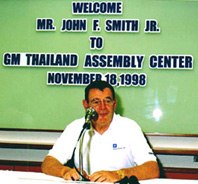
Jack Smith Jr.
Chairman and CEO of General Motors world wide, Jack Smith Jr., was in our neck of the woods for four hours last week and held a quick Press Conference for the waiting and watching media bloodhounds. The Pattaya Mail didnt quite score an invitation (probably as retribution for my suggesting that GM have been indulging in vacillation of late), but having the Automaniacal ear to the ground we got wind of the Press do. Actually GM were quite nice about it when I rang them and I didnt have to wear dark glasses and a trenchcoat to get past the minders at the door. Two Opels were sitting there in pride of place in the foyer, trucked in the day before, my spies told me. Was this an omen, I asked myself?
Signing in I got given my security badge and a cup of coffee and a front row seat while I waited for the pearls of wisdom from the man who probably earns more in one minute than I do one month! After three quarters of an hour wait, the minders got excited and Jack Smith Jr. entered the auditorium, wiping away the remnants of his lunch, to fill us in on life at the top in GM.
Jack told us all about the new GM plants in Argentina, Poland and China and how the Thailand Plant was a "World class Plant, global in outlook with the latest techniques." He also said how the global goal for this region was to have a 10% share by 2010.
The invited Press Corps were an interesting bunch, and probably had 90% Finance Writers and 10% car people because the questions put to Jack were about world politics and regional financial problems. Since Jack had come from the APEC meeting, this was probably the reason, but, hell, we had come there to find out from the worlds number 1 car maker, what car they were going to make here.
Since nobody in the press gallery was going to do it, Automania stood up and asked the Big Man the Big Question. (Remember that initially GM were going to make Opel Vectras, then something smaller, then mothball the plant and wait for God or something, and then at last count it was going to be a minivan.)
Jack smiled and said it was going to be a car (back to Plan A, hoobloodyray!) but he would not disclose what it was going to be. "It will be released in Bangkok at the Motor Show on December 2nd, but you will have to wait till then to see what it is!" said he. So much for open-ness of government, "transparency" and all the other 1998 buzz words!
At that point, the minders brought the press conference to a close before another journo might ask other pointed questions relating to car production!
We were then herded into busses and taken for a trip around the plant. Nice plant from the outside, even if someone had left a Toyota Corona parked outside one building. Naughty! Naughty! It will be a robotic plant in the main, with real human beings used for rectification of paint and minor details like that. I "innocently" asked one minder where they were going to source the engines from and was told that some were from Japan and some would be from Europe, depending upon the model.
At last! A clue! What does GM produce that comes in different engine sizes and different countries of origin? My guess is Corsas, but the model run is getting long in the tooth right now, so it is probably the Corsa replacement. Anyway, well all know after December 2nd. Thanks, Jack!
Traps for young players Yet another distressing case of visitors (and locals) being stood over by the Beach Road Brigands who rent out motorcycles. Heres the all too often repeated scenario. The hirer is told he must leave his passport as security and as soon as that happens he is powerless. Any accident damage, no matter how minor, is going to be made out to be very expensive and you have no way of beating this problem. They have your passport!Young fellow had a scrape on a Honda CBR and was told the repairs would be 17,000 Baht if you please. He got his own estimate and even that was over-inflated at 10,000. Going back to the hirer with this new quote, he was then told that there was even more damage than they had thought originally and the price to fix (and get his passport back) was now 20,000 Baht. All he can now do is go to the Tourist Police and hope. It will still be a very expensive exercise.
The moral of this tale is to only hire any form of transport that has guaranteed 100% First Class Insurance, and never leave your passport with anyone! Finding motorcycle renters with First Class insurance is well nigh impossible, and renting cars from the side of the road is just as bad. They may have some kind of insurance, but you can bet your bottom dollar it wont cover YOU in an accident. It will be the compulsory 3rd party injury insurance and thats all. Beware! You have been warned.
Autotrivia QuizI really should apologize for last weeks quiz question about the Mk IV Jaguars. It was a real trick, because the factory never made any Mk IVs! Sure there was a Mk V, but the model before it was never released as the Mk IV. They were just called 2 1/2 litre or 3 1/2 litre Jaguars. It was only after the next model (the Mk V) came out that people started calling the earlier ones Mk IVs.
Lets stick with Jaguar for this weeks question. What was the original name (not initials!) for this manufacturer? Fax or email the editorial office. First correct wins the Automania FREE beer!
| Back to Columns Headline Index |
By David Garred,
Club Manager Dusit Resort Sports ClubGday Pattaya. This week in the column I want to see if I can help out a few of the Snow Skiers before they return home to their white Christmas. I also have a tip for all of us that follows along the same lines as my suggestion last week to get into exercise now.
Save your Knees when Skiing With the Ski season here and so many of you lucky campers going to take a ski holiday, its a good opportunity to get some advice on how to avoid Ski injuries.Severe knee sprains disable more than 20,000 skiers each year in the U.S.A. and account for 20% of all ski injuries. Unlike other sports injuries, any product, service or level of conditioning cannot prevent knee sprains. The only way to reduce risk is through good ski technique and proper response during dangerous situations.
In analyzing more than 14,000 Ski injuries, American researchers found that injury to the anterior cruciate ligament (the ligament that stabilizes the knee joint) is imminent when the following six factors all occur at the same time:
> The uphill arm is back.
> The skier is off balance, leaning backward.
> The hips are below the knees.
> The uphill ski is unweighted.
> The skiers weight is on the inside edge of the downhill ski.
> The upper body faces the downhill ski.If you can quickly eliminate one or more of these six elements, you can probably prevent a ski injury.
Heres how to put them into practice.
Know how to fall:
> Keep your arms forward.
Exercise to protect your Arteries People who engage in either recreational or competitive aerobic (that is: cardiovascular or heart & lung) training, may be better able than sedentary individuals to clear fats out of their blood stream.
> Keep your skis together. Preventing your skis from separating makes it easier to have weight on the uphill ski and you have your downhill thigh in line with the downhill ski.
> Keep your hands over your skis. This keeps you forward.
Avoid the following:
> Dont fully straighten your legs once youve fallen. Keep your knees flexed.
> Dont get up while you are still sliding. Once down, stay down.A recent study showed that both recreational and competitive athletes both had lower levels of triglycerides in the hours after a rich meal.
In other words, the exercisers seemed to expose their arteries to lower volumes of potentially damaging lipoproteins. The study suggests athletes with higher volume aerobic training levels had the best blood lipid profiles after a high fat meal.
Athletes with higher levels of training in the study had lower levels of cholesterol content and a lower number of potentially damaging, dense, low-density lipoprotein molecules.
What this all boils down to is people who exercise regularly will be better able to avoid the life endangering effects of high fat eating.
Carpe diem
| Back to Columns Headline Index |
Copyright 1998 Pattaya Mail Publishing Co.Ltd.
370/7-8 Pattaya Second Road, Pattaya City, Chonburi 20260, Thailand
Tel.66-38 411 240-1, 413 240-1, Fax:66-38 427 596; e-mail: [email protected]
Created by Andy Gombaz, assisted by Chinnaporn Sangwanlek.