Navigating the rivers of Sumatra
Sumatra is one of the largest islands in the world and the
second largest of the Greater Sunda Islands, which include Java, Sulawesi and Borneo. It
is about 473,606 square km and separated from the Malay Peninsula by the Malacca Straits.
A huge volcanic mountain range, called the Bukit Barisan is the spine of the island,
running from the Northwest to the Southeast, bordering on the Indian Ocean. The highest
volcanic mountain is the Gunung Kerinci, which soars to an altitude of 3805 meters. The
Eastern part of the island is lowland built up from silt of the mountains and deposited
there over the millenniums by the several navigable rivers, like the Musi, which leads to
the city of Palembang.
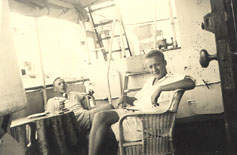 Captain Alphabet Jansen and I during a lunch
break.
Captain Alphabet Jansen and I during a lunch
break.
It was in 1954 that I spent the better part of a year as an
acting first mate on a 556 ton coaster called the MV Landak. To be a first mate on a hulk
like that did not mean much, as I was actually only a third mate and paid as such. My only
assistant was a local Indonesian lad with a restricted diploma for coastal trade. The deck
and engine crew was Malay and the catering department Singapore Chinese. Our trade was
mostly Singapore - Palembang and vice versa, a weekly service if we could manage, which
left us very little time for leisure in ports. Palembang was a dreary place but Singapore
was great fun in those days.
The Chief Engineer was a loner who hardly ever came out of
his cabin to be social and who had his meals in his cabin, being invariably drunk. The
captain was a man incapable of tasting, as his taste buds had been ruined at an earlier
age by a persistent cold or other ailment. He was proud of the fact and when I complained
about the in-palatability of the fare, he laughed and said that he couldn’t care
less, as he was unable to savour it anyway. My roly-poly Chinese cabin attendant called
Ah-Seng noticed the predicament I was in and consequently fed me delicious Chinese
concoctions from the Chinese kitchen at frequent intervals. My favourite was turtle stew
made of river turtle sometimes called terrapin. The Malay sailors also brought me Rendang
and other spicy specialities of the Malay kitchen and when we anchored in the inner
harbour, in front of the old Clifford Pier in Singapore, the old Chinese foreman of the
labourers would bring me Hokkien Mee when we stopped working for a midnight break. This
delicious Ma Mee was made with oblong mussels, crab and shrimps.
All this was of course very fattening, and as I was also
drinking beer, I recalled that I gained a lot of weight. When I mentioned this to Ah-Seng
he commented that to be fat meant that I was rich. It was a lonely life, as I had nothing
in common with the Captain nor the Chief Engineer and the monotony of our schedule made
things tedious. Fortunately the “tasteless” Captain was replaced one day by a
most amiable man called Jansen, and not to confuse him with another Janssen, which I had
come to know as most unpleasant man, we called our Jansen, “Alphabet Jansen”
because of the many initials before his name. With him I had a most agreeable
relationship, as he was kind and a man of many interests and much experience. The food
improved, I cut down on the delicacies of the Chinese galley and achieved to loose weight
again.
Sometimes we were redirected and steamed up the other great
rivers of Sumatra, the Batang Hari to Jambi, the Rokan, the Inderagiri and the Siak to
Pekanbaru. We loaded thousands of cases of shrimp paste in Bagansiapiapi, a town famous
for the smelly condiment, rubber at Tanjung Balai on the Asahan River, in the fertile
lands of Deli, as well as at Langsa, in Aceh, north of Medan. While we were waiting for
the cargo barges to arrive on the Sungai Langsa, we caught small squid in the estuary at
night. By hanging a cargo light over the side they would come attracted by the light and
as for some reason they swim backward, it was easy to scoop them up with a fish net at
their rear. One of the Malay sailors taught me how to prepare the cephalopods with garlic
in their own ink, which is quite delicious.
Sailing up those rivers wasn’t easy and often the
branches of the trees would scrape the bridge. The trick was to navigate the outer bends
of the river, which are always deeper than the inner ones. The mangroves were monotonous
and the insects would attack viciously. To approach the correct river mouth of the deltas
one had navigation instructions like: “Keep three rows of fishing sticks (seros) on
starboard and two on the port bow. Proceed to the next buoy, keep it on starboard and sail
due east after rounding it until the next row of seros which should be kept on the port
bow,” and so on. The problem was that the buoy could have been swept away during a
recent flood and the fishermen might have decided to move their seros to another location.
I do not know why I remember my small cabin on starboard so
well. Whenever I can’t sleep, which with advancing age is quite often, I fantasise to
be back in my bunk on the Landak, with the fan spinning in front of the wind catcher in
the porthole. Air conditioning was not installed in our ships and one had a fan. Sometimes
the heat was unbearable, muggy and suffocating especially when we sailed with the wind or
churned the muddy ochre rivers. Every now and then we would meet a small prahu (canoe),
usually made from a hollowed out tree trunk, or pass some houses on stilts bordering the
rivers with children swimming in the strong currents and mothers doing their laundry and
bathing, but usually it was just mangroves and jungle, full of screaming birds and
hollering monkeys. It was said that the forest of Southern Sumatra housed the so-called
Kubus, ancient and primitive people who lived in trees and were very shy of civilisation.
The straits of Malacca and the roads at Singapore are
notorious for the so-called “Sumatrans”, heavy squalls coming from the Sumatra
mainland during the West Monsoon. They cause anchors to drag, which is a dangerous
business with so many ships anchored on the roads of the busy harbour. As I said before,
Singapore had many assets for us in those days, as its worldly pleasures, its tax-free
goods like alcohol, cigarettes and electronic equipment were a great asset.
It was also the Chinese food we craved and one of our
favourite places for this was Albert Street where there were many restaurants. They became
busy after the movies at about eleven at night. One ate upstairs while the food was
ordered by yelling out of the windows. When one paid, the waiter would throw the money out
of the window, down to the cooks on the street. A block further was Bugis Street,
frequented by ladies and transvestites. I never fancied Bugis Street, patronised by the
late-late crowd until the early hours of the morning.
But as there was just the captain and me and one of us had
to be on board at all time, there was no fun in going to these places on one’s own.
All I did was see a movie and visit some shops, after which I returned to the ships in our
private sampang (small Chinese boats, made from sampan wood). It was rowed by an emaciated
China man who made himself indispensable whenever we were in port.
One-to-One marketing: walking the
talk
by Imtiaz Muqbil,
Executive Editor,
Travel Impact Newswire
The buzzwords have gone from ‘segmented
marketing’ to ‘target marketing’ to the latest ‘One-to-One
Marketing’. But never mind the nomenclature. On paper it refers to more or less the
same thing: How to reach customers, preferably direct, talk to them in their own language,
cater to their specific needs, satisfy them in every possible way. And then wait for a big
pay cheque and promotion.
Well, not quite. In reality, one-to-one marketing is easier
said than done. Handshakes now no longer mean just that, but one computer linking up with
another. Warm, hand-written notes are out, LotusNotes is in. As technology grinds into the
travel & tourism industry, hotel owners are finding themselves swirling in a sea of
techno gobbledy-gook which costs a bomb, means little and may or may not deliver the
goods. Worse, the guy who is supposed to translate it into plain English may simply tire
of 24-hour days and go work for a bank.
Cutting through these complexities is going to be the main
focus at the International Hotels and Restaurants Association 36th annual convention in
Manila next month. The theme, ‘One-to-One Marketing’ is clearly the flavour of
the season in an industry that has seen its bottom drop out in Asia and is desperate to
bring back business at the lowest possible cost. Technology, on which marketing is
becoming almost totally reliant, was already making an impact before the Asian crisis hit.
How it can help Asia’s recovery should make interesting listening.
The IH&RA is bringing to Asia a theme that it has
previously aired in Europe. In one sense, that is good. Asia needs tested and proven
solutions, not maverick technologies that soon become obsolete. Indeed, an analysis of the
papers presented at the IH&RA’s recent Eurotech conference in Nice, France,
showed that one-to-one marketing will depend almost entirely on how simply it can be
executed. Said Flo Lugli, VP Worldwide Sales & Marketing of Cendant Corporation,
“Our challenge will be to streamline and simplify the transactions and consumption of
our products.”
Grahame Senior, chief executive of the Senior King Group
and president of the IN Network of Independent Agencies, will be pressing just that point
in an interactive session on Targeted Marketing for the 21st Century at the Manila
congress. Arguing that “smart consumers need smarter marketing”, Senior will
explain his philosophy: “Fish where the fish are... and use the right fly”.
Looking at global shifts in consumer attitudes and empowerment, he has been assigned to
track new motivations and opportunities to communicate and convince.
Hospitality case studies will be used to demonstrate
targeted techniques for getting the right message to the right customer - with the right
results. Senior believes that direct marketing campaigns can cut out wastage, improve
response rates and increase conversions to new and loyal customers. That may sound a tall
order but IH&RA spokesperson Caroline Harvey is encouraging Asia-Pacific hoteliers to
come and see for themselves whether Senior will walk the talk, especially as many first
need to bring customers back to the region before getting them through the doors.
Hotels pay the highest distribution costs of all travel
sectors and are anxious to reduce them. The Internet beckons. On it, hoteliers can list
out their entire product range to whatever detail they wish. Last year, about two million
hotel bookings were made online in North America. One forecast predicts 15 million
reservations world-wide in two years. If that happens, it won’t be long before hotels
join airlines in cutting travel agents’ commissions.
So, all those bookings will solve the hotels’
marketing problem, right? Wrong. Hotels still need to ensure a fine degree of revenue
management to generate the best possible yield. That means juggling rates and room
categories with seasonality and types of customers. And that’s where things begin to
get murky as marketing people come under the mercy of the techies and worse, the
suppliers. Said George Bayz, President and CEO of MAI Systems, “Technologies are
moving so fast that everyone is looking for the right partner as no supplier can do
everything for everyone.”
Critical to the concept of one-to-one marketing will be
another two buzzwords, data-mining and its first cousin data-warehousing, which involves
collecting ‘gold data’ on customer information and converting it into
recognition, loyalty and repeat traffic. Customer profiles are fed into computers and
organised in ways they can be ‘queried’. Marketers people can know who has
stayed for how long and when, what she ordered for dinner, whether she used her laptop and
the laundry service. By knowing all this, marketers think they can generate loyalty partly
by letting regular guests know how much they know about them.
The downside, of course, is that customers may not want
hotels to know that much about them at all. Lawyers will have a ball, especially if guests
have not been explicitly asked if they want to be at the receiving end of one-to-one
marketing. At exactly the same time that the IH&RA congress is convening in Manila,
(October 24, 1998) the European Union will be implementing a law to protect personal data
and block its transfer between countries. Says Janne Glaesel, partner of Bech-Bruun and
Trolle law firm in Denmark, “The directive will cover the following data collection
activities: customer recognition, direct marketing, market research and the transfer and
sale of data inside and outside the EU.”
That could mean back from LotusNotes to handwritten ones
which Michael Rumkey, Executive VP of Human Resources in Holiday Hospitality, says may
still be the best one-to-one marketing approach. He questions whether technology has
actually improved the concept of hospitality. Too much cost-cutting has focussed on
throwing technological solutions at problems, he says. “The industry must refocus on
guest requirements, employee expectations and satisfaction and personal contact and
service, relying on technology only to remove the burden of mundane tasks in order to
increase service and value.” His killer line: “Most young people are IT
literate, but lack the basic interpersonal skills essential to the hospitality
industry.”
So, high-tech? High-touch? Or a balance of the two? Harvey
promises a congress of business-building ideas for independent and chain hotel and
restaurant operators, an evaluation of brand marketing strategies in the interactive age,
a look at the Asia-Pacific in a New Light and an overview of global marketing trends and
advice on how to turn challenges into business opportunities.
Don’t miss the international hospitality event of the
year - the 36th IH&RA Annual Congress, 22 - 26 October 1998, Manila, Philippines. This
year’s theme: ‘One to One: Marketing in the Interactive Age’. For further
information contact Lucy O’Reilly on [email protected],
or (33 1) 44 89 94 00.
The Beauty House opens on Pattaya
Second Road
by Teetha Clench Pattaya Mail’s
Fashion Editor
Teetha is so excited! She loves new things and innovations,
too. New boyfriends can be a bit tiresome, as it takes time to ‘break them in’
but a new beauty shop... well, that is something else.
The beauty shop was first known in ancient Egypt. Not that
Teetha was there as her identical twin sister ‘Elsa the Cow’ says. She’s
just jealous of Teetha, whose parents, recognizing Teetha’s obvious differences from
her sister, sent Teetha to a school in Switzerland when she was three.
It has been said that beauty is the one thing which
guarantees a woman’s acceptance in society. If a woman was not born beautiful, it was
considered a terrible misfortune. Even though Teetha has been a stunning beauty since
birth, she loves going to beauty shops. From merely stunning, a good beauty shop can make
Teetha positively radiant.
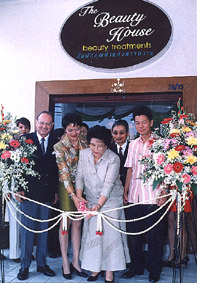 The lovely Ms.Achara Pajchimanan cuts the ribbon
and officially opens the Beauty House.
The lovely Ms.Achara Pajchimanan cuts the ribbon
and officially opens the Beauty House.
Especially in this ‘hi-tech’ age, those not as
fortunate as Teetha can be changed from ‘ordinary’ to ‘very good
looking.’
Skin that was once like leather can be made to be as soft
as a baby’s bottom and all manner of ‘nipping this, tucking that’, a
‘dab of color here’ can work miracles.
This goes along with the Thai saying ‘Chickens are
made beautiful by their feathers and a woman is made beautiful by her make-up.’
Teetha, along with her friend and genius designer Mince
Aphai went to visit The Beauty House owned by the fashion and beauty maven, Naphaporn
Wentworth. Naphaporn has been in the beauty industry so long and has such experience!
Teetha and Mince could not help but be impressed.
Teetha was in a quandary as to what to wear but Mince with
his usual genius told Teetha that as beauty shops had been around since Egyptian times,
Teetha could go as ‘Cleopatra.’
Needing much less make-up than Elizabeth Taylor to
duplicate this queen’s beauty, Teetha’s main problem was finding a suitable
‘litter and bearers’ to take her to the opening in the style she knew was
necessary. But Somchai, the security guard, with whom Teetha has become quite friendly,
offered his and three friend’s services. Mince worked like mad, designing
outfits for the men, which were ‘Egyptian’ and yet so revealing that... never
mind.
All eyes were, of course, on Teetha (and it seems some
found Somchai and his friends costume’s quite interesting) as she was borne on her
litter to the opening.
The Beauty House is located between the Alcazar Cabaret and
the Bangkok Bank, on Pattaya Second Road.
This oh so modern and fashionable beauty shop has
everything for today’s woman; and possibly some of today’s ‘men’ too!
Anyhoo...
If you should want a face massage, a skin peel, a high-tech
‘wrinkle remove’, or a massage with mysterious and fragrant oils, the Beauty
House is the place for you.
There is also a service for ridding oneself of annoying
cellulite, using the ‘Ultra-tone’ process.
This month only, the Beauty House is offering free facial
massages to new customers.
The Beauty House is open from 10 a.m. to 10 p.m., every
day. You may call for an appointment at 361-749 or 361-750.
Everyone gasped when they saw Somchai and his burly friends
put Teetha’s litter gently on the ground in front of the shop.
Teetha shouuld have known. She was planning to try one of
the beauty treatments, but the staff told Teetha that in no way could they improve her
looks.
Being perfect is such a curse, sometimes.
Becoming unusually rich in
Thailand
by Barrie Kenyon
If you want to end up with a small fortune here, better
bring with you a large one. Or so they say. Hundreds of farangs in Pattaya alone have lost
their nest eggs by investing in small bars or night clubs which went bust. Naivete may
have been principally responsible or the fact that investing in the entertainment business
often means operating at or beyond the fringes of the law. Antagonize just one of your
Thai workers and the police may soon be knocking at your door to ask about that work
permit which was never obtainable in the first place.
In Succeed In Business (Times Books
International, paperback 1998, 450 baht) , Canadian Bea Toews and Australian Robert
McGregor have produced a readable summary of the pros and cons of doing business in the
kingdom. They quickly dismiss the nitery scene by quoting warnings of Bernard Trink in Nite
Owl about the virtual impossibility of operating legally with all the necessary
licenses. Then they explore the more promising areas such as import and export
opportunities, franchises, taxation, government bureaucracies and the like. Of course,
some details are necessarily out of date already, for example the 1979 Alien Business Law
has very recently been amended, and the authors are less than perfect on visa rules. At
one point, they describe a non immigrant visa as a “working visa” which can be
legal dynamite unless an application for a work permit has been lodged.
The main conclusion drawn by the authors is that, to
succeed in business, you have to understand the Thai social way too. Knowing whether you
should offer to pay for a business meeting meal, appreciating something of Buddhist and
rural influences and recognizing that Thai conceptions of status are very different from
yours are all indispensable for a successful outcome. The book is particularly good on
explaining Thai communication strategies such as nam jai, the milk of human
kindness, which means extending generosity to others without expecting anything in return
or hen yai, which is the ability to empathize with people. Sobbing at a
colleague’s funeral or praising one of your staff in public are bad ideas because
they may make others feel uncomfortable.
Succeed In Business does not actually tell you where
to put your money in order to come up trumps. Rather, it analyses the likely growing areas
of the economy such as agricultural exports and telecommunications and makes it clear that
your Thai business partners will be key players in any commercial enterprise. In Thailand,
it is still very much who you know rather than what, as anyone who has had to deal with
customs or the VAT authorities will confirm. There is also an insightful description of
Thai financial markets and the current balance sheet. Or nearly current, as the country
now owes internationally a staggering 87 billion baht. This fact alone ensures that Thais
will want to continue to do business with farangs, increasingly on a partnership basis.
It’s all a matter of being well informed before you commit your foreign cash. Afterwards
will almost certainly be too late.
St. Andrew’s Night Charity
Ball at Royal Cliff
Tickets are now available for one of the major social
events of the year, St. Andrew’s Night Charity Ball, to be held at the Royal Cliff
Beach Resort’s Siam Ballroom on November 27, 1998.
St. Andrew, one of the twelve apostles and brother to St.
Peter, is the patron saint of Scotland and Russia. PILC will celebrate his feast day in
true Scottish fashion. The evening will start with a reception at 7:30. An excellent
4-course dinner including wine will be served at 8:15. During the meal a special ceremony
of addressing the haggis (a unique Scottish dish!) will occur before the main course. The
haggis is toasted with whisky, and then dinner will resume.
PILC is very privileged and lucky to have the Royal Scots
Guards to entertain after dinner. To see this regiment in full ceremonial dress marching,
piping and dancing is truly awe inspiring and very moving indeed. Also in the cabaret PILC
will have their very own Scottish/Canadian highland dancer, Erin Johnson, who will
demonstrate her skill.
During the evening PILC will raffle some truly lavish
prizes including two round-trip air tickets to Europe. More details of the prizes will be
available next month. Attention will next turn to the dance floor with a terrific modern
band playing everything from Beatles to Aqua. They are guaranteed to get you on your feet
and to insure that everyone has a great evening. All that’s needed now is your
support.
This evening will benefit three very special causes, the
Camillian Trust Aids Relief Center in Rayong, the Redemptorist School for the Blind (for a
Braille computer), and the Fountain of Life School. Last year’s ball was a sell out
and raised 225,000 Baht. This year PILC wants to raise even more. Please do your best to
support this event.
Tickets are 1350 Baht each including 4-course dinner, half
bottle of wine, souvenir photograph, all entertainment and dancing. You can come either as
a group of eight or you can book individually. This year admission will be by ticket only,
and tables will be reserved as tickets are purchased so obviously the sooner you book the
better the seat. Buy your tickets soon from Mary Harris, tel. 306-067; Ffion Mercer, tel.
225-359; Marcee Laudick, tel. 370-299; Catherine Bond, tel. 704-297; Jo Hall, tel.
241-061; Sally Taggart, tel. 225-688; or Lillian Ross, tel. 306-123.
Successfully Yours: Jill Thomas
Jill Thomas, an expatriate Welsh lady, is the new Head at
St. Andrews International School, Rayong. Dark piercing eyes hold your attention while she
speaks excitedly about her school. However, she is much more reticent when talking about
herself, but scratch under the “school marm” exterior and you will find a very
interesting character.
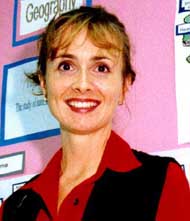 Jill
and her engineer husband Gethin are not living in Thailand as a happy accident, but are
here as part of a deliberate lifestyle decision. Their introduction to the Kingdom came
after a trip to Australia - on their way back they stopped off for a three day stop-over.
After their return to the UK they began to realize that they were only talking about
Thailand and not the great sun burned land “down under” they had visited for
three weeks! “Thailand was just so vibrant and so different. We both decided we
wanted to come here and began looking for jobs.” They were both successful and are
now happily enjoying their tropical experiences here.
Jill
and her engineer husband Gethin are not living in Thailand as a happy accident, but are
here as part of a deliberate lifestyle decision. Their introduction to the Kingdom came
after a trip to Australia - on their way back they stopped off for a three day stop-over.
After their return to the UK they began to realize that they were only talking about
Thailand and not the great sun burned land “down under” they had visited for
three weeks! “Thailand was just so vibrant and so different. We both decided we
wanted to come here and began looking for jobs.” They were both successful and are
now happily enjoying their tropical experiences here.
It has been a fascinating trip from the green valleys of
Wales to Green Valley Rayong. Her childhood and early adult life was in Swansea (South
Wales). The middle daughter of an Industrial Chemist she realized early that she was
caught between two professions.
From childhood she was obviously an accomplished musician,
so she nurtured the desire to become a professional muso. But at age 14 she worked in a
summer school for people with severe learning disabilities and found she had a natural
bent in that direction as well. “I really found I liked working with people.”
Leaving school she completed a music degree first, then
backed up for a post graduate certificate in education.
With dual qualifications she ended up as Head of a
Department of Music in Wales, and was already recording her own CD’s, but now
considers she has “retired” from the music industry.
She has applied herself to the art and craft of teaching
for the past ten post-graduate years and is a great believer in the simple concept of
asking for help or advice where appropriate. Jill is happy to thank her own personal
mentor, Chris Manley, a Deputy Head in the UK who she feels really understood children and
managed to pass on some of that knowledge to her. “Firm but fair” was the way
she described his teaching model.
She has now been at St Andrews for only a short time, but
listening to her you would imagine she had been there all her life, she has familiarized
herself so well with the school and its workings. She is not a remote administrator, but
is still very much a hands-on teacher, running classes in English, Music and Humanities.
Packing as much as possible into every day, she believes in
“Making the most of the opportunities you see in life, the one life you’ve
got.” In fact, her advice to the young teacher on the way up is to “Glean as
much as you can from every experience, be it positive or negative.” You get the
feeling, talking to Jill, that she has made all of her life a positive experience!
Her hobbies are mainly, like herself, very active and
physical. Squash, horse-riding and diving rate high. She loves traveling - especially to
Bali where she enjoys the off-shore diving. Cinema and theatre are also on her spare time
pursuits list, but the opportunities for these are not so great in Pattaya so she does
this more often on her trips back to the UK.
Jill Thomas is vivacious, energetic, enthusiastic and
literate with an innate sense of music - the pupils at St. Andrews International School do
not know just how fortunate they are with their new Headmistress. I was never so lucky!
AutoMania: Who is Michael
Schumacher?
by Dr. Iain Corness
The 1998 Grand Prix season has seen two times world
champion Michael Schumacher pull up from a seemingly hopeless position to again be the
major challenger to Finn Mika Hakkinen for the title. But just who is Michael Schumacher,
the hero of Germany?
Michael Schumacher was born on the third of January 1969 to
Rolf and Elisabeth Schumacher. His childhood was spent in the working class town of
Kerpin-Manheim near Cologne, Germany.
Michael began his four wheeled career in GoKarts when only
four years of age, with a lawn-mower engined contraption put together by his father. This
was the start.
 Schumacher
Senior was heavily involved with GoKarts, from the mechanical engineering point of view,
so it became only natural for his son to drive them. When Michael was only eleven he
arrived at the one point in his life which would seal his future direction for ever. He
went to Belgium for the World Karting Championship and saw a driver that impressed him
deeply, Ayrton Senna.
Schumacher
Senior was heavily involved with GoKarts, from the mechanical engineering point of view,
so it became only natural for his son to drive them. When Michael was only eleven he
arrived at the one point in his life which would seal his future direction for ever. He
went to Belgium for the World Karting Championship and saw a driver that impressed him
deeply, Ayrton Senna.
Michael, with his determination already showing, was soon
making a name for himself in Karts and in 1984 he won the German Junior Championship,
followed by the European Championship in 1987.
Again, in common with the accepted and usual path to the
top, he began car racing in Formula Ford or Formula Koenig as it was known in Germany. In
his first full season he won nine of the ten rounds. This was enough to attract the
attention of Willi Webber who was running a Formula 3 team and Michael was given a test
drive.
His test was sensational. Within ten laps he was lapping
faster than the regular driver. Willi could see a good thing when he saw one! Webber hired
him and became his manager.
In his first year in the more powerful formula he was one
of the top three (with compatriot Heinz-Harald Frentzen and Austrian Karl Wendlinger).
The following season Schumacher was dominant, but instead
of placing his new talent in Formula 3000, Webber managed to secure a berth for Schumacher
in the Mercedes junior team driving a sports car for Sauber.
Highly experienced drivers Jochen Neerspasch and Jochen
Mass schooled the young Schumacher in the art of race car driving. It was here that he
learned to drive smoothly - and fast.
His opportunity to get a Formula 1 ride came from the
misfortune of others. Bertrand Gachot, Eddie Jordan’s driver ended up in jail in the
UK for driving offences and Schumacher was given a test. Again his times were sensational,
and Eddie Jordan quickly had an option on the young German.
Jordan wanted to sign up Schumacher with a three year
contract but wily Willi outfoxed the Irishman and after much legal wrangling, Schumacher
finished up that year at the stronger Benetton team. Poor Eddie has had a similar legal
battle this year with Michael’s younger brother Ralf - some people never learn!
He continued with his meteoric rise through the ranks and
won his first Championship in 1994. The following year he backed up again with another
World Championship, but this was gained at the expense of some queries as to his methods.
He won the Championship in the final round after a collision with Damon Hill in the
Williams sidelined his only challenger.
In 1996 he moved to Ferrari and a much larger bank balance.
His abilities to “lead” a team are obvious, and during the 1997 season in
conjunction with the legendary team boss Jean Todt, he assisted Ferrari to become a major
challenger again.
But once more, his determination to succeed resulted in a
major problem with an on-track incident with Jacques Villeneuve, but this time Schumacher
came off the worst. This time the FIA could not ignore the action and Michael was
disciplined by losing his second place in that year’s final standings. (Quite frankly
this was the equivalent of forty slaps on the wrist with a wet tram ticket.)
In this year’s chase, Schumacher has again shown his
prowess in the wet and his determination to bring the Ferrari home in first place. For
most observers, Schumacher is the best driver in the current Formula 1 group - the only
question to be resolved is can he temper his determination to succeed at seemingly any
cost?
Autotrivia Quiz
Last week I asked you about two Italian motor cars. The
first was Il Porco Rosso (the Red Pig) and the second was La Barra Rossa Volante (the
Flying Red Coffin). These were made by Alfa Romeo and each had two engines (the correct
answer), and what’s more, each was a perfect bitch to drive.
Il Porco had the engines mounted side by side, with each
one having its own gearbox (and gear lever), so the poor driver had to shift two gearboxes
in a race car. No wonder it dispatched poor old Arcangeli.
On the other hand, La Barra had one engine in the front and
the other in the rear of the car, with the driver squashed between them. It was capable of
over 320 KPH, but fortunately for Nuvolari it was exceptionally unreliable and so the
factory dropped it from the racing line-up.
Let’s stick with Alfa Romeo. Please note it is not
“ALPHA” Romeo. “Alfa” came from Anonima Lombardo Fabbrica Automobili
and before Nicola Romeo joined the outfit they were known as A.L.F.A.’s. Some of
their very classic cars were designed by Vittorio Jano, who went on to design a Formula 1
car for Lancia, many years later.
However, the grille badge on an Alfa Romeo is very
interesting. If you have an Alfa in the garage, rush out and check - the rest of you will
just have to believe me. The badge is circular and on the left side of the badge there is
a red cross on a white background. On the right side there is a snake swallowing a man!
For this weeks Automania FREE beer of the week, just fax or
email the editorial office with the answer to this ... what is the meaning of the cross
and the swallowing snake?
Copyright 1998 Pattaya Mail Publishing Co.Ltd.
370/7-8 Pattaya Second Road, Pattaya City, Chonburi 20260, Thailand
Tel.66-38 411 240-1, 413 240-1, Fax:66-38 427 596; e-mail: [email protected]
Created by Andy Gombaz, assisted by Chinnaporn Sangwanlek.